
Fan Coil Valve: Types, Operating Principle and Selection Criteria
Learn how 2-way and 3-way valves control water flow in fan coil units, which actuators are available and how to select the right valve.
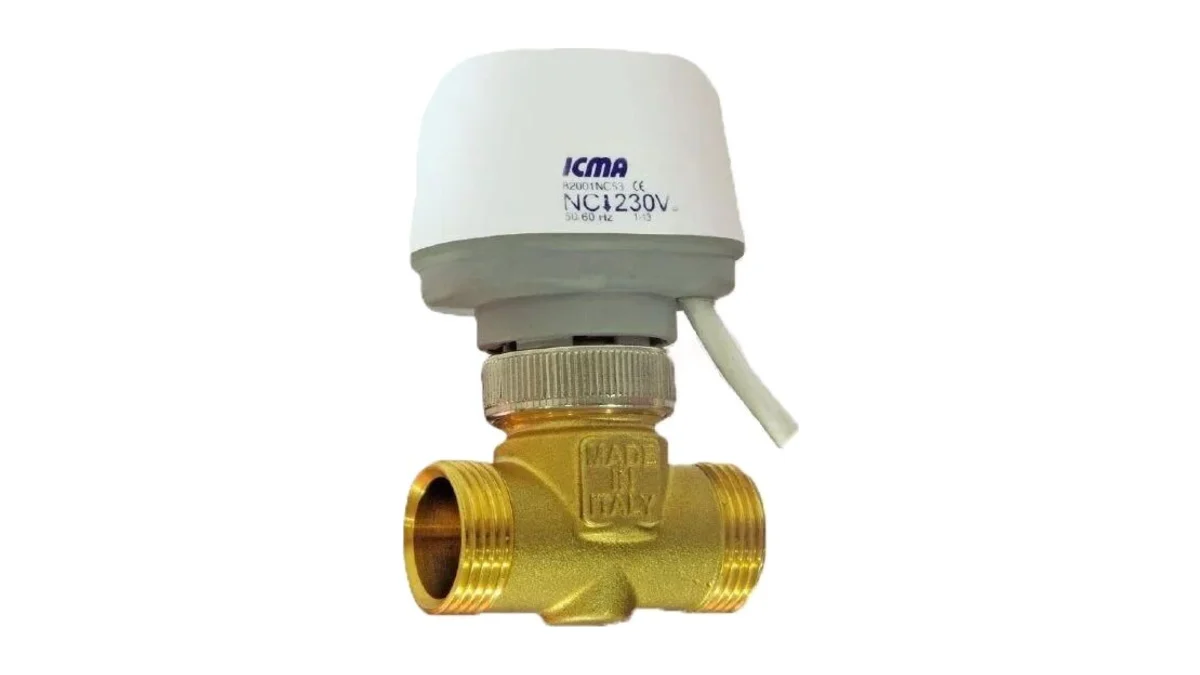
Fan coil units are common terminal devices that provide heating and cooling in offices, hotels, hospitals and shopping centres. Their comfort and efficiency depend on accurately controlling how much hot or chilled water reaches the coil. The component that does this is the fan coil valve.
This article explains what a fan coil valve does, the difference between 2-way and 3-way valves, the actuator types in use and the criteria to consider when selecting a valve.
What Is a Fan Coil Valve?
A fan coil valve controls the flow of heating or cooling water to the fan coil’s coil. It usually consists of a valve body and an actuator mounted on it. Based on the signal from a room thermostat or building management system, the actuator opens, closes or modulates the valve to keep the room at the set temperature. Manually adjusted valves exist, but automatic control is by far the most common solution in fan coil applications.
Types of Fan Coil Valves
2-Way Valves
A 2-way valve opens, closes or throttles the flow to the coil. When it closes, no water passes through the unit, so the total system flow varies with load (variable flow system). Combined with variable speed pumps, this saves pumping energy. In such systems, differential pressure control or a bypass arrangement should be provided so the pump does not run against closed valves.
3-Way Valves
A 3-way valve sends the water either through the coil or through a bypass. When the coil is shut off, water returns via the bypass, so the circuit flow stays roughly constant (constant flow system). It is preferred in installations with fixed speed pumps or where continuous circulation is required at the end of a circuit.
| Feature | 2-way valve | 3-way valve |
|---|---|---|
| Function | Opens/closes or throttles flow to the coil | Diverts flow between coil and bypass |
| System flow | Varies with load | Remains roughly constant |
| Suitable pump | Variable speed pump | Fixed or variable speed pump |
| Additional requirement | Differential pressure control / bypass | Bypass line (on the valve or in the piping) |
Actuator Options
- Thermoelectric (on-off) actuators: A heated element slowly opens or closes the valve. Normally closed (NC) and normally open (NO) versions are available.
- Motorised on-off actuators: Drive the valve fully open or fully closed according to the thermostat’s on/off signal.
- Modulating actuators: Hold the valve in intermediate positions using analogue signals such as 0–10 V, giving more precise temperature control.
The supply voltage (for example 24 V or 230 V), the control signal and the valve position on power failure (NC/NO) must match the thermostat or building automation system.
Fan Coil Valve Selection Criteria
- Fluid: Water or water-glycol; the glycol ratio affects material compatibility and flow calculations.
- Operating pressure and temperature: The valve’s pressure rating and temperature range must cover the system values.
- Flow rate and Kv value: Size the valve by the Kv value required for the coil’s design flow; selecting by pipe size alone degrades control quality.
- Connection type and size: Must suit the fan coil connection and the pipework.
- System type: 2-pipe systems usually need one valve per unit, while 4-pipe systems use separate valves for the heating and cooling coils.
- Control type: On-off or modulating control determines the actuator type.
- Power consumption and tightness: Low-power actuators and valves with good shut-off tightness reduce operating costs.
Frequently Asked Questions
What is the difference between a 2-way and a 3-way fan coil valve?
A 2-way valve opens and closes the flow to the coil, so system flow varies with load. A 3-way valve diverts flow between the coil and a bypass and keeps the circuit flow roughly constant.
What do normally closed (NC) and normally open (NO) actuators mean?
They describe the valve position when the actuator is not powered. With an NC actuator the valve closes on power loss; with an NO actuator it stays open. The choice depends on the thermostat logic and the system’s safety needs.
Why is the Kv value important when selecting a fan coil valve?
The Kv value indicates how much flow the valve passes at a given pressure drop. If it does not match the coil’s design flow, the valve either delivers too little flow or loses control accuracy.
Conclusion
Fan coil valves are control components that directly affect comfort and energy efficiency in heating and cooling systems. With the right 2-way or 3-way valve for the system, a correct Kv value and a compatible actuator, fan coil units run in a balanced and economical way. Explore suitable products on our HVAC valves page or contact the ORFA sales team for technical support.
Buy HVAC valves online
Browse products on or-fa.com, our export store, see prices in USD and order online.
Buy Online →Request a QuoteAsk on WhatsAppRelated product group
HVAC Valves →Technical support
Talk to our team to choose the right product.
+90 224 444 67 32[email protected]
Related Articles
Let’s choose the right product for your project
Buy from our online store or request a project-specific quotation.