
Plate Heat Exchangers: Operating Principle, Types and Advantages
Learn how plate heat exchangers achieve high heat transfer in a small footprint thanks to corrugated plates, and how to choose the right type, materials and gaskets.
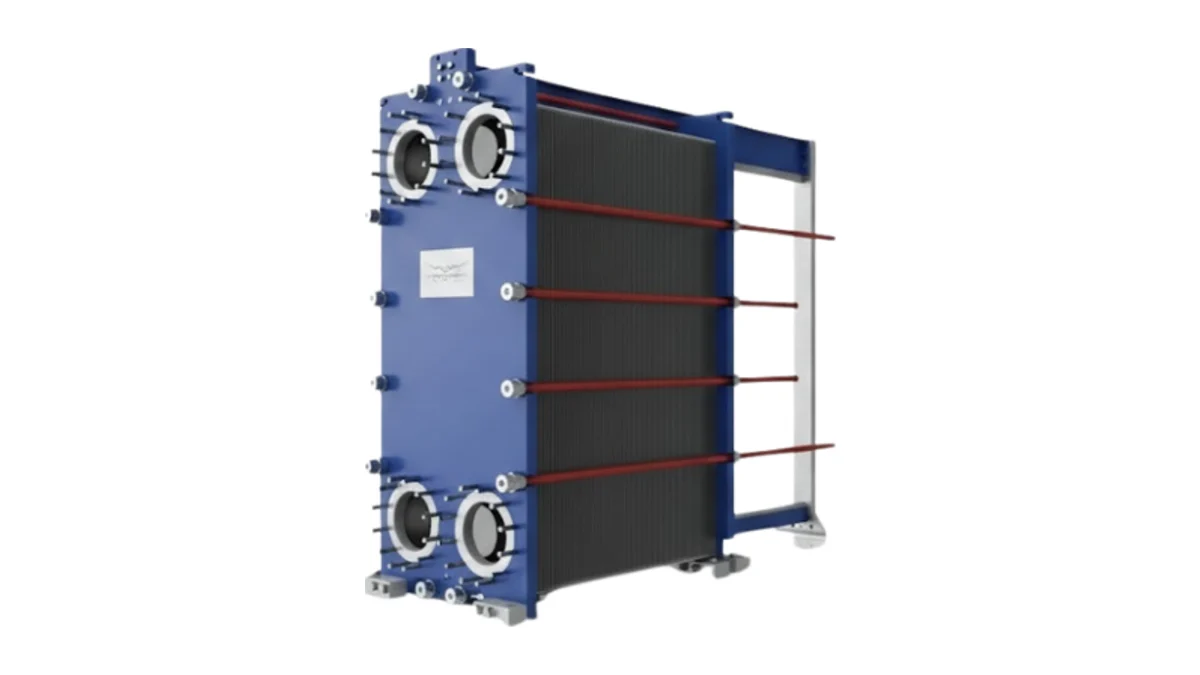
Heat transfer lies at the heart of energy management in industrial plants, and choosing the right heat exchanger has a direct impact on operating costs. A plate heat exchanger transfers heat between two fluids through thin metal plates without mixing them, taking up little space and operating at high efficiency.
This article covers how a plate heat exchanger works, why turbulent flow matters so much, the differences between gasketed, brazed and welded designs, and how to select materials.
How Does a Plate Heat Exchanger Work?
A plate heat exchanger consists of corrugated metal plates stacked in a frame. The hot and cold fluids flow alternately through the narrow channels between the plates, so each plate has the hot fluid on one side and the cold fluid on the other. Heat passes through the plate wall and the fluids never mix. The fluids are usually arranged in counter-flow, which makes the best use of the available temperature difference.
The Role of Turbulent Flow in Heat Transfer
The high efficiency of a plate heat exchanger comes from the corrugation pattern pressed into the plates. The corrugations make the fluid flow turbulently even at low velocities. Turbulence breaks up the stagnant boundary layer at the plate surface that resists heat flow, so the heat transfer coefficient is typically 3 to 5 times higher than in shell-and-tube heat exchangers, depending on conditions.
As a result, the same duty can be handled by a much smaller unit. High turbulence also helps limit the build-up of dirt and deposits on the surface.
Types of Plate Heat Exchangers
| Type | Construction | Key feature |
|---|---|---|
| Gasketed (demountable) | Plates sealed with gaskets and clamped together by tie bolts | Can be opened for mechanical cleaning; capacity can be increased by adding plates |
| Brazed | Plates vacuum-brazed into a single block | Very compact, no gaskets; cannot be opened, cleaned chemically |
| Welded | Plates joined by welding without gaskets | Suits high temperature, high pressure or aggressive media where gaskets are the limiting factor |
Operational Advantages
- Compact design: far smaller footprint than a shell-and-tube unit of the same thermal duty.
- Modular capacity: on gasketed units, plates can be added if the frame allows.
- Close temperature approach: counter-flow and high heat transfer coefficients allow approach temperatures down to around 1 °C, which maximises heat recovery.
- Easy cleaning: gasketed units can be opened to remove fouling and scale by hand; all types can be cleaned in place (CIP).
- Low hold-up volume: the small internal volume lets the system respond quickly to temperature changes.
Plate and Gasket Material Selection
Plate material is chosen according to the corrosiveness of the fluids. AISI 304 or AISI 316 stainless steel is used for water and general duties, while titanium plates are preferred for chloride-bearing media such as seawater. In the food industry, AISI 316 plates are widely used in processes that require rapid heating and cooling, to meet hygiene requirements.
On gasketed units the gasket material must also suit the fluid and temperature; for example, EPDM is common in hot water and steam circuits and NBR with oil-bearing fluids. The wrong gasket will soon lead to leaks.
Applications
- HVAC: central heating, domestic hot water and district heating substations.
- Cooling circuits: separating cooling tower water from the process circuit.
- Chemical industry: temperature control of exothermic reactions.
- Food and beverage: pasteurisation and rapid heating or cooling processes.
- Energy recovery: transferring waste heat to process or domestic water.
Frequently Asked Questions
What is the main difference between a plate and a shell-and-tube heat exchanger?
In a plate heat exchanger the corrugated plates create turbulence that raises the heat transfer coefficient, so the same duty is achieved with a much smaller unit. Shell-and-tube units are more often chosen for very high pressures and temperatures or for heavily fouling fluids.
Can the capacity of a plate heat exchanger be increased later?
On gasketed units, plates can be added if the frame and tie bolts are long enough. This is not possible with brazed or welded units.
How is a plate heat exchanger cleaned?
Gasketed units are opened and the plates cleaned individually. Brazed and welded units cannot be opened, so they are cleaned in place (CIP) with suitable chemicals.
Conclusion
Plate heat exchangers deliver high heat transfer in a small volume thanks to turbulent flow, and they are flexible and easy to maintain. Consult the ORFA technical team to choose the right type, plate material and gasket combination for your process, and explore our heat exchangers product group.
Buy heat exchangers online
Browse products on or-fa.com, our export store, see prices in USD and order online.
Buy Online →Request a QuoteAsk on WhatsAppRelated product group
Heat Exchangers →Technical support
Talk to our team to choose the right product.
+90 224 444 67 32[email protected]
Related Articles
Let’s choose the right product for your project
Buy from our online store or request a project-specific quotation.