
Limit Rod Expansion Joint: Design, Specifications and Applications
Learn how limit rod expansion joints protect pipework crossing building expansion gaps against settlement, thermal expansion and seismic movement, and review their key specifications.
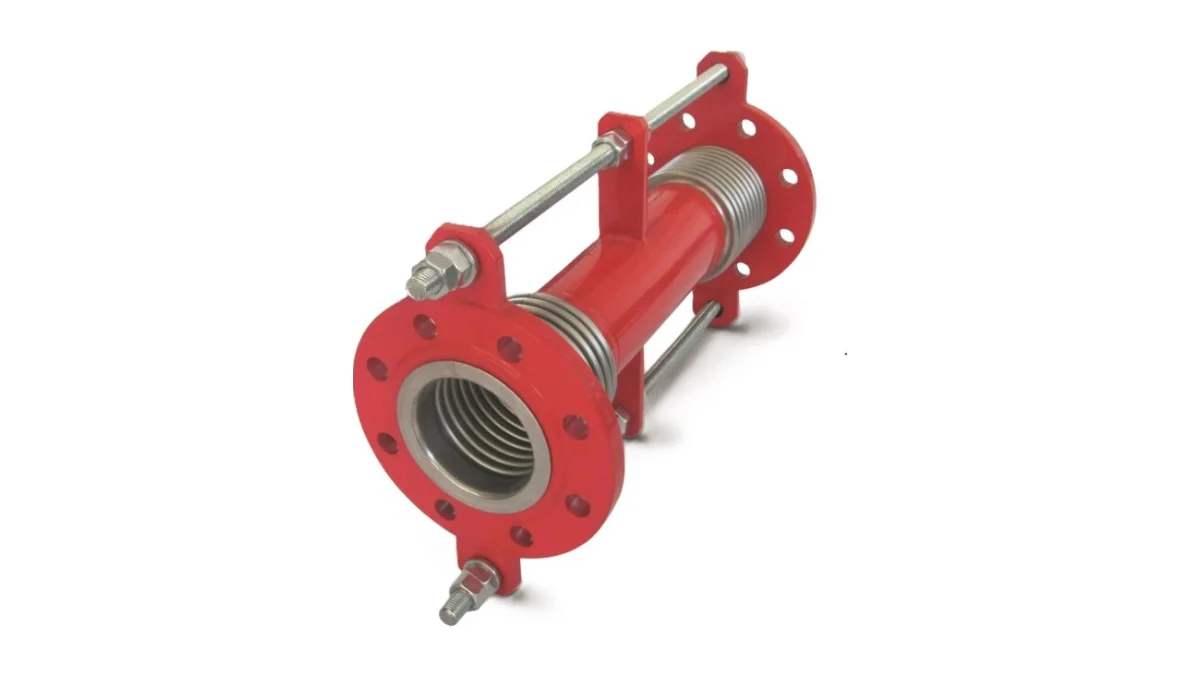
Buildings and industrial plants are exposed over time to ground settlement, thermal expansion and contraction, and seismic movement. When rigid pipework cannot accommodate these movements, pipes, flanges and connected equipment can suffer stress, bending, leaks or even rupture. A limit rod expansion joint is a metal bellows expansion joint that gives the pipeline controlled flexibility, especially where it crosses a building expansion gap.
This article explains how limit rod expansion joints are built, what the limit rods actually do, and where these joints are used.
What Is a Limit Rod Expansion Joint?
A limit rod expansion joint is a double-bellows (universal) unit: two metal bellows are joined by an intermediate pipe spool. Limit rods (control rods) fitted across the assembly keep its movement within design limits. Thanks to this construction the joint can accommodate:
- Settlement and building movement: vertical and lateral offsets between separate building blocks.
- Thermal expansion and contraction: length changes caused by temperature variation.
- Seismic movement: sudden displacements that may occur during an earthquake.
The double-bellows design is particularly suited to large lateral movements, while the bellows also accept a degree of axial and angular movement.
What Do the Limit Rods Do?
Limit rods restrict the joint from over-extending or over-compressing. In normal operation the bellows move freely; the rods only come into play when the movement reaches the design limit. As a result:
- The bellows are protected from movement beyond their rated range.
- The intermediate spool is stabilised and movement is shared evenly between the two bellows.
- If a main anchor fails, the bellows are protected against excessive movement and pressure thrust.
Technical Specifications
| Property | Value |
|---|---|
| Lateral movement capacity | Standard 50, 100, 150 and 200 mm; other values by project-specific design |
| Bellows material | Stainless steel to DIN 17440 |
| End fittings | Stainless steel or carbon steel |
| End connections | Rotating flanges, weld ends, grooved ends |
| Nominal size | DN25 (1″) – DN1000 (40″) |
| Pressure rating | PN16 standard; custom designs for higher pressures |
| Temperature range | -196 °C to +600 °C, depending on materials |
| Design basis | Bellows designed to EJMA (Expansion Joint Manufacturers Association); pressure-temperature ratings to DIN 2401 |
The allowable operating pressure depends on nominal size and operating temperature, so all three should be considered together when selecting a joint.
Benefits
- Protects the pipeline: concentrates movement in the bellows, reducing pipe stress and the risk of cracks and leaks.
- Controlled movement: the limit rods keep the bellows within their design limits.
- Longer equipment life: reduces loads transmitted to pumps, valves and flanged connections.
- Suited to expansion gaps: safely accommodates relative movement between two structures.
Applications
- Building expansion joint (seismic gap) crossings
- Heating, cooling and ventilation (HVAC) systems
- Industrial process lines and power plants
- Underground, above-ground and overhead pipelines
- Fire protection systems
Frequently Asked Questions
What movements can a limit rod expansion joint absorb?
Its double-bellows design mainly absorbs lateral movement and also accepts some axial and angular movement. Standard lateral capacities are 50, 100, 150 and 200 mm.
Do the limit rods prevent the joint from moving?
No. The rods allow free bellows movement in normal service and only engage when the movement reaches the design limit, protecting the bellows against over-extension or over-compression.
Which sizes and pressure ratings are available?
Sizes from DN25 (1″) to DN1000 (40″), PN16 as standard. Custom designs are possible for higher pressure ratings.
Conclusion
Where building and ground movement cannot be avoided, a limit rod expansion joint is a reliable way to keep pipework intact across expansion gaps. Selected with the right movement capacity, pressure rating and end connection, it helps the installation operate safely for many years. Explore more options on our Metal Bellows Expansion Joints page, or contact the ORFA sales team at +90 224 444 67 32 or [email protected] with your project details.
Buy limit rod expansion joints online
Browse products on or-fa.com, our export store, see prices in USD and order online.
Buy Online →Request a QuoteAsk on WhatsAppRelated product group
Metal Bellows Expansion Joints →Technical support
Talk to our team to choose the right product.
+90 224 444 67 32[email protected]
Related Articles
Let’s choose the right product for your project
Buy from our online store or request a project-specific quotation.