
Pressure Relief Control Valve: Operating Principle and Installation
Learn the operating principle, installation and setting of the pilot-operated pressure relief valve that protects lines against pump start-stop surges and pressure spikes.
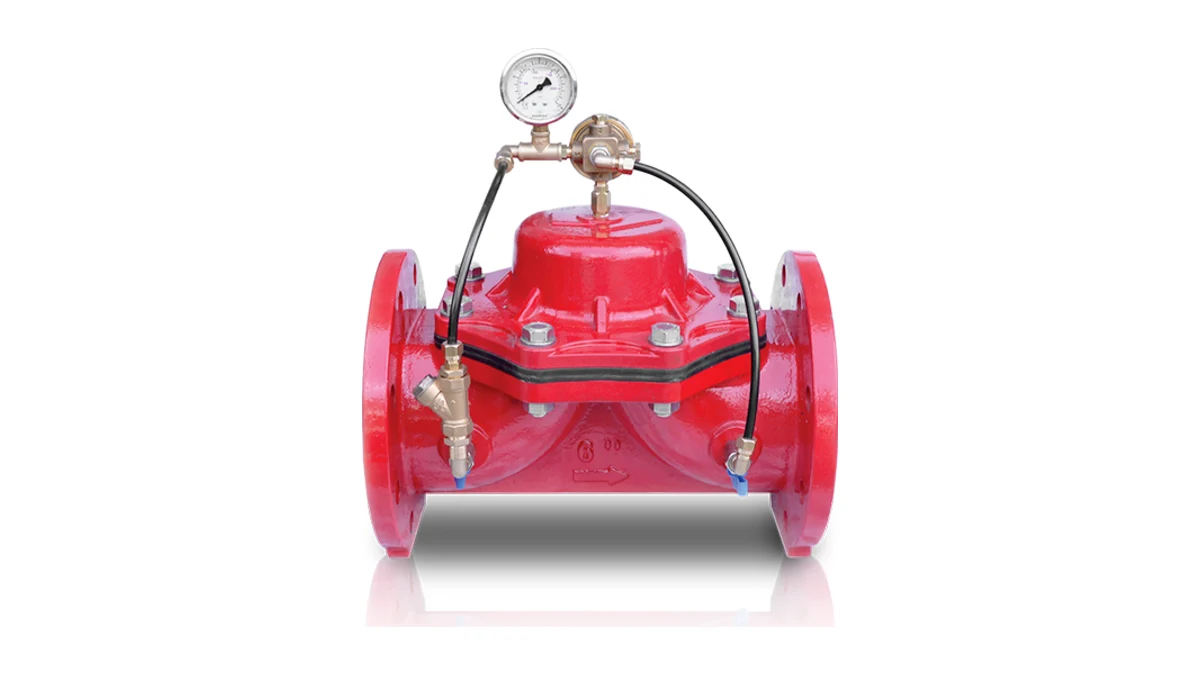
In water transmission networks, booster lines, irrigation systems and fire pump circuits, an unexpected rise in pressure can seriously damage pipes, valves and pumps. A pressure relief control valve opens quickly when line pressure exceeds a preset value, removing the excess pressure from the line, and closes in a controlled manner once pressure returns to normal.
This article explains how the valve works, its advantages and applications, and what to consider during installation and setting.
What Is a Pressure Relief Control Valve?
It is a pilot-operated hydraulic control valve, made up of a main valve and a pressure relief pilot, that works on line pressure. It is usually installed on a branch from the main line via a tee. In normal operation it is closed; when line pressure exceeds the set point it opens and discharges water to atmosphere, a drain or a tank, limiting the pressure in the main line.
How Does It Work?
- Line pressure below the set point: The pilot is closed and the main valve stays drip-tight.
- Line pressure above the set point: The pilot opens, the control chamber of the main valve is relieved and the valve opens quickly to discharge the excess pressure.
- Pressure back to normal: The pilot closes and the main valve closes slowly and smoothly so as not to create a new surge in the network.
The pilot setting is designed not to be affected by back pressure on the discharge side.
Advantages
- Fast relief: Opens quickly as soon as overpressure occurs, protecting equipment.
- Line pressure limiting: Prevents line pressure from exceeding the set point regardless of flow changes.
- Surge-free closing: Closes slowly and drip-tight after relief.
- No energy required: Fully hydraulic, operating on line pressure.
- Precise, easy setting: Relief pressure is adjusted with the screw on the pilot.
- Easy maintenance and flexible installation: Simple design; works in horizontal and vertical positions.
Applications
- Booster lines and water transmission networks: Relieving pressure spikes caused by pump start-up and shut-down.
- Irrigation systems: Protecting pipelines against overpressure caused by pump and valve operations.
- Industrial plants: Limiting sudden pressure rises in process water lines.
- Fire pump circuits: Relieving excess pressure on the fire pump discharge line.
Installation and Setting
Installation
- Install the valve on a branch of the main line via a tee, observing the flow arrow on the body.
- A strainer upstream of the valve is recommended.
- An isolation valve may be fitted upstream for maintenance; it must always be kept open in service.
- Connect the discharge outlet to a drain or tank that carries the relieved water away safely.
Setting the Relief Pressure
- Pressurise the system and read the line pressure gauge.
- Turn the pilot adjusting screw clockwise to raise the relief pressure, anticlockwise to lower it.
- Choose a set point above normal operating pressure but below the pressure limit of the equipment in the line.
- When finished, lock the adjusting screw with the lock nut.
Frequently Asked Questions
Is a pressure relief valve the same as a pressure sustaining valve?
No. A pressure sustaining valve works in-line and passes water downstream to maintain inlet pressure. A pressure relief valve is installed on a branch and removes overpressure by discharging water out of the line.
Can a relief valve replace a safety valve?
No. Pressure vessels and boilers must be fitted with safety valves certified to the relevant standards. A relief valve is a control valve that protects water lines from operational pressure rises.
How is the relief pressure determined?
The set point is chosen slightly above the system’s normal operating pressure and below the allowable pressure of the pipes, valves and equipment in the line.
Conclusion
A pressure relief control valve protects water lines against pump operations and pressure spikes without consuming energy, and extends the life of the installation through fast opening and controlled closing. Correct setting and a proper discharge connection are essential for safe operation. You can explore other pilot-operated valves in our hydraulic control valves product group.
Buy pressure relief valves online
Browse products on or-fa.com, our export store, see prices in USD and order online.
Buy Online →Request a QuoteAsk on WhatsAppRelated product group
Hydraulic Control Valves →Technical support
Talk to our team to choose the right product.
+90 224 444 67 32[email protected]
Related Articles
Let’s choose the right product for your project
Buy from our online store or request a project-specific quotation.