
Pneumatic Piston Valve: A Guide to Y-Type Angle Seat On-Off Valves
Learn how air-operated Y-type piston valves work, which actuator types exist, how to install them correctly and which media they can handle.
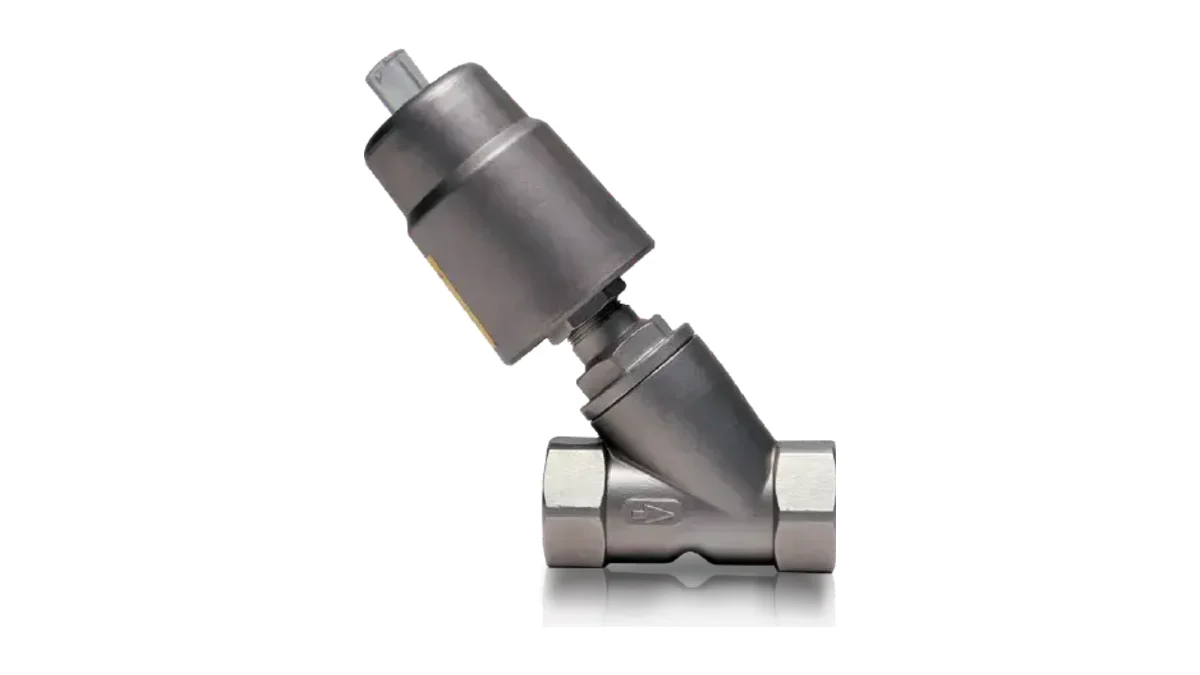
Automatically opening and shutting off flow is a basic requirement for efficiency, process safety and repeatable production in industrial plants. A pneumatic angle seat valve – often called a pneumatic piston valve – opens and closes the flow quickly and reliably by means of an air-driven piston actuator, and it connects easily to automation systems.
Also known as Y-type pneumatic valves, these valves are widely used, especially in stainless steel versions, in textile, food, chemical and steam applications. This article explains how they work, which types exist, their advantages and what to consider for correct selection.
What Is a Pneumatic Piston Valve?
A pneumatic piston valve consists of a Y-type (angled) body, a sealing disc (plug) inside the body, a stem carrying the disc and a pneumatic piston actuator mounted on top. Compressed air moves the piston, and the piston lifts the disc from the seat or presses it onto the seat via the stem, so the flow is either fully open or fully shut off.
Thanks to the angled body, the medium changes direction less than in a straight globe valve, which reduces pressure loss and increases flow capacity.
Operating Principle and Types
The most common version is the spring-return normally closed (NC) type:
- Control air is supplied to the actuator (usually through a solenoid valve).
- Air pressure overcomes the spring force and lifts the piston; the disc leaves the seat and the valve opens.
- When the control air is removed, the spring pushes the piston back and the valve closes.
Other actuator types are available depending on the application:
| Type | Air applied | Air removed | Typical reason to choose |
|---|---|---|---|
| Normally closed (NC), single-acting | Opens | Closes by spring | Lines that must stop flowing on air/power failure |
| Normally open (NO), single-acting | Closes | Opens by spring | Lines that must keep flowing on failure (e.g. cooling) |
| Double-acting | Separate air ports to open and close | Stays in last position | High closing force or frequent cycling |
The open/closed position can be seen on the actuator’s visual indicator; on many models limit switches for position feedback and stroke limiters can be fitted.
Advantages
- Fast opening and closing: Being air-operated, the valve reaches the fully open or fully closed position quickly – ideal for on-off duty.
- Easy automation: It can be controlled through a solenoid valve from a PLC, timer relay or thermostat.
- Low air consumption: Single-acting types use air for only one movement (opening on NC types); the spring provides the return stroke.
- Fail-safe position: Spring-return types move to a defined position (closed or open) on air or power failure.
- High flow capacity: The Y-body provides a smoother flow path and limits pressure loss.
- Long service life: A simple mechanism and self-adjusting stem packing keep maintenance needs low.
Installation and Operating Notes
- Flow direction: Follow the arrow on the body. In liquid lines, flow under the disc (against closing) is commonly used to reduce water hammer at closing; always follow the manufacturer’s installation instructions.
- Mounting position: The valve works in most positions, but avoid mounting the actuator facing downwards so that dirt and condensate do not collect at the packing.
- Control air: Use clean, dry, conditioned air; the control pressure must be within the range specified by the manufacturer for the actuator size and line pressure.
- Strainer: A strainer upstream protects the disc and seat from particles.
Applications and Media
Pneumatic piston valves are used wherever fast and frequent on-off switching is required:
- Textile printing and dyeing machines (water, steam and dye lines)
- Cleaning, filling and water/steam lines in food and beverage plants
- Utility lines in pharmaceutical and cosmetics plants
- Compatible chemical media in the chemical industry
- Process water and steam lines in paper mills
- Cooling water lines in iron and steel plants
- Water treatment and clean or low-solids waste water
With suitable body and seal materials they can handle water, hot water, superheated water, steam, compressed air, inert gases (e.g. nitrogen), oils and many chemicals. For special gases such as LPG, hydrogen or oxygen, use versions approved by the manufacturer for that medium (degreased versions for oxygen).
Stainless Steel Y-Type Pneumatic On-Off Valves
A stainless steel body offers high corrosion resistance and a long service life in environments that require cleaning, such as food, textile and chemical plants. Combined with the Y-type design, it gives a durable automatic valve with high flow capacity. Threaded, weld-end or flanged connections make it easy to adapt the valve to different installations.
Frequently Asked Questions
Can a pneumatic piston valve modulate flow?
Standard pneumatic piston valves operate on-off (fully open / fully closed). If flow must be set at intermediate positions, proportional control valves with a positioner should be used.
How do I choose between NC and NO?
If shutting the line on air or power failure is safe, choose normally closed (NC); if flow must continue (e.g. cooling water), choose normally open (NO).
Can it be used on steam lines?
Yes. Models with seals and packing rated for steam temperature are widely used on steam lines; check the maximum pressure and temperature ratings when selecting.
Conclusion
With their Y-type body, fast response and easy automation, pneumatic piston valves are a reliable solution for industrial on-off applications. With the right actuator type, materials and flow direction they operate trouble-free for many years. See other automatic valve options on our On-Off Control Valves page, or contact the ORFA technical team on +90 224 444 67 32 for the right model for your application.
Buy pneumatic on-off valves online
Browse products on or-fa.com, our export store, see prices in USD and order online.
Buy Online →Request a QuoteAsk on WhatsAppRelated product group
On-Off Control Valves →Technical support
Talk to our team to choose the right product.
+90 224 444 67 32[email protected]
Related Articles
Let’s choose the right product for your project
Buy from our online store or request a project-specific quotation.