
Capacitive Level Sensor: Probe Types, Selection Criteria and Applications
Explore the probe types, selection criteria and applications of capacitive level sensors used in everything from liquid tanks to cement silos.
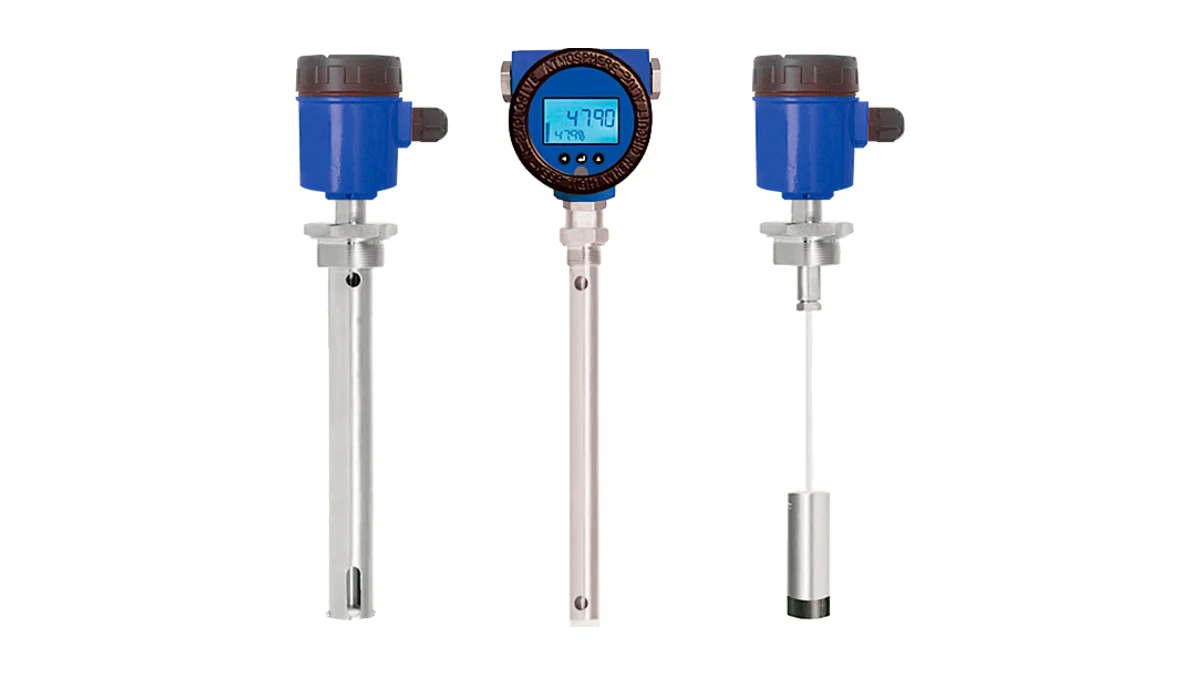
Inaccurate level measurement in tanks and silos can cause production disruptions, equipment damage from overfilling or dry running, and material losses. A capacitive level sensor measures the change in capacitance between a probe and the tank wall and delivers level information for liquids as well as bulk solids such as powders and granules, without any moving parts.
This article covers the working principle, probe types, what to consider when selecting a sensor and typical applications.
How Does a Capacitive Level Sensor Work?
The probe and the tank wall (or a reference electrode) form a capacitor. Capacitance depends on electrode area, the distance between the electrodes and the dielectric constant of the medium in between. As the level rises, material with a higher dielectric constant replaces the air around the probe and capacitance increases. Depending on the model, the electronics convert this change into a relay output at a set point (level switch) or a continuous analogue signal along the probe (level transmitter).
Probe Types
Insulated and bare probes
Conductive liquids (water, brine, many chemical solutions) normally require a fully insulated probe, for example PTFE-coated; otherwise the liquid would short-circuit the probe to the tank wall. Bare probes can be used in non-conductive liquids (oils, fuels) and dry solids. The insulation also protects the probe against corrosion.
Rod and cable probes
Rigid rod probes are preferred in short and medium-height liquid tanks. Deep silos use weighted cable probes, which cope better with the loads exerted by bulk solids.
Probes with reference electrode
In non-metallic tanks (plastic, concrete) the wall cannot act as an electrode, so a sensor with its own reference electrode (coaxial or twin-electrode design) is required.
Selection Criteria
| Criterion | Why it matters |
|---|---|
| Conductivity and dielectric constant of the medium | Determines insulated vs bare probe and measuring sensitivity. |
| Type of measurement | A switch for point alarms, a 4-20 mA transmitter for continuous level. |
| Temperature and pressure | Hot tanks need models with a cooling neck or extension; ratings depend on the model. |
| Chemical compatibility | Probe and insulation materials must suit acids, alkalis and solvents. |
| Build-up and foam | Sticky media and conductive foam can affect the reading; choose a suitable probe type and setting. |
| Tank material and geometry | Non-metallic tanks need a reference electrode; deep silos need a cable probe. |
Advantages
- No moving parts: No mechanical wear, so maintenance needs are low.
- Robust against vibration: Mechanically sturdy and suitable for vibrating environments.
- Measurement along the probe: Continuous models track the level over the full active probe length.
- Easy zero/span adjustment: Empty and full values can be set quickly on site.
- Flexible installation: Modular designs adapt to different tanks and connections; suitable models can also be mounted from below.
Applications
- Liquid tanks: Water, oil, glycol and coolant tanks
- Food: Liquid and semi-liquid products in food machinery, brine tanks and wine storage
- Marine: Fuel, fresh water and waste water tanks on ships
- Pressurised tanks: Applications such as liquid CO2 tanks, with a suitable model
- High-temperature tanks: Using models with a cooling neck
- Low-conductivity liquids: Non-conductive media such as oils and fuels
- Bulk solids: Grain stores and cement silos; sand, milk powder, feed, flour, organic and plastic granule hoppers
- Difficult media: Hot, sticky or high-viscosity acids and chemicals with the right probe and insulation
Frequently Asked Questions
Does a capacitive level sensor work in non-conductive liquids?
Yes. Capacitive measurement relies on the dielectric constant rather than conductivity, so it can be used with non-conductive liquids such as oils and fuels. Sensitivity adjustment is more important with low-dielectric media.
When is an insulated probe needed?
In conductive liquids, to prevent a short circuit between probe and tank wall. The insulation also protects the probe in aggressive chemicals.
Which probe type is used in silos?
Deep silos generally use weighted cable probes; short hoppers can use rod probes.
Conclusion
With the right probe type and setting, capacitive level sensors provide reliable level information for materials ranging from liquids to powders and granules. Selection should consider conductivity, temperature and pressure, chemical compatibility and tank design together. Browse our Level Control Devices page and contact the ORFA technical team for help choosing a sensor.
Buy level control devices online
Browse products on or-fa.com, our export store, see prices in USD and order online.
Buy Online →Request a QuoteAsk on WhatsAppRelated product group
Level Control Devices →Technical support
Talk to our team to choose the right product.
+90 224 444 67 32[email protected]
Related Articles
Let’s choose the right product for your project
Buy from our online store or request a project-specific quotation.