
Flanged Static Balancing Valve: Hydronic Balancing for Large Pipelines
Explore the features, setting and selection of flanged static balancing valves that deliver the design flow to every circuit in large heating and cooling pipelines.
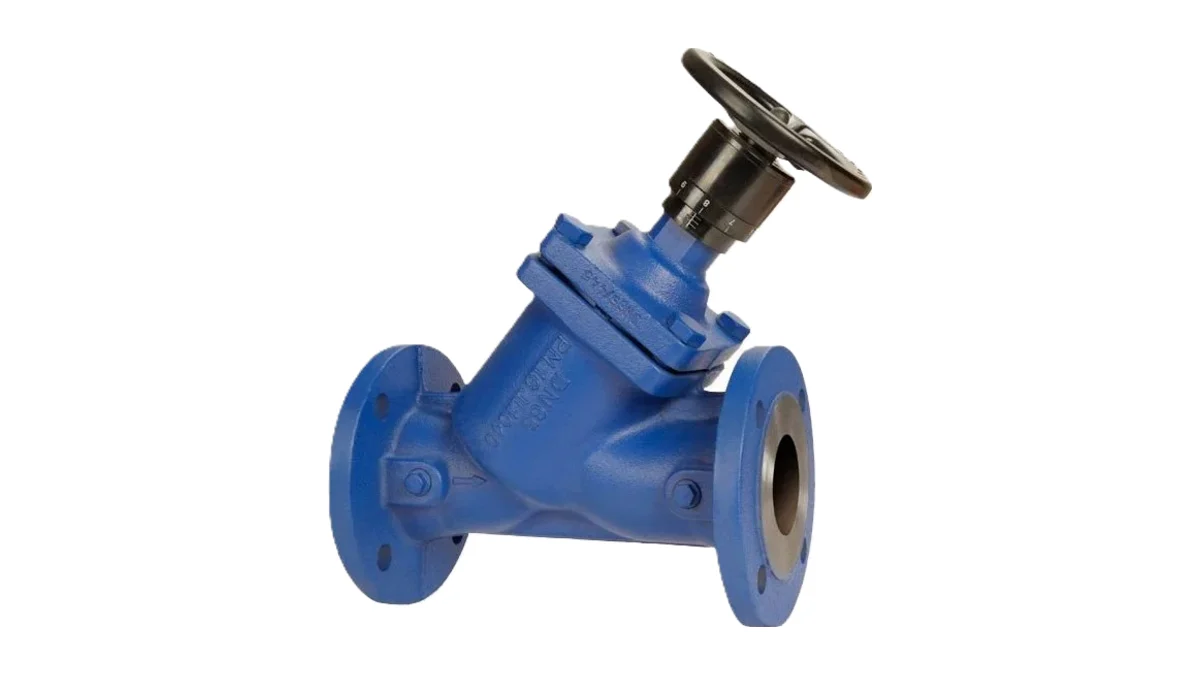
In heating and cooling systems, circuits close to the pump tend to receive too much water while remote circuits receive too little. This imbalance leads to under-heated or under-cooled zones, pumps running at unnecessarily high flow and wasted energy. A flanged static balancing valve is a balancing valve with a lockable setting that ensures each circuit in large-diameter pipework receives its design flow.
Thanks to its flanged design it is used on DN65 and larger main distribution lines, risers and branches, and chiller and boiler circuits.
What Is a Static Balancing Valve?
A static balancing valve adds a fixed, preset resistance to a circuit to bring the flow through that circuit to its design value. The valve is set to a specific opening during commissioning, and this setting does not change by itself during operation – hence the name “static”.
Most balancing valves have measuring points (test nipples) on the inlet and outlet. A balancing instrument connected to these points measures the differential pressure across the valve and calculates the flow using the valve’s Kv value and setting.
Technical Specifications
| Feature | Value |
|---|---|
| Body and bonnet material | GG25 (EN-GJL-250) grey cast iron |
| Connection | Flanged |
| Nominal size | DN65 (2 1/2″) – DN300 (12″) |
| Maximum working pressure | 16 bar (PN16) |
| Working temperature | -10 °C to +120 °C |
| Disc material | Depends on model, selected to suit the application |
Advantages
- Correct flow distribution: Every circuit receives its design flow, eliminating comfort problems and “remote circuit” complaints.
- Energy efficiency: Since excess flow is prevented, the pump can run at lower flow and head; combined with variable-speed pumps this gives significant savings.
- Setting memory: After balancing, the setting is locked; when the valve is closed for service and reopened it returns to the same position.
- Shut-off function: The valve can also be used to isolate the circuit for maintenance.
- Easy installation and maintenance: The flanged connection makes it easy to fit the valve securely in large lines and remove it when needed.
- Durability: The GG25 cast iron body offers long life in closed-loop heating and cooling water applications.
Applications
- Balancing risers and main branches in building heating systems
- Water side of chillers, cooling towers and air handling units (AHUs)
- Main lines of fan coil groups
- Industrial process heating and cooling water circuits
- District heating substations
Selection and Balancing
- Determine flow and differential pressure: Establish the circuit’s design flow and the expected differential pressure across the valve (typically a few kPa).
- Calculate Kv: Find the required Kv with Kv = Q / √ΔP (Q in m³/h, ΔP in bar); choose the valve size so that this Kv is reached in the middle of the setting range.
- Set the valve: During commissioning, measure the flow with the instrument and adjust the valve setting to the design flow.
- Lock the setting: Lock the setting and record it in the balancing report.
For accurate measurement, leave sufficient straight pipe upstream and downstream of the valve and install it as recommended by the manufacturer.
Frequently Asked Questions
What is the difference between static and dynamic balancing valves?
A static balancing valve works with a fixed preset and does not react to pressure changes in the system by itself. A dynamic balancing valve automatically keeps the flow at the set value even when the differential pressure changes.
In which sizes is the flanged static balancing valve used?
The flanged model described here is available from DN65 (2 1/2″) to DN300 (12″). For smaller sizes, threaded static balancing valves are preferred.
How is the flow measured?
A balancing instrument connected to the valve’s test nipples measures the differential pressure; the instrument calculates the flow from the valve type, size and setting.
Conclusion
Flanged static balancing valves are key components for correct flow distribution, comfort and energy efficiency in large heating and cooling pipelines. With correct Kv selection and proper balancing, the system works as designed. Explore other balancing and control valves on our HVAC Valves page.
Buy static balancing valves online
Browse products on or-fa.com, our export store, see prices in USD and order online.
Buy Online →Request a QuoteAsk on WhatsAppRelated product group
HVAC Valves →Technical support
Talk to our team to choose the right product.
+90 224 444 67 32[email protected]
Related Articles
Let’s choose the right product for your project
Buy from our online store or request a project-specific quotation.