
PTFE Seated Wafer Butterfly Valve: A Compact, Chemical-Resistant Solution
Explore the design, limits and applications of PTFE (Teflon) seated wafer butterfly valves, which resist corrosive and chemical media thanks to their PTFE-lined seat.
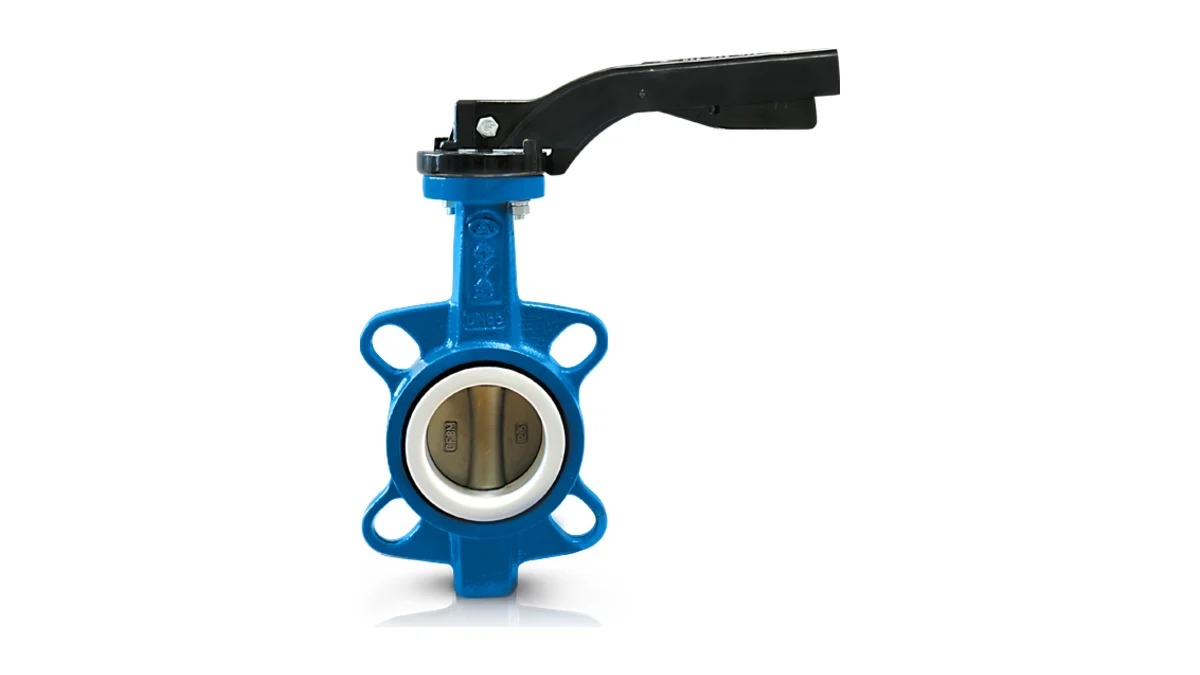
With their low weight, short length and quarter-turn operation, butterfly valves are one of the most economical shut-off solutions for large pipelines. However, standard EPDM or NBR seats are not always compatible with acids, alkalis, solvents and other aggressive media. A PTFE seated wafer butterfly valve – also called a Teflon seated butterfly valve – is a compact butterfly valve whose body seat is lined with PTFE, so it can be used safely with such media.
This article covers the design, advantages, limits and selection points of PTFE seated wafer butterfly valves.
What Is a PTFE Seated Wafer Butterfly Valve?
A butterfly valve opens or shuts the flow with a disc that rotates 90° on a stem. A wafer type body is placed between two pipe flanges and clamped by the flange bolts, so it is short and light.
In PTFE seated models, the seat (liner) inside the body has a PTFE surface in contact with the medium. Behind the PTFE liner there is usually an elastic backing layer such as EPDM or silicone, which gives the rigid PTFE resilience so the disc seals tightly. The medium therefore contacts only the PTFE seat and the disc, not the body material.
Advantages
- High chemical resistance: PTFE resists most acids, alkalis and solvents; it is chosen where EPDM or NBR seats are not suitable.
- Tight shut-off: The elastically backed PTFE seat gives a tight seal with the disc.
- Low friction and non-stick surface: PTFE’s low friction coefficient and non-stick surface reduce build-up of deposits.
- Compact and light: The wafer body takes up far less space than gate or globe valves.
- Fast operation: Opens and closes quickly with a quarter turn (90°).
- Automation-ready: Can be operated by lever, gearbox, pneumatic or electric actuator.
Typical Technical Features
| Feature | Typical value / option |
|---|---|
| Body material | Grey cast iron, ductile iron or stainless steel |
| Disc material | Stainless steel (other alloys depending on application) |
| Seat | PTFE-lined, elastomer (e.g. EPDM) backed |
| Connection | Wafer type, between PN10/PN16 flanges |
| Nominal size | Depending on model, e.g. DN50 – DN300 |
| Working temperature | Typically about -20 °C to +150 °C for EPDM-backed PTFE seats |
| Operation | Lever, gearbox, pneumatic or electric actuator |
Limits and Points to Consider
- Higher operating torque: A PTFE seat is stiffer than an elastomer seat; base actuator selection on the manufacturer’s torque values.
- Temperature limit: The limit is set not only by the PTFE but also by the elastomer backing behind it. Consider pressure and temperature limits together.
- Disc material: The disc is the only metal part in contact with the medium; for corrosive media, check the disc material’s compatibility in chemical resistance tables too.
- Vacuum and abrasive media: Confirm suitability with the manufacturer for vacuum service and abrasive, solids-laden media.
Applications
- Chemical and petrochemical plants
- Chemical dosing and process lines in water treatment plants
- Food and beverage industry
- Mining and metal processing plants (with a suitable disc material)
- Shipbuilding and marine applications
- HVAC and industrial water systems
Frequently Asked Questions
Is the PTFE on the disc or in the body?
In PTFE seated butterfly valves, the PTFE lines the seat (liner) inside the body. The disc is usually stainless steel and seals against this PTFE seat when closed.
Why choose a PTFE seated valve instead of an EPDM seated one?
EPDM suits many water applications but is not compatible with oils, many solvents and some aggressive chemicals. A PTFE seat offers much broader chemical resistance for these media.
Up to what temperature can a PTFE seated butterfly valve be used?
For EPDM-backed PTFE seats the typical upper limit is about 150 °C. The exact value depends on the model’s backing material and the pressure; check the manufacturer’s data.
Conclusion
PTFE seated wafer butterfly valves combine a compact design and fast operation with PTFE’s outstanding chemical resistance. With the right disc material, suitable temperature-pressure limits and the correct actuator, they provide a long-lasting shut-off solution for corrosive lines. Explore other butterfly valve types on our Butterfly Valves page.
Buy wafer butterfly valves online
Browse products on or-fa.com, our export store, see prices in USD and order online.
Buy Online →Request a QuoteAsk on WhatsAppRelated product group
Butterfly Valves →Technical support
Talk to our team to choose the right product.
+90 224 444 67 32[email protected]
Related Articles
Let’s choose the right product for your project
Buy from our online store or request a project-specific quotation.