
Capacitive Level Transmitter: Continuous Liquid Level Measurement with 4-20 mA
Learn how capacitive level transmitters measure liquid level in tanks and boilers continuously and convert it into a 4-20 mA signal, and how they are calibrated and used.
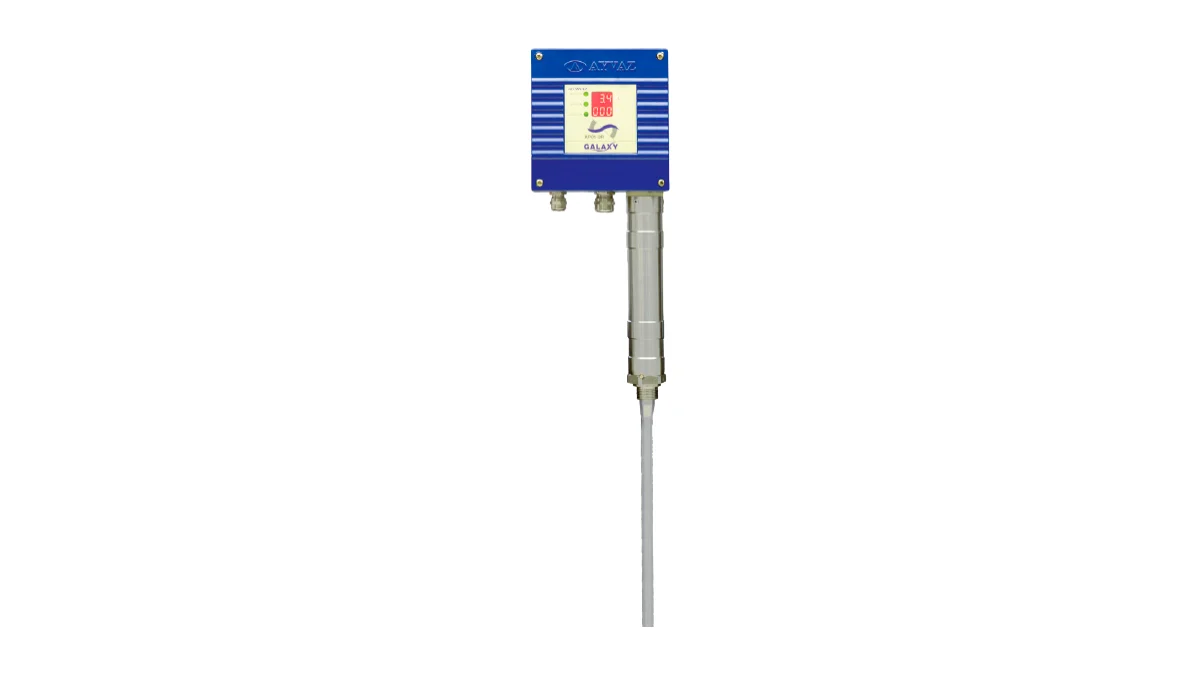
In process control, a simple “full” or “empty” signal is often not enough; to manage pump speed, feed valves or inventory correctly, the level must be known at all times. A capacitive level transmitter measures the liquid level continuously along its probe and converts it into a standard 4-20 mA analogue signal.
Suitable for both conductive and non-conductive liquids, these transmitters have no moving parts and therefore run for long periods with little maintenance. Below you will find the working principle, calibration and typical applications.
How Does a Capacitive Level Transmitter Work?
The capacitance of a capacitor depends on the plate area, the distance between the plates and the dielectric constant of the material between them. In a capacitive level transmitter, the electrode rod and the tank wall (or a reference electrode) form this capacitor. Since the electrode geometry is fixed, what changes the measured capacitance is how much of the probe is surrounded by liquid and how much by air or vapour.
Because the liquid has a higher dielectric constant than air, capacitance increases in proportion to the level along the probe. The electronics measure this change and convert it into a linear current signal, typically 4 mA for an empty tank and 20 mA for a full one. The signal is used directly by PLCs, indicators, control panels or proportional controllers.
Calibration: Zero and Span
Measurement accuracy depends on calibrating the transmitter for the liquid being measured:
- Zero: Set 4 mA with the probe uncovered or at the lowest measuring level.
- Span: Set 20 mA with the liquid at the highest required level.
- Check: Verify that the signal changes linearly at intermediate levels.
Advantages
- Continuous measurement: The level is tracked along the whole probe, not just at fixed points.
- Conductive and non-conductive liquids: With the right probe (insulated or bare) it works with water, oils, fuels and chemicals.
- Standard 4-20 mA output: Connects directly to automation systems; current signals are robust against interference over long cable runs.
- No moving parts: No mechanical wear, so maintenance is minimal.
- Compact and easy to install: Mounted from the top of the tank through a single process connection.
Selection Points
- Probe length: Must cover the required measuring range.
- Probe insulation: Conductive liquids require a fully insulated probe.
- Temperature and pressure: Hot, pressurised applications such as steam boilers need models designed for those conditions; ratings depend on the model.
- Tank material: Plastic tanks require a probe with a reference electrode.
- Supply and output: Must match the supply voltage and signal type of the control system.
Applications
| Sector / application | Typical tanks |
|---|---|
| Heating and steam systems | Steam boilers (proportional level control), high-temperature tanks |
| Fuel and oil | Fuel tanks, oil tanks |
| Food and beverage | Food machinery, concentrate tanks, brine tanks, wine storage |
| Cooling | Glycol and coolant tanks, liquid CO2 tanks |
| Marine | Ship tanks and marine applications |
| General storage | Clean water tanks, plastic tanks, low-conductivity liquids |
Frequently Asked Questions
Why does a 4-20 mA signal start at 4 mA rather than 0 mA?
With a “live zero”, 0 mA indicates a fault such as a broken cable or loss of supply, so an empty tank can be distinguished from a failure.
Can a capacitive level transmitter be used on a steam boiler?
Yes. Capacitive electrodes rated for boiler conditions are used to measure the water level continuously and modulate the feed pump or valve. Low-water safety must still be provided by separate, independent safety devices.
What if the measured liquid changes?
Because the dielectric constant changes, the zero and span settings must be repeated with the new liquid.
Conclusion
Capacitive level transmitters monitor liquid level continuously with a standard signal, making it easy to automate pumps, valves and inventory management. The right probe type, a suitable pressure-temperature rating and correct on-site calibration determine reliable measurement. Browse our Level Control Devices page and contact the ORFA technical team for help choosing a transmitter.
Buy level control devices online
Browse products on or-fa.com, our export store, see prices in USD and order online.
Buy Online →Request a QuoteAsk on WhatsAppRelated product group
Level Control Devices →Technical support
Talk to our team to choose the right product.
+90 224 444 67 32[email protected]
Related Articles
Let’s choose the right product for your project
Buy from our online store or request a project-specific quotation.