
What Is a Combined Balancing Valve? Operation and Advantages
A combined balancing valve keeps the set flow rate in heating and cooling circuits regardless of pressure fluctuations and, fitted with an actuator, also acts as the control valve.
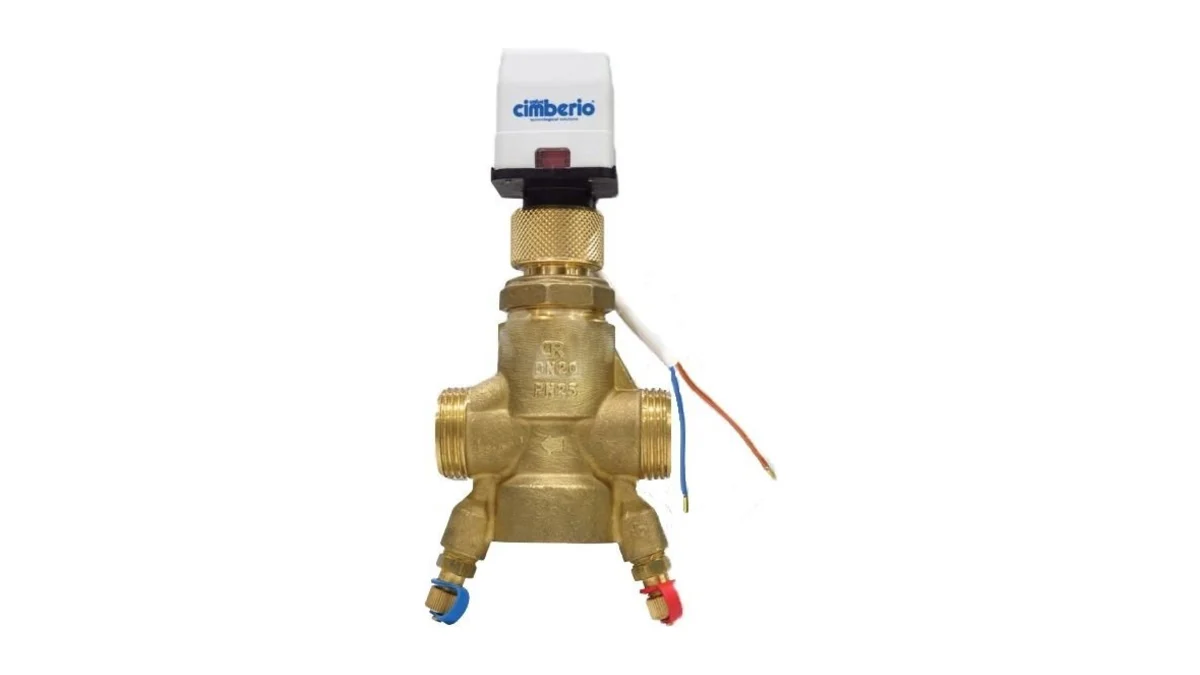
When the heating or cooling medium (water or water-glycol) is unevenly distributed in an HVAC system, some zones are under-supplied while others receive more flow than needed. The result is wasted energy, poor comfort and reduced system performance. A combined balancing valve solves this by uniting flow presetting, automatic pressure balancing and control in a single body.
This article explains what a combined balancing valve is, how it works and where it adds value.
What Is a Combined Balancing Valve?
A combined balancing valve is installed at terminal units (fan coils, air handling unit coils, radiator groups, etc.) or branches in heating and cooling systems and provides several functions at once:
- Flow presetting: The maximum flow rate through the valve is set with a presetting knob.
- Automatic pressure balancing: It automatically compensates for pressure fluctuations in the system and maintains the set flow rate.
- Flow control (with actuator): Fitted with an electric actuator, the valve modulates the flow precisely according to a control signal and also serves as the control valve.
- Fluid distribution: As a result, the medium is distributed to each branch in the designed quantity.
These valves are also known as pressure independent control valves (PICV) and belong to the dynamic balancing valve family.
How It Works
- Presetting: The presetting knob is adjusted to the design flow rate of the terminal unit.
- Automatic balancing: When pressure conditions change (for example as valves in other branches open and close), a differential pressure regulating element inside the valve, such as a diaphragm or piston, keeps the differential pressure across the control section constant, so the preset flow is maintained.
- Flow modulation: The electric actuator opens and closes the valve according to the control signal, adjusting the flow between zero and the preset value.
Advantages of a Combined Balancing Valve
- Energy savings: Each circuit receives only its design flow, avoiding overflow and unnecessary pump energy.
- Better comfort: Balanced flow in all branches keeps room temperatures more stable.
- Stable control: Because pressure fluctuations are compensated automatically, control performance is not affected by the position of other valves in the system.
- Fewer components: Balancing, differential pressure control and control valve functions are combined in one body, reducing the number of separate valves and installation work.
- Improved system performance: Noise and equipment problems caused by unbalanced flow are reduced.
- Flexibility: The presetting can be changed after initial installation, making it easy to adapt to system changes.
Applications
- Heating systems (radiator and underfloor heating circuits, etc.)
- Cooling systems (fan coil units, air handling units, etc.)
- Central heating and cooling systems
- Heating and cooling circuits in industrial processes
Selection Considerations
- The design flow of the terminal unit must lie within the valve’s presetting range.
- The valve’s working differential pressure range (minimum and maximum) must suit system conditions.
- Choose a connection type (threaded, flanged) and size that match the installation.
- Body material, pressure and temperature ratings must meet operating conditions.
- The actuator’s control signal (on/off or modulating) must be compatible with the building management system.
Frequently Asked Questions
What is the difference between a combined balancing valve and a static balancing valve?
A static balancing valve provides a fixed restriction, so the flow changes when system pressure changes. A combined balancing valve automatically balances differential pressure, maintaining the set flow despite pressure fluctuations, and also works as a control valve with an actuator.
Can a combined balancing valve be used without an actuator?
Yes. Without an actuator the valve works as an automatic flow limiter. With an actuator the flow can be modulated according to a control signal.
Can the presetting be changed later?
Yes. The flow can be readjusted with the presetting knob after installation to suit system requirements.
Conclusion
By maintaining flow independently of pressure fluctuations, combined balancing valves improve energy efficiency and comfort in heating and cooling systems while simplifying commissioning and reducing component count. Selecting a valve with the right presetting and differential pressure range ensures stable, long-lasting operation. See more options on our HVAC Valves page.
Buy dynamic balancing valves online
Browse products on or-fa.com, our export store, see prices in USD and order online.
Buy Online →Request a QuoteAsk on WhatsAppRelated product group
HVAC Valves →Technical support
Talk to our team to choose the right product.
+90 224 444 67 32[email protected]
Related Articles
Let’s choose the right product for your project
Buy from our online store or request a project-specific quotation.