
Dry Rotor Circulation Pumps: Design, Types and Applications
In a dry rotor circulation pump the motor is separate from the pumped liquid and the shaft is sealed by a mechanical seal. Learn about its role in large heating and cooling systems.
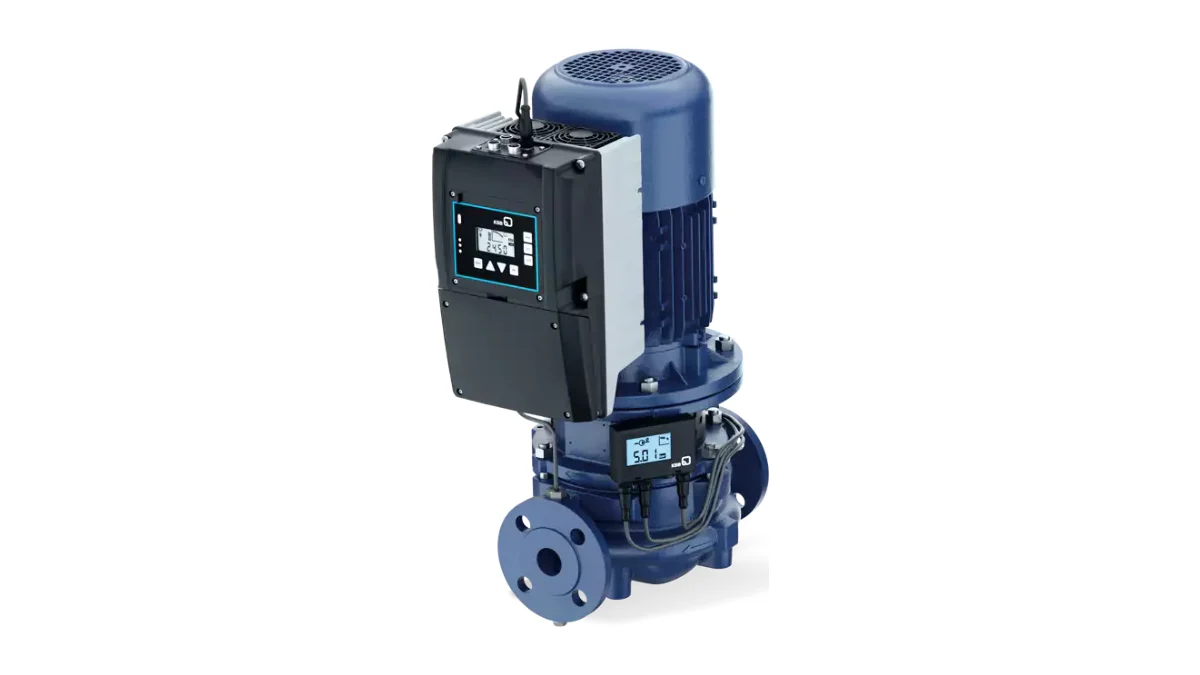
In large facilities such as hospitals, shopping centres, office buildings and factories, circulating heating and chilled water requires far higher flow and head than in residential systems. The preferred solution here is the dry rotor circulation pump. With the motor separated from the pumped liquid, these pumps can reach large capacities using standard motors.
This article covers the design, types and applications of dry rotor pumps and how they differ from wet rotor pumps.
What Is a Dry Rotor Circulation Pump?
In a dry rotor pump, the motor has no contact with the pumped liquid. It is usually a standard electric motor cooled by air from its own fan. Where the pump shaft leaves the casing, sealing is usually provided by a mechanical seal.
This design allows larger motor powers and is advantageous in large systems requiring high flow and head, as well as in high-temperature applications.
Types of Dry Rotor Pumps
- Inline pumps: Suction and discharge are on the same axis; they are installed directly in the pipeline and take up little space.
- Twin pumps: Two pumps in one casing. They can alternate, act as standby or run together at peak demand; the system keeps running while one pump is serviced.
- Monoblock and end-suction pumps: Floor- or baseplate-mounted types for larger flows.
Applications
- Central heating systems: Large buildings, hospitals, schools and shopping centres.
- Central cooling systems: Chillers, air handling units and industrial cooling plants.
- Large hot water systems: High-flow hot water circulation.
- Industrial cooling loops: Process cooling circuits in factories.
- Heat recovery systems: Circuits that make use of waste heat.
- Geothermal heating systems: Applications requiring high temperature and flow.
Technical Features
- Materials: Casings are usually cast iron; stainless steel options are available depending on the application.
- Wide performance range: Models are available for different flow and head requirements.
- Connections: Larger sizes generally use flanged connections.
- Standard motors: A failed motor can be replaced with a standard motor, and speed can be controlled with a frequency converter.
Benefits
- High capacity: Meets the flow and head requirements of large systems.
- Energy efficiency: High-efficiency motors and speed control can lower operating costs.
- Long life: As the motor does not contact the liquid, it is less affected by water quality.
- Easy servicing: Parts such as the motor and the seal can be replaced individually.
Dry Rotor vs Wet Rotor Pumps
| Feature | Dry rotor | Wet rotor |
|---|---|---|
| Motor cooling | By the motor fan (air) | By the pumped water |
| Shaft sealing | Mechanical seal | Not required |
| Capacity | Medium and large | Small and medium |
| Noise | Higher due to the fan | Very low |
| Maintenance | Seal must be checked periodically | Minimal |
For homes and small buildings, quiet and compact wet rotor circulation pumps are more suitable.
Operation and Maintenance
- The mechanical seal is a wear part; check it regularly for leaks.
- Never run the pump dry; dry running quickly destroys the seal.
- Keep the motor fan air inlet clear and install the pump in a well-ventilated plant room.
- Do not transfer pipe loads to the pump; support the pipework independently.
Frequently Asked Questions
When should a dry rotor pump be chosen?
It is chosen for large heating, cooling and industrial systems needing high flow and head, where the capacity of wet rotor pumps is insufficient.
Is a dry rotor pump quiet?
Because of its fan-cooled motor, it is generally louder than a wet rotor pump. It is therefore usually installed in plant rooms such as boiler rooms or mechanical rooms.
Which part of a dry rotor pump needs the most maintenance?
The mechanical seal. Replace it when leakage appears; avoiding dry running extends seal life.
Conclusion
With high capacity, standard motors and easy servicing, dry rotor circulation pumps are core equipment for large heating, cooling and process systems. Selecting the right type and capacity and checking the seal regularly ensure years of efficient operation. Browse the models in our Circulation Pumps product group.
Buy circulation pumps online
Browse products on or-fa.com, our export store, see prices in USD and order online.
Buy Online →Request a QuoteAsk on WhatsAppRelated product group
Circulation Pumps →Technical support
Talk to our team to choose the right product.
+90 224 444 67 32[email protected]
Related Articles
Let’s choose the right product for your project
Buy from our online store or request a project-specific quotation.