
What Is a Hydraulic Separator? Role and Operating Principle in Heating Systems
Learn the operating principle, benefits, correct connection and sizing of the hydraulic separator that decouples boiler and consumer circuits in heating systems.
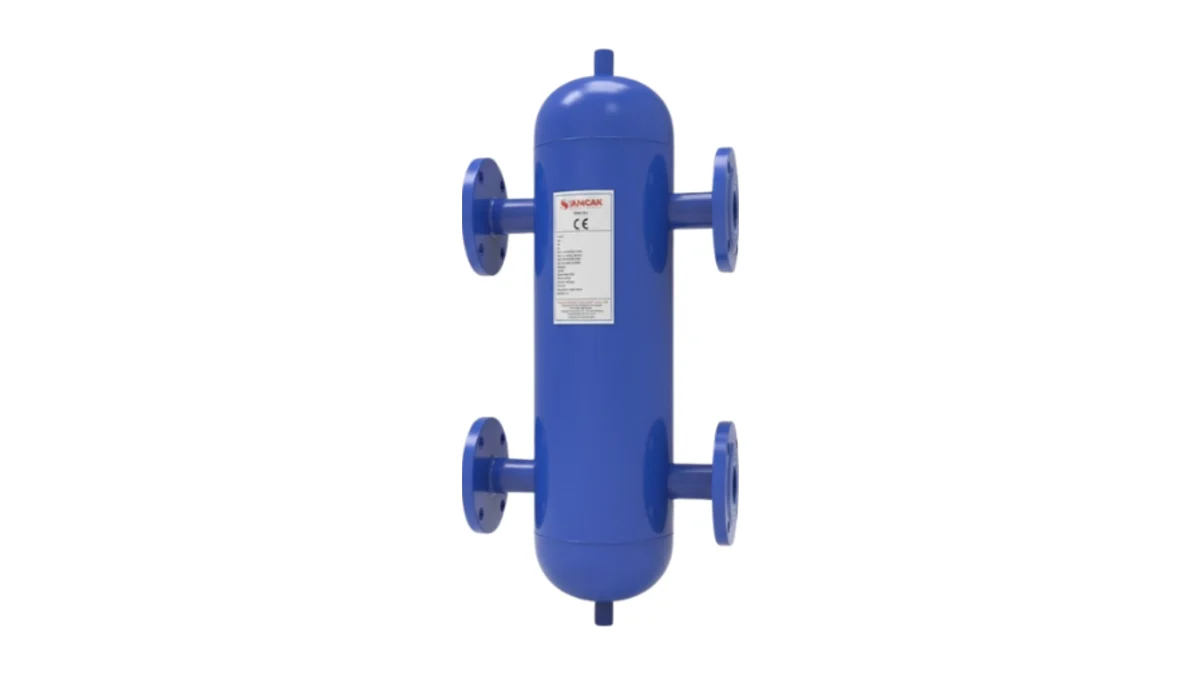
In heating systems with more than one boiler or pump, the flow rates of the boiler circuit and the consumer circuits are often different. If this is not managed properly, pumps interfere with each other’s flow, some circuits are starved of water and boiler operating conditions deteriorate. A hydraulic separator (low loss header, also called a balancing vessel) sits between the boiler (primary) circuit and the consumer (secondary) circuits and hydraulically decouples them: a simple but effective component.
This article covers the operating principle of a hydraulic separator, its benefits, and the key points for connection and sizing.
How Does a Hydraulic Separator Work?
A hydraulic separator is a vertical vessel of large cross-section to which the flow and return lines of the boiler circuit and of the consumer circuits are connected. Thanks to the large cross-section, flow velocity and pressure drop inside the vessel are very low, so the boiler pump and consumer pumps each operate at their own flow rate without affecting one another.
The direction of flow inside the vessel depends on the difference between the two circuits’ flow rates:
| Condition | Flow inside the vessel | Result |
|---|---|---|
| Boiler flow = consumer flow | Practically no vertical flow | Flow and return temperatures are preserved |
| Boiler flow > consumer flow | Excess hot water flows downwards and mixes with the return | Return temperature to the boiler rises |
| Boiler flow < consumer flow | Part of the return water flows upwards and mixes with the flow | Flow temperature to consumers drops |
Benefits of a Hydraulic Separator
- Hydraulic independence: boiler and consumer pumps do not affect each other’s flow and pressure; each circuit runs at its design flow.
- Boiler protection: in conventional boilers, keeping boiler flow slightly above consumer flow raises the return temperature, reducing thermal stresses caused by very cold return water and the risk of corrosion from flue gas condensation.
- Stable boiler operation: boiler flow is unaffected by valves opening and closing on the consumer side, so the boiler runs more steadily and the tendency to cycle frequently due to flow fluctuations is reduced.
- Suitable for cascade systems: makes it easier to combine several boilers and many consumer circuits at a single point.
- Air and dirt separation: the low velocity inside the vessel helps air collect at the top and sludge and dirt at the bottom. An automatic air vent at the top and a drain valve at the bottom complete this function.
Connection and Sizing
- Boiler flow and consumer flow connect to the upper part of the vessel; returns connect to the lower part.
- The vessel diameter is chosen to keep internal velocity low; a common rule of thumb is a vessel diameter about 3 times the connection pipe diameter. The exact size should be determined by calculation for the system’s maximum flow or from manufacturer data.
- Fit an automatic air vent at the top and a drain valve at the bottom of the vessel.
- Adding temperature measurement on the flow and return lines makes it easier to check the flow balance between circuits.
Where Is It Used?
- Cascade (multiple) boiler systems
- Central heating plants and large boiler rooms
- Systems with several consumer circuits at different flows and temperatures, such as radiators, underfloor heating, air handling units and domestic hot water
- Hybrid systems combining different heat sources such as heat pumps and solar energy
Frequently Asked Questions
Are a hydraulic separator and a low loss header the same thing?
Yes. Hydraulic separator, low loss header and balancing vessel are different names for a component with the same function: hydraulically decoupling the boiler and consumer circuits.
How does a hydraulic separator protect a boiler from cold return water?
When boiler circuit flow is kept slightly above the total consumer flow, the excess hot water flows down through the vessel and mixes with the return, so warmer water returns to the boiler. This approach suits conventional boilers; condensing boilers benefit from a low return temperature.
Does every heating system need a hydraulic separator?
No. Simple systems with a single boiler and a single pump usually do not need one. It is recommended for systems with several boilers or pumps and multiple circuits with different flow rates.
Conclusion
A hydraulic separator decouples the boiler and consumer circuits so that each pump runs at its own flow, improves boiler operating conditions and helps rid the system of air and dirt. Consult the ORFA technical team on hydraulic separators and air and dirt separators for your installation, and explore our pressure tanks and vessels product group.
Buy pressure tanks and vessels online
Browse products on or-fa.com, our export store, see prices in USD and order online.
Buy Online →Request a QuoteAsk on WhatsAppRelated product group
Pressure Tanks and Vessels →Technical support
Talk to our team to choose the right product.
+90 224 444 67 32[email protected]
Related Articles
Let’s choose the right product for your project
Buy from our online store or request a project-specific quotation.