
What Is a Lift Check Valve? Operation, Installation and Applications
Lift check valves are non-return valves whose disc moves perpendicular to the seat, giving tight shut-off. We explain how they work and the rules for correct installation.
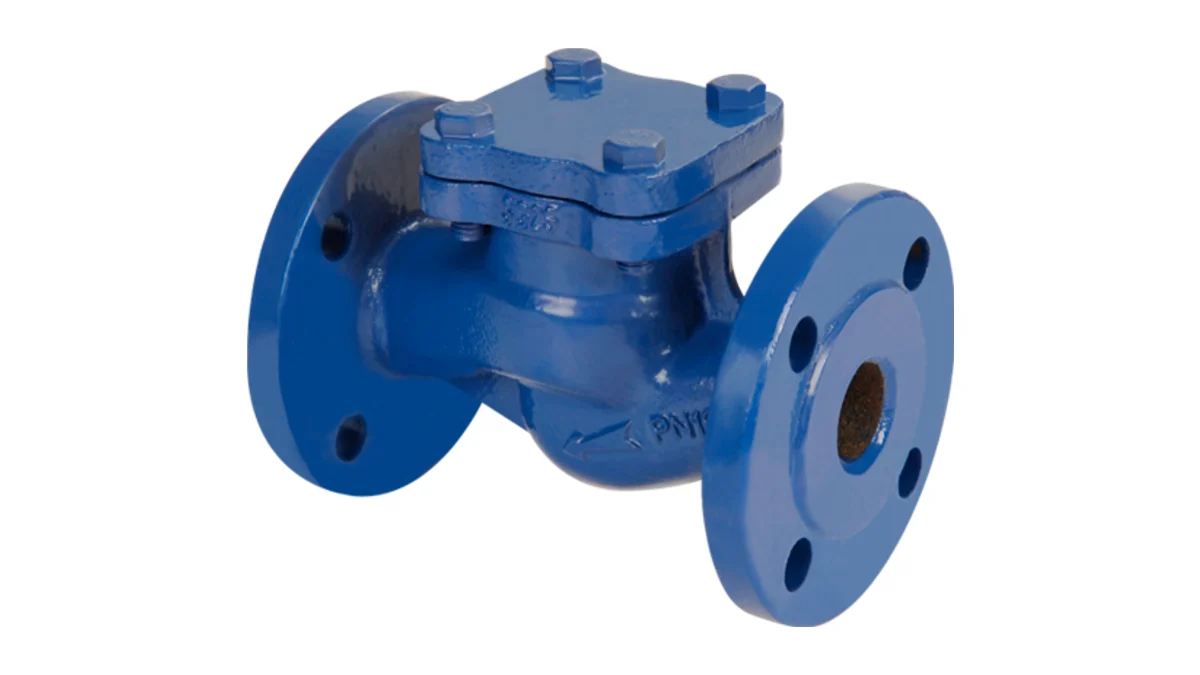
In industrial plants, liquids, gases and steam must travel in the right direction through pipelines for systems to run efficiently and safely. Backflow can spin pumps in reverse, damage equipment and cause contamination or unwanted mixing. A lift check valve is a type of check valve that allows flow in one direction only and prevents backflow with tight shut-off.
This article explains how a lift check valve works, its advantages, what to watch for during installation and where it is used.
What Is a Lift Check Valve?
In a lift check valve, the closing element is a disc or piston. Guided inside the body, the disc moves up and down perpendicular to the seat. Pressure from flow in the correct direction lifts the disc off the seat and opens the valve; when flow stops or reverses, the disc returns to the seat under its own weight and, where fitted, spring force, closing the line.
The body is usually similar to a globe valve: the medium changes direction inside the body as it passes the seat. This gives tight shut-off but a higher pressure loss than swing check valves.
Working Principle
- Forward flow: Fluid pressure lifts the disc and the valve opens.
- Open position: With the disc raised, the medium passes through the seat and continues down the line.
- Flow stops or reverses: The pressure difference holding the disc open disappears; the disc moves towards the seat under its weight and spring force.
- Closed position: The disc seats and backflow is prevented. Reverse pressure presses the disc even more firmly onto the seat.
Advantages of Lift Check Valves
- Fast closing: Thanks to the short disc stroke and, on spring-loaded models, the spring force, the valve closes quickly when flow stops, limiting the build-up of reverse flow velocity and the associated water hammer risk.
- Tight shut-off: The disc seating perpendicular to the seat gives good sealing.
- Backflow protection: Protects pumps, equipment and lines from damage and contamination caused by backflow.
- Wide media compatibility: With suitable materials, usable for water, steam, gas and other media.
- Connection options: Available with flanged, threaded or welded ends.
Installation Points
- Flow direction: The arrow on the valve body must match the flow direction.
- Installation position: Lift check valves without a spring close by disc weight, so they must be installed with the disc moving vertically (usually in a horizontal line with the cover on top). Spring-loaded models can also be used in other positions permitted by the manufacturer.
- Strainer: Particles trapped between disc and seat spoil the seal; fitting a strainer upstream is recommended for dirty media.
- Away from turbulence: Installing directly after turbulence sources such as pump outlets, elbows or valves can make the disc chatter and wear quickly; leave a sufficient straight pipe run where possible.
Applications
- Water and wastewater systems
- Steam and condensate systems
- Heating and cooling systems
- Chemical and petrochemical industry
- Power plants
- Fire protection systems
- Pump discharge lines
Materials and Selection
Lift check valves can be made with body materials such as grey cast iron, ductile iron, cast steel and stainless steel, with stainless steel or bronze discs and stainless steel springs. When selecting one, consider:
- body and trim materials suited to the type, temperature and pressure of the medium,
- the line’s pressure class and connection type (flanged, threaded, welded),
- the installation position (whether a spring-loaded model is needed),
- acceptable pressure loss and the required opening pressure.
Frequently Asked Questions
What is the difference between a lift check valve and a swing check valve?
In a lift check valve the disc moves up and down perpendicular to the seat, giving tight shut-off but higher pressure loss. In a swing check valve the disc pivots on a hinge, giving lower pressure loss.
Can a lift check valve be installed in a vertical line?
Models without a spring close by disc weight and must be installed so that the disc moves vertically. Spring-loaded models can be used in other positions permitted by the manufacturer; always check the installation position in the product catalogue.
Does a lift check valve prevent water hammer?
Its fast closing prevents reverse flow from gaining speed, reducing the risk of water hammer caused by check valve closure. It does not, however, eliminate every cause of water hammer on its own.
Conclusion
With tight shut-off and fast closing, lift check valves provide reliable backflow protection in pipelines. Choosing a model suited to the medium, pressure and installation position ensures long, trouble-free operation. For other check valve types, see our Check Valves page.
Buy lift check valves online
Browse products on or-fa.com, our export store, see prices in USD and order online.
Buy Online →Request a QuoteAsk on WhatsAppRelated product group
Check Valves →Technical support
Talk to our team to choose the right product.
+90 224 444 67 32[email protected]
Related Articles
Let’s choose the right product for your project
Buy from our online store or request a project-specific quotation.