
Lug Type Butterfly Valve: Dead-End Service, Installation and Selection
A lug type butterfly valve is bolted to each flange separately through threaded lugs on its body, so the valve stays in place even when the pipe on one side is removed.
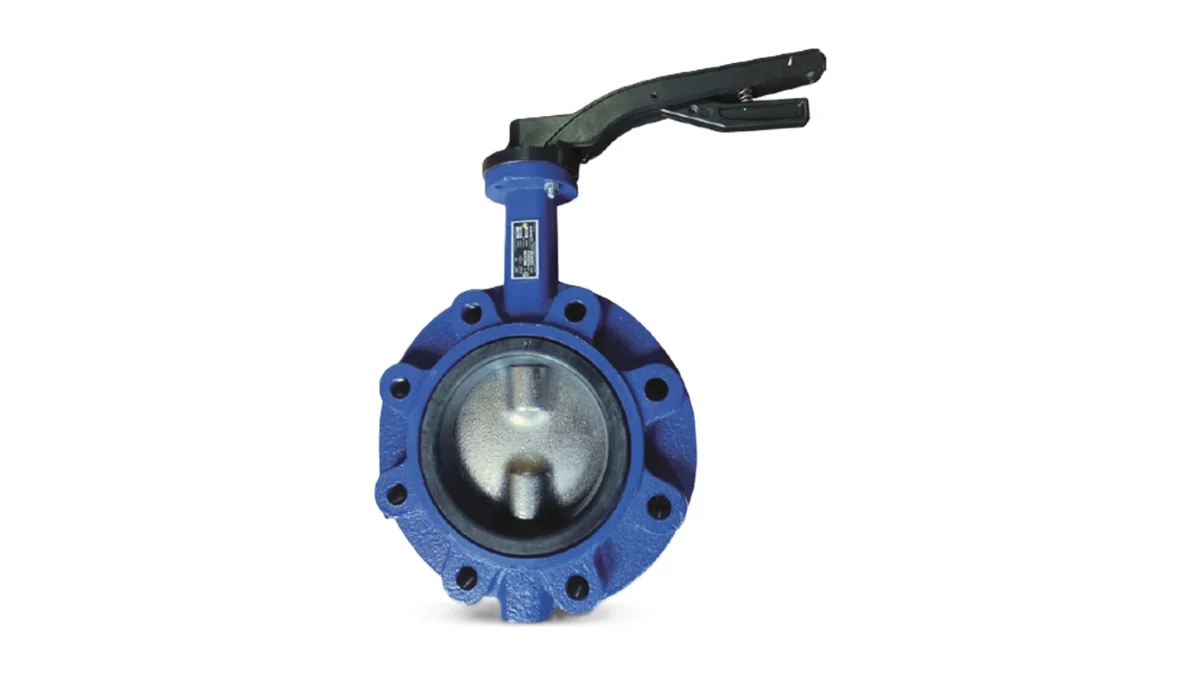
Butterfly valves are compact, quarter-turn valves that control flow with a rotating disc. The lug type butterfly valve is the version with threaded mounting lugs on its body. Because of this, the valve is bolted to each flange separately; when one side of the line is removed, the valve can stay attached to the other flange and serve as an end-of-line valve.
This article covers the design of the lug type butterfly valve, how it differs from the wafer type, installation points and typical applications.
What Is a Lug Type Butterfly Valve?
Around the body of a lug type butterfly valve are threaded lugs matching the flange bolt holes. The flange on each side is fastened into these threaded holes with its own bolts. In a wafer valve, long studs pass between the two flanges and clamp the valve, so removing one flange also releases the valve.
| Feature | Lug type | Wafer type |
|---|---|---|
| Connection | Each flange bolted separately into threaded lugs on the body | Clamped between flanges with through-studs |
| Dead-end service | Suitable (up to the pressure permitted by the manufacturer) | Not suitable |
| Removing one side for maintenance | Valve stays bolted to the other flange | Valve connection is released as well |
| Weight and cost | Heavier and usually more expensive | Lighter and more economical |
Working Principle
Inside the valve is a disc that rotates on a stem. When the stem is turned 90° by a lever, gearbox or actuator, the disc moves parallel to the flow to open the valve, or perpendicular to the flow, seating against the liner to close the line.
Advantages of Lug Type Butterfly Valves
- Dead-end service: The valve can keep the line closed without pipework on the other side.
- Easier maintenance: Equipment or pipe downstream of the valve can be removed without draining the whole line.
- Compact design: The short face-to-face length suits tight spaces.
- Effective flow control: Can be used to start, stop and, where needed, regulate flow.
- Material options: Body, disc and liner materials are available for different media and operating conditions.
- Operator options: Lever, gear operated, single- or double-acting pneumatic actuated, or electric actuated.
Installation Points
- Place the valve between the flanges with the disc slightly open so that the disc and liner are not damaged.
- Tighten the bolts evenly in a crosswise sequence.
- The flange standard and pressure class must be compatible with the valve.
- Check that the disc will not hit the adjacent pipe, flange or equipment when it opens.
Applications
- HVAC systems: Heating, ventilation and air conditioning installations
- Water treatment and distribution systems
- Wastewater treatment plants
- Food and chemical plants: Control of process liquids
- Fire protection systems
- Mining, shipbuilding and drilling facilities
Selection Criteria
- Body, disc and liner materials suited to the medium (for example, EPDM is common for water service and NBR for oily media),
- pressure class and liner temperature limit suited to operating pressure and temperature,
- the manufacturer’s pressure rating for dead-end service, if the valve will be used at a line end,
- operator type according to size, torque and automation needs.
Frequently Asked Questions
Can a lug type butterfly valve be used at the end of a line?
Yes. Because each flange is bolted separately, the valve can keep the line closed without pipework on the other side. However, the permitted pressure in dead-end service may be lower than the nominal rating; check the product catalogue.
How do I choose between lug and wafer types?
Lug type is preferred at line ends, frequently maintained points or where equipment needs to be removed; the lighter, more economical wafer type suits in-line positions with fixed pipework on both sides.
What operator options are available for lug butterfly valves?
Lever, gear operator, single- or double-acting pneumatic actuator and electric actuator.
Conclusion
Lug type butterfly valves combine a compact design with dead-end capability and easier maintenance. Choosing the right materials, pressure class and operator ensures efficient and safe operation. For all butterfly valve options, see our Butterfly Valves page.
Buy lug butterfly valves online
Browse products on or-fa.com, our export store, see prices in USD and order online.
Buy Online →Request a QuoteAsk on WhatsAppRelated product group
Butterfly Valves →Technical support
Talk to our team to choose the right product.
+90 224 444 67 32[email protected]
Related Articles
Let’s choose the right product for your project
Buy from our online store or request a project-specific quotation.