
Packaged Heat Exchanger System: Components, Operation and Applications
Learn how packaged heat exchanger systems produce domestic hot water and heating water from an existing hot water or steam source, and where they are used.
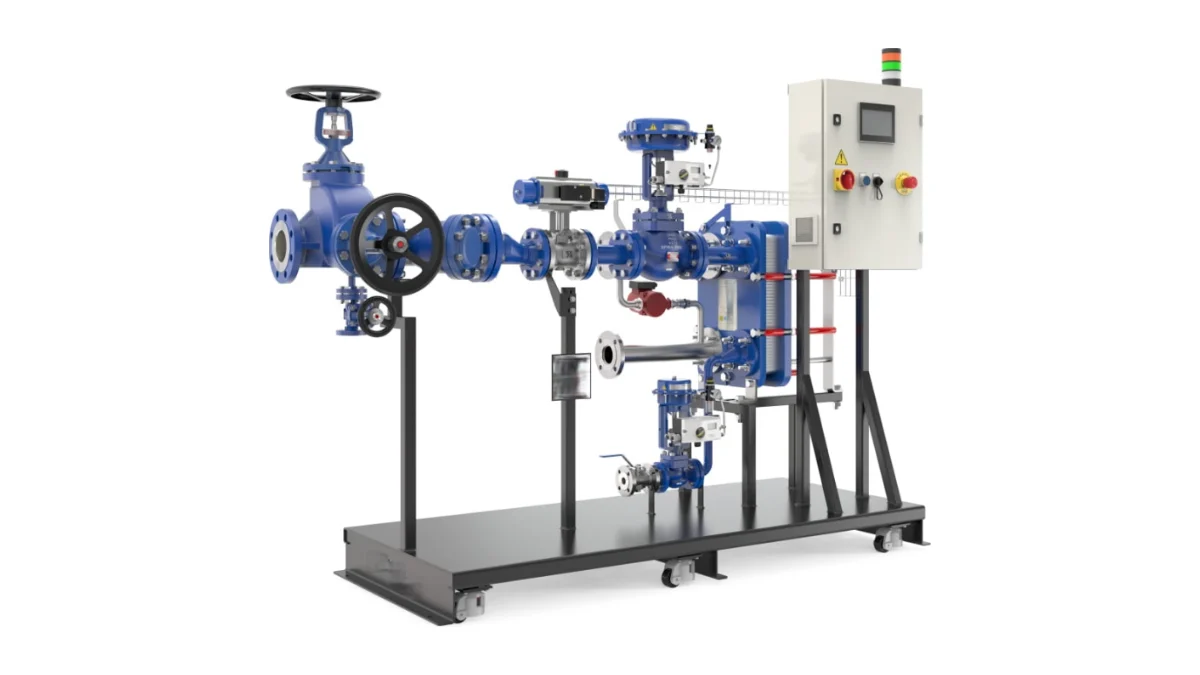
In factories, hotels, hospitals and residential complexes, domestic hot water and space heating are often supplied from an existing boiler, a steam line or a district heating network. The most practical way to transfer that heat safely and under control to a second circuit is a packaged heat exchanger system. Because the heat exchanger, control valve, sensors and controls arrive pre-assembled on a single skid, site work is reduced to a minimum.
This article explains what a packaged heat exchanger system consists of, how it works, its benefits and where it is typically used.
What Is a Packaged Heat Exchanger System?
A packaged heat exchanger system is a ready-made heat transfer station in which all the elements needed to exchange heat between two fluids at different temperatures are factory-assembled into one unit. The heat-supplying side is the primary circuit (hot water, high-temperature water or steam) and the heat-receiving side is the secondary circuit (domestic water, heating water or process water). The two fluids never mix; heat passes only through the plates or tubes.
Plate heat exchangers are the most common choice in packaged units thanks to their compact design and high heat transfer efficiency. Each unit is engineered for the required capacity and the type of primary medium.
Components of a Packaged Heat Exchanger System
Depending on the application, a packaged unit typically includes:
- Heat exchanger: usually a gasketed or brazed plate heat exchanger.
- Control valve and actuator: modulates the primary flow to keep the secondary outlet temperature constant.
- Temperature sensors and control panel: measure the outlet temperature and drive the valve to the set point.
- Circulation pump: provides flow in the secondary circuit (and in the primary circuit where needed).
- Safety and measuring devices: safety valve, pressure gauges and thermometers.
- Piping and fittings: isolation valves, strainers and check valves.
- For steam systems: a steam trap set that discharges condensate from the heat exchanger outlet.
Operating Principle
The hot primary medium flows through one side of the heat exchanger and the secondary water through the other. Heat passes through the plates from the hot fluid to the cold fluid. A sensor at the secondary outlet continuously measures the water temperature; the controller compares it with the set point and opens or closes the primary control valve to adjust the amount of heat entering the exchanger.
As a result, the outlet temperature stays at the required value even when demand changes, and no more energy is used than necessary. When steam is the primary medium, it condenses in the heat exchanger and releases its latent heat; the condensate is discharged through a steam trap.
Benefits of a Packaged Heat Exchanger System
- Fast, simple installation: components are pre-mounted, leaving only the inlet/outlet and electrical connections on site.
- Automatic temperature control: the required temperature is held without operator intervention.
- Energy efficiency: the existing heat source is used only as needed, and the high efficiency of the plate heat exchanger reduces losses.
- Compact design: small footprint and easy integration into existing plant.
- Application-specific design: engineered for capacity, primary medium and temperature regime.
- Circuit separation: primary and secondary circuits are hydraulically separated, so systems with different pressures and water qualities do not affect each other.
Applications
| Application | Typical use |
|---|---|
| Domestic hot water | Instantaneous hot water from boiler water or steam in hotels, hospitals, schools, factories and housing |
| Space heating | Supplying radiator, underfloor heating and fan-coil circuits |
| Process heating and cooling | Supplying fluid at a defined temperature to industrial processes |
| Swimming pool heating | Keeping pool water at the required temperature while separating it from boiler water |
| Waste heat recovery | Recovering heat from process or condensate lines |
Frequently Asked Questions
What is the difference between a packaged system and a stand-alone heat exchanger?
A stand-alone heat exchanger is only the heat transfer element. A packaged system also includes the control valve, sensors, pump, safety devices and control panel in one unit, so it can be commissioned quickly on site.
Can a packaged heat exchanger run on steam?
Yes. The primary medium can be hot water, high-temperature water or steam. In steam systems a steam trap set is added at the heat exchanger outlet to discharge condensate, and the control valve modulates the steam flow.
How is the outlet temperature kept constant?
A sensor at the secondary outlet measures the temperature and the controller modulates the primary control valve to adjust the heat input, so the temperature stays at the set point even as demand varies.
Conclusion
A packaged heat exchanger system is a quick-to-install, automatically controlled and space-saving way to produce domestic hot water, heating water or process water from an existing heat source. Share your operating conditions with the ORFA technical team for correct sizing and component selection, and explore our heat exchangers product group.
Buy heat exchangers online
Browse products on or-fa.com, our export store, see prices in USD and order online.
Buy Online →Request a QuoteAsk on WhatsAppRelated product group
Heat Exchangers →Technical support
Talk to our team to choose the right product.
+90 224 444 67 32[email protected]
Related Articles
Let’s choose the right product for your project
Buy from our online store or request a project-specific quotation.