
What Is a Pressure Transmitter? Working Principle, Types and Selection
Learn how a pressure transmitter works, how it differs from a transducer, the gauge, absolute and differential types, selection criteria and applications.
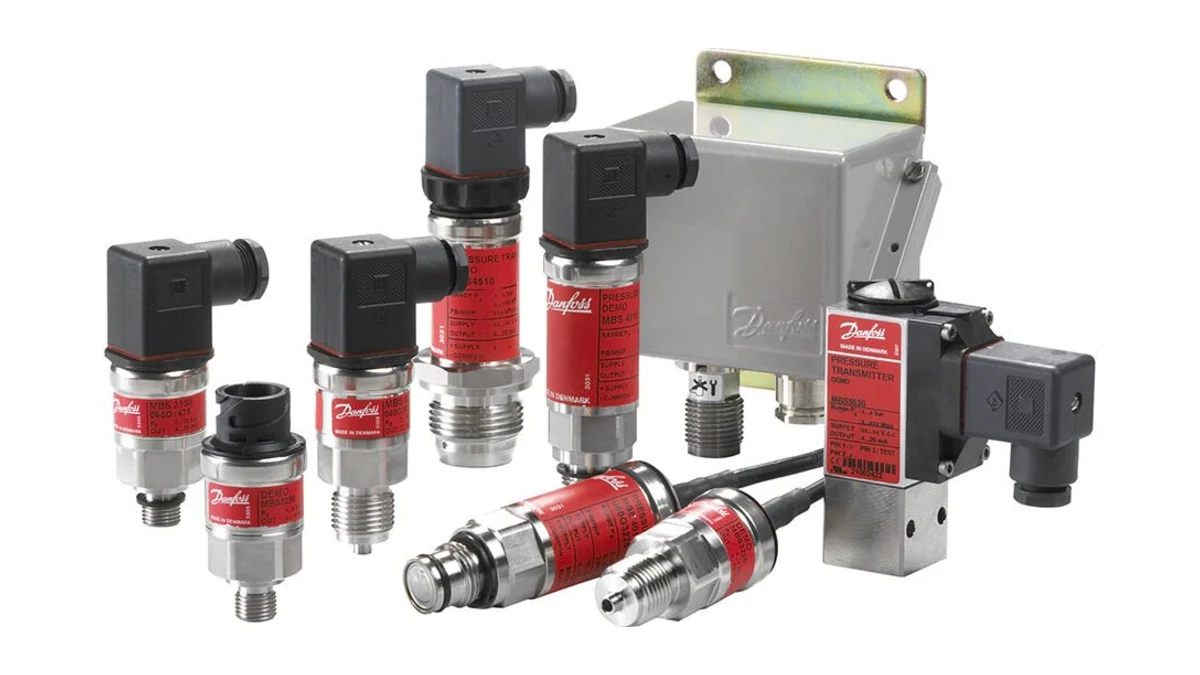
Pressure is a key parameter to be monitored in almost every process, from steam boilers and booster sets to chemical reactors and hydraulic circuits. A pressure transmitter is a process instrument that converts the measured pressure into a standard electrical signal such as 4-20 mA and sends it to a PLC, SCADA system, variable speed drive or display.
This article explains how a pressure transmitter works, how it differs from a transducer, the main types, selection criteria and applications.
What Is a Pressure Transmitter?
A pressure transmitter consists of a sensor that detects pressure, electronics that process the sensor signal and a process connection. The output is linearly proportional to the measuring range. For example, a 0-10 bar transmitter outputs 4 mA at 0 bar and 20 mA at 10 bar. The 4 mA “live zero” allows faults such as a broken cable (0 mA) to be distinguished from a genuine zero pressure.
How Does It Work?
- Process pressure acts on the sensor diaphragm through the process connection.
- The deflection of the diaphragm is converted into an electrical change by a piezoresistive, capacitive, thin-film or ceramic sensor.
- The electronics amplify this weak signal, compensate for temperature effects and convert it into a standard output.
- The output (4-20 mA, 0-10 V, 1-5 V or digital communication such as HART/Modbus) is sent to the control system.
Pressure Transducer vs Pressure Transmitter
A pressure transducer is the sensing element that converts pressure into a low-level electrical signal, typically in the millivolt range. A pressure transmitter processes this signal into a strong, standard signal (especially 4-20 mA) that can be sent over long distances with little noise. Although the terms are sometimes used interchangeably, in industrial automation devices with a standard output are usually called transmitters.
Types of Pressure Transmitters
| Type | What it measures | Typical use |
|---|---|---|
| Gauge pressure | Pressure relative to atmosphere | Pump, booster set, boiler and line pressure |
| Absolute pressure | Pressure relative to full vacuum | Vacuum processes, barometric measurement |
| Differential pressure | Difference between two points | Filter monitoring, orifice flow measurement, closed tank level |
| Hydrostatic level transmitter | Pressure of a liquid column | Open tank, well and reservoir level |
Selection Criteria
- Measuring range: Ideally the normal operating pressure sits around the middle of the range; check the overpressure limit for pressure surges.
- Media compatibility: Diaphragm and wetted part materials (e.g. stainless steel, ceramic) must suit the fluid.
- Process temperature: Use a siphon or cooling element for high-temperature media such as steam.
- Accuracy: The accuracy class and long-term stability required by the application.
- Output signal: Analogue or digital output matching the control system.
- Process connection: Threaded (e.g. G 1/4″, G 1/2″), flanged or hygienic.
- Environment: Ambient temperature, humidity, vibration, IP rating; Ex approval for hazardous areas.
Applications
- Water and wastewater: Pressure control in booster and pump stations, VSD-controlled pump systems
- Energy and steam systems: Boiler and steam line pressure monitoring
- Chemical and petrochemical: Reactor and pipeline pressure control
- Food and beverage: Process pressure measurement with hygienic connections
- HVAC: Pressure monitoring in closed circuits and cooling systems
- Marine and machinery: Hydraulic and lubrication circuits
Frequently Asked Questions
Why is the 4-20 mA output so common?
A current signal is not affected by voltage drop over long cables, is resistant to electrical noise, and the 4 mA live zero makes cable breaks easy to detect.
What is the difference between a pressure transmitter and a pressure switch?
A transmitter provides the continuous pressure value as an analogue or digital signal. A pressure switch only changes a contact at a set pressure.
How is a transmitter installed on a steam line?
To protect the sensor from high temperature, connect the transmitter through a siphon (pigtail) in which condensate collects, together with an isolation valve.
Conclusion
Pressure transmitters are indispensable instruments for safe, efficient monitoring and automatic control of processes. With the right range, materials and connection, they deliver stable and accurate measurement for years. Explore the range on our Pressure Measurement and Control Equipment page.
Buy pressure transmitters online
Browse products on or-fa.com, our export store, see prices in USD and order online.
Buy Online →Request a QuoteAsk on WhatsAppRelated product group
Pressure Measurement and Control Equipment →Technical support
Talk to our team to choose the right product.
+90 224 444 67 32[email protected]
Related Articles
Let’s choose the right product for your project
Buy from our online store or request a project-specific quotation.