
Saturated Steam Table: Pressure, Temperature and Enthalpy Values
Temperature, enthalpy and specific volume of saturated steam from 0 to 45 bar g, with a calculator for intermediate pressures and a steam demand example.
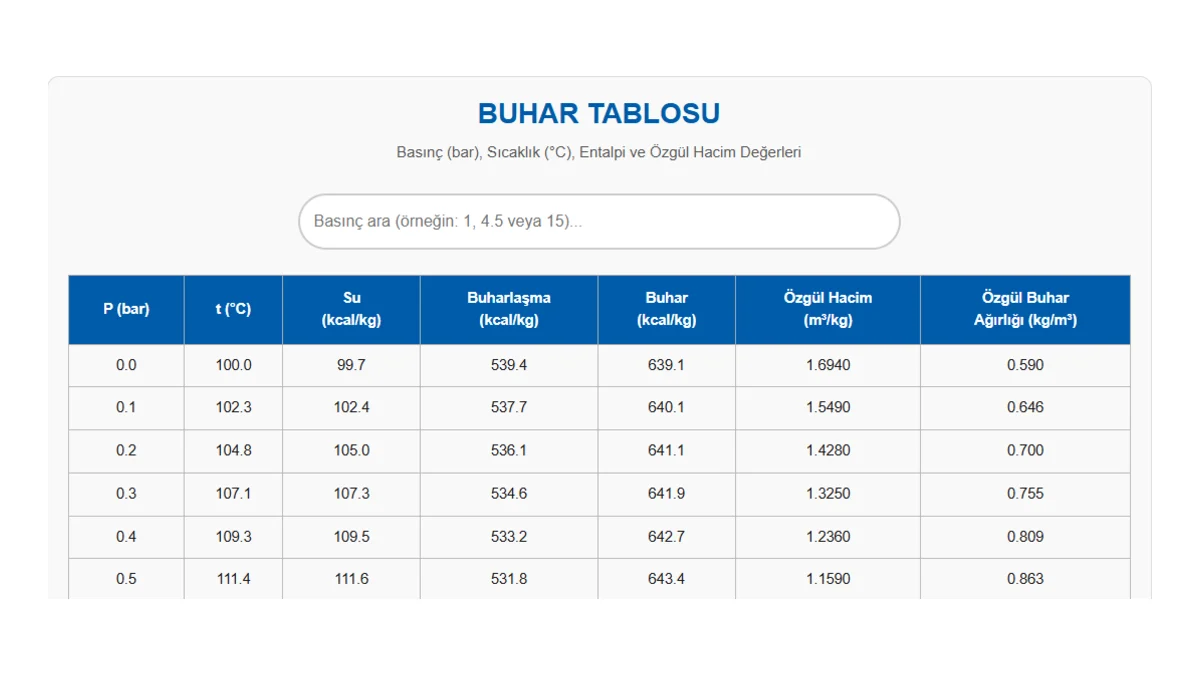
A saturated steam table gives the saturation temperature, enthalpy (heat content) and specific volume of saturated steam at each pressure. It is the first reference used when sizing steam boilers, heat exchangers, steam traps and steam lines.
The table below covers gauge pressures (bar g) from 0 to 45 bar and lists temperature, enthalpy, specific volume and density of saturated steam. With the calculator above the table you can also find approximate values for pressures between the table rows.
How to Read the Steam Table
- P (bar g): Gauge pressure as read on a pressure gauge. 0 bar g corresponds to atmospheric pressure; the table takes absolute pressure as approximately “P + 1 bar”.
- t (°C): Saturation (boiling) temperature at that pressure.
- hf – enthalpy of water: Heat contained in 1 kg of water at saturation temperature (sensible heat).
- hfg – latent heat: Heat required to turn 1 kg of water into steam at the same temperature. This is the main energy steam releases to a heating surface when it condenses.
- hg – enthalpy of steam: hf + hfg; the total heat content of dry saturated steam.
- Specific volume and density: The volume occupied by 1 kg of steam and its inverse; used for pipe sizing and steam velocity calculations.
Example: Steam Consumption of a Heater
Consider a heat exchanger with a 500 kW heat load supplied with saturated steam at 10 bar g. The table gives a saturation temperature of 184.1 °C and a latent heat of 477.4 kcal/kg (about 1999 kJ/kg). If condensate leaves at saturation temperature, steam consumption is approximately:
ṁ = 500 kW × 3600 / 1999 kJ/kg ≈ 900 kg/h
The same table shows that 1 kg of steam at 10 bar g occupies 0.1774 m³, a value used to size the steam main. Choosing a steam trap that matches the calculated load is also based on these data.
Saturated Steam Table (0–45 bar g)
Steam Table Calculator
Values are linearly interpolated between table rows and are approximate. The rows used are highlighted in the table.| P (bar g) | t (°C) | Water hf (kcal/kg) | Evaporation hfg (kcal/kg) | Steam hg (kcal/kg) | Specific volume (m³/kg) | Density (kg/m³) |
|---|---|---|---|---|---|---|
| 0.0 | 100.0 | 99.7 | 539.4 | 639.1 | 1.6940 | 0.590 |
| 0.1 | 102.3 | 102.4 | 537.7 | 640.1 | 1.5490 | 0.646 |
| 0.2 | 104.8 | 105.0 | 536.1 | 641.1 | 1.4280 | 0.700 |
| 0.3 | 107.1 | 107.3 | 534.6 | 641.9 | 1.3250 | 0.755 |
| 0.4 | 109.3 | 109.5 | 533.2 | 642.7 | 1.2360 | 0.809 |
| 0.5 | 111.4 | 111.6 | 531.8 | 643.4 | 1.1590 | 0.863 |
| 0.6 | 113.3 | 113.6 | 530.6 | 644.1 | 1.0910 | 0.917 |
| 0.8 | 116.9 | 117.2 | 528.1 | 645.4 | 0.9772 | 1.023 |
| 1 | 120.2 | 120.6 | 525.9 | 646.5 | 0.8854 | 1.129 |
| 1.2 | 123.3 | 123.7 | 523.9 | 647.5 | 0.8098 | 1.235 |
| 1.4 | 126.1 | 126.5 | 522.0 | 648.5 | 0.7465 | 1.340 |
| 1.5 | 127.4 | 127.9 | 521.0 | 648.9 | 0.7184 | 1.392 |
| 1.6 | 128.7 | 129.2 | 520.1 | 649.3 | 0.6925 | 1.444 |
| 1.8 | 131.2 | 131.7 | 518.4 | 650.2 | 0.6460 | 1.548 |
| 2 | 133.5 | 134.1 | 516.8 | 650.9 | 0.6056 | 1.651 |
| 2.2 | 135.8 | 136.4 | 515.2 | 651.6 | 0.5700 | 1.754 |
| 2.4 | 137.9 | 138.5 | 513.7 | 652.3 | 0.5385 | 1.857 |
| 2.6 | 139.9 | 140.6 | 512.3 | 652.9 | 0.5103 | 1.960 |
| 2.8 | 141.8 | 142.6 | 510.9 | 653.5 | 0.4851 | 2.061 |
| 3 | 143.6 | 144.5 | 509.6 | 654.0 | 0.4622 | 2.164 |
| 3.5 | 147.9 | 148.9 | 506.4 | 655.2 | 0.4132 | 2.420 |
| 4 | 151.8 | 152.9 | 503.4 | 656.4 | 0.3747 | 2.669 |
| 4.5 | 155.5 | 156.7 | 500.7 | 657.4 | 0.3425 | 2.920 |
| 5 | 158.8 | 160.2 | 498.1 | 658.2 | 0.3155 | 3.170 |
| 5.5 | 162.0 | 163.4 | 495.6 | 659.1 | 0.2925 | 3.419 |
| 6 | 165.0 | 166.5 | 493.3 | 659.8 | 0.2727 | 3.667 |
| 6.5 | 167.8 | 169.4 | 491.0 | 660.5 | 0.2552 | 3.918 |
| 7 | 170.4 | 172.2 | 488.9 | 661.1 | 0.2403 | 4.161 |
| 7.5 | 172.9 | 174.9 | 486.8 | 661.7 | 0.2268 | 4.409 |
| 8 | 175.4 | 177.4 | 484.8 | 662.2 | 0.2148 | 4.655 |
| 8.5 | 177.7 | 179.8 | 482.8 | 662.6 | 0.2040 | 4.902 |
| 9 | 179.9 | 182.2 | 481.0 | 663.2 | 0.1943 | 5.147 |
| 10 | 184.1 | 186.6 | 477.4 | 664.0 | 0.1774 | 5.637 |
| 11 | 188.0 | 190.7 | 474.0 | 664.8 | 0.1632 | 6.127 |
| 12 | 191.6 | 194.6 | 470.8 | 665.4 | 0.1511 | 6.618 |
| 13 | 195.0 | 198.3 | 467.7 | 666.0 | 0.1407 | 7.107 |
| 14 | 198.3 | 201.8 | 464.7 | 666.5 | 0.1317 | 7.593 |
| 15 | 201.4 | 205.1 | 461.8 | 666.9 | 0.1237 | 8.084 |
| 16 | 204.3 | 208.3 | 459.0 | 667.3 | 0.1166 | 8.576 |
| 17 | 207.1 | 211.3 | 456.4 | 667.7 | 0.1103 | 9.066 |
| 18 | 209.8 | 214.2 | 453.7 | 668.0 | 0.1047 | 9.551 |
| 19 | 212.4 | 217.1 | 451.2 | 668.2 | 0.0995 | 10.050 |
| 20 | 214.9 | 219.8 | 448.7 | 668.5 | 0.0949 | 10.539 |
| 21 | 217.2 | 222.4 | 446.3 | 668.7 | 0.0907 | 11.031 |
| 22 | 219.6 | 224.9 | 443.9 | 668.8 | 0.0868 | 11.525 |
| 23 | 221.8 | 227.4 | 441.6 | 669.0 | 0.0832 | 12.019 |
| 24 | 223.9 | 229.8 | 439.3 | 669.1 | 0.0799 | 12.514 |
| 25 | 226.0 | 232.1 | 437.1 | 669.2 | 0.0769 | 13.011 |
| 26 | 228.1 | 234.4 | 434.9 | 669.3 | 0.0740 | 13.510 |
| 27 | 230.1 | 236.6 | 432.8 | 669.4 | 0.0714 | 14.008 |
| 28 | 232.0 | 238.8 | 430.6 | 669.4 | 0.0689 | 14.507 |
| 29 | 233.8 | 240.9 | 428.5 | 669.4 | 0.0666 | 15.008 |
| 31 | 237.5 | 245.0 | 424.5 | 669.4 | 0.0624 | 16.015 |
| 33 | 240.9 | 248.9 | 420.5 | 669.4 | 0.0587 | 17.027 |
| 35 | 244.2 | 252.7 | 416.7 | 669.3 | 0.0554 | 18.051 |
| 37 | 247.3 | 256.3 | 412.9 | 669.2 | 0.0524 | 19.084 |
| 39 | 250.3 | 259.8 | 409.2 | 669.0 | 0.0497 | 20.121 |
| 41 | 253.2 | 263.2 | 405.6 | 668.8 | 0.0473 | 21.142 |
| 43 | 256.1 | 266.5 | 402.2 | 668.5 | 0.0451 | 22.183 |
| 45 | 258.8 | 269.7 | 398.8 | 668.2 | 0.0430 | 23.234 |
Values are taken from standard saturated steam tables; enthalpies are in kcal/kg (1 kcal/kg = 4.1868 kJ/kg).
Frequently Asked Questions
What is the difference between bar g and bar a?
Bar g is gauge pressure, read on a pressure gauge with atmospheric pressure taken as zero. Bar a is absolute pressure, approximately gauge pressure plus 1 bar. The pressures in this table are gauge pressures.
Which enthalpy should be used in heating calculations?
If steam condenses and the condensate is discharged at saturation temperature, the energy given to the heating surface is the latent heat (hfg). If the condensate is subcooled further, the sensible heat released by the water can be added.
Can this table be used for superheated steam?
No. This table is for saturated steam only. For steam heated above its saturation temperature, use a superheated steam table.
How accurate is the calculator?
The calculator interpolates linearly between two neighbouring rows. Because the table steps are small, the results are adequate for practical plant calculations; precise thermodynamic work should use IAPWS-IF97 based data.
Conclusion
The steam table is the basis for calculating steam consumption, pipe sizes, condensate loads and steam trap selection. Reading saturation temperature and latent heat correctly – and knowing whether a pressure is gauge or absolute – is the first step towards an efficient and safe steam system. Explore suitable products for your steam lines in our steam traps product group.
Buy steam traps online
Browse products on or-fa.com, our export store, see prices in USD and order online.
Buy Online →Request a QuoteAsk on WhatsAppRelated product group
Steam Traps →Technical support
Talk to our team to choose the right product.
+90 224 444 67 32[email protected]
Related Articles
Let’s choose the right product for your project
Buy from our online store or request a project-specific quotation.