
Single-Acting Pneumatic Actuator: Spring-Return Valve Automation
A single-acting pneumatic actuator drives the valve with air and returns it with springs. Get to know the actuator that brings the valve to a safe position on air failure.
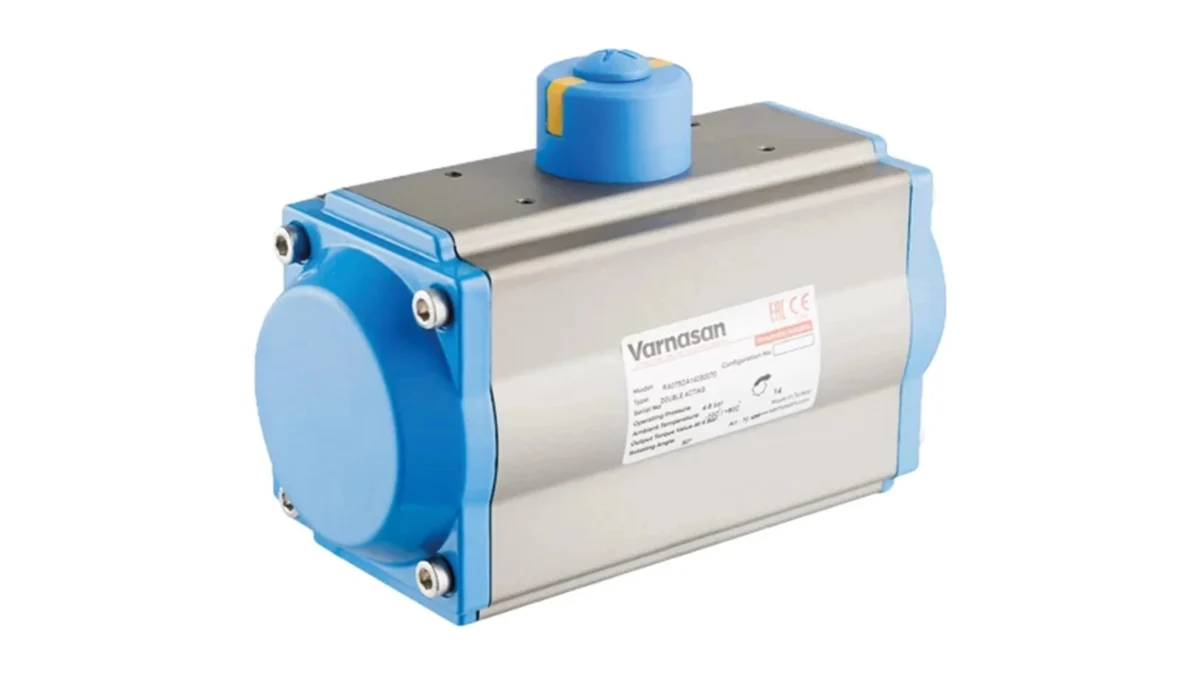
In automated valve and damper control, it is often vital that the system moves to a safe position if power is lost. A single-acting pneumatic actuator meets this need by driving the valve with compressed air and returning it with spring force. Its simple design and reliable operation make it a popular choice across many industries.
This article explains how single-acting pneumatic actuators work, their advantages, technical features and typical applications.
What Is a Single-Acting Pneumatic Actuator?
A single-acting pneumatic actuator uses compressed air for only one direction of travel, while spring cartridges inside the body provide the return stroke. This is why it is also known as a spring-return actuator. A rack and pinion mechanism converts the linear movement of the pistons into a 90° rotation of the shaft.
How Does It Work?
- Air supplied: Compressed air pushes the pistons, compressing the springs, and the valve turns through 90° (for example, it opens).
- Air removed: The compressed springs push the pistons back and the valve returns to its starting position (for example, closed).
Depending on how it is mounted, the actuator can be used as normally closed (closes the valve on air loss) or normally open (opens the valve on air loss). Air is usually directed by a 3/2-way solenoid valve.
Advantages
- Fail-safe position: On loss of air or power, the springs return the valve to a predefined safe position without any additional energy source.
- Simple, reliable design: Easy to maintain and repair, durable and dependable over a long service life.
- Lower air consumption: Compressed air is used for only one direction of travel.
- Wide range of uses: Used in many fields, particularly the water, gas, oil and chemical industries.
Because of the spring pack, single-acting actuators are generally larger than double-acting models of the same torque. Where no fail-safe position is required, a double-acting actuator can be a more compact and economical solution.
Technical Features
| Feature | Value |
|---|---|
| Body material | Extruded aluminium |
| Piston material | Cast aluminium |
| Shaft material | Electroless nickel-plated carbon steel (stainless steel optional) |
| Operating medium | Air or non-corrosive gases |
| Supply pressure | Up to 8 bar. The minimum operating pressure depends on the spring set: sets with fewer springs work from about 2.5–3 bar, full spring sets need 5.5–6 bar. |
| Output torque | Depends on model, spring set and air pressure; sizing is done with the manufacturer’s torque table |
| Temperature range | Typically -20 °C to +80 °C for standard models; high- and low-temperature versions are available |
| Travel adjustment | A few degrees at the end positions (typically ±5°; depends on model) |
| Valve mounting | ISO 5211 |
Applications
- Butterfly valves: In irrigation, HVAC and industrial installations.
- Ball valves: For reliable control in high-pressure and high-temperature lines.
- Dampers: For flow control in air and gas ducts.
- Safety-critical lines: Where flow must be shut off or opened automatically on loss of power.
Frequently Asked Questions
What happens if the air supply to a single-acting actuator fails?
The compressed springs push the pistons back and the valve returns to its predefined safe position: closed on normally closed models, open on normally open models.
What is the difference between normally closed and normally open actuators?
A normally closed actuator closes the valve when air is lost, while a normally open actuator opens it. The choice depends on the safe position of the process.
Which solenoid valve is used with a single-acting actuator?
Single-acting actuators usually use a 3/2-way solenoid valve that pressurises and exhausts the single air port.
Conclusion
With their simple design, reliable operation and, above all, their ability to bring the valve to a safe position on air failure, single-acting pneumatic actuators are an essential part of industrial automation. Correct torque and spring selection ensures safe, long-lasting operation. To explore the models, visit our Pneumatic Actuators product group.
Buy pneumatic actuators online
Browse products on or-fa.com, our export store, see prices in USD and order online.
Buy Online →Request a QuoteAsk on WhatsAppRelated product group
Pneumatic Actuators →Technical support
Talk to our team to choose the right product.
+90 224 444 67 32[email protected]
Related Articles
Let’s choose the right product for your project
Buy from our online store or request a project-specific quotation.