
What Is a Solenoid Valve? Working Principle, Types and Applications
Learn how solenoid valves open and close fluid flow on an electrical signal, plus their port and position types, selection criteria and typical applications.
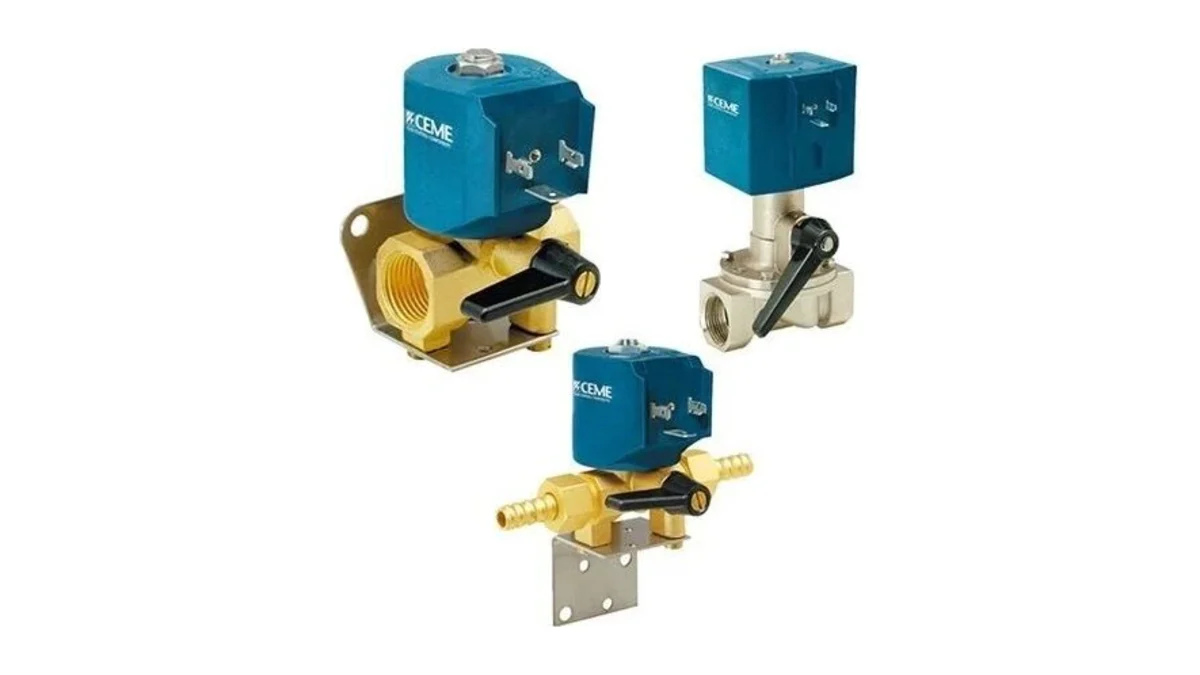
Industrial automation depends on liquids, gases and air being switched on and off quickly, remotely and repeatably. One of the most common components for this job is the solenoid valve. Operated by an electrical signal, solenoid valves form the basis of fluid control in applications ranging from water treatment and HVAC systems to compressed air lines and process machinery.
This article explains what a solenoid valve is, how it works, the main port and position types, what to consider when selecting one and where it is typically used.
What Is a Solenoid Valve?
A solenoid valve is an electromechanical valve actuated by an electromagnetic coil that opens, closes or diverts the flow of a fluid. When the coil is energised, the magnetic field moves an iron core (plunger) inside the valve, and this movement opens or closes the valve orifice. The valve can therefore be controlled directly by a thermostat, pressure switch, timer relay or PLC.
How Does a Solenoid Valve Work?
The main parts of a solenoid valve are the coil, the movable core (plunger), a spring, a sealing element (seal or diaphragm) and the body. The operating sequence is:
- Coil energised: Current flows through the coil and creates a magnetic field.
- Core moves: The magnetic field overcomes the spring force and pulls the core.
- Valve changes position: The core movement opens the orifice (NC type) or closes it (NO type).
- Coil de-energised: The spring pushes the core back and the valve returns to its normal position.
Direct-Acting and Pilot-Operated (Servo) Valves
- Direct-acting solenoid valves: The core opens and closes the orifice directly. They can operate at zero pressure differential and are generally used for small sizes and low flow rates.
- Pilot-operated (servo) solenoid valves: The coil only opens a small pilot orifice; the main diaphragm or piston is moved by the line pressure differential. This allows a small coil to control large line sizes. These valves require the minimum pressure differential specified by the manufacturer to operate correctly.
Types of Solenoid Valves
Solenoid valves are classified by the number of ports, their de-energised position, operating method and body material. In designations such as “2/2” or “3/2”, the first number is the number of ports and the second is the number of switching positions.
| Type | Design | Typical use |
|---|---|---|
| 2/2-way | One inlet, one outlet; on/off duty | Opening and shutting off water, air, gas and fuel lines |
| 3/2-way | Three ports; diverts flow between two lines or exhausts | Control of single-acting pneumatic cylinders and actuators, diverting |
| 5/2 and 5/3-way | Five ports; alternately supplies two outlets | Control of double-acting pneumatic cylinders and actuators |
Normally Closed (NC) and Normally Open (NO)
- Normally closed (NC): The valve is closed when the coil is de-energised and opens when energised. Because it shuts off flow automatically on power failure, it is preferred in safety-related applications.
- Normally open (NO): The valve is open when de-energised and closes when energised. It is used in circuits where flow must continue most of the time and should not be interrupted by a power failure.
Advantages of Solenoid Valves
- Fast response: They open and close quickly, giving precise control in time-critical operations.
- Easy automation: Being electrically operated, they connect directly to PLCs, thermostats and other control devices.
- Compact design: Their small size makes them easy to fit into machines and panels.
- Reliability: Correctly selected and used with clean media, they provide long, trouble-free service.
- Remote control: They allow on/off control without manual intervention.
Selection Criteria
- Medium: Water, air, steam, fuel or gas each require suitable body and seal materials. Steam and fuel applications, for example, need valves specifically designed for those media.
- Operating pressure and pressure differential: Check the maximum operating pressure and, for pilot-operated types, the minimum required pressure differential.
- Temperature: Medium and ambient temperatures must be within the limits of the seal material.
- Connection size and flow: Choose a valve that matches the pipe size and the required flow rate.
- Coil voltage and protection rating: Select a coil that matches the available supply (AC/DC) and the ambient conditions.
- De-energised position: Choose NC or NO depending on whether flow should stop or continue during a power failure.
Applications
- Industrial automation and process machinery
- Water treatment and irrigation systems
- Heating, ventilation and air conditioning (HVAC)
- Compressed air and pneumatic circuits
- Food processing and beverage filling plants
- Burner and fuel lines (with valves suitable for the medium)
- Medical and laboratory equipment
Frequently Asked Questions
Does a solenoid valve close when power is lost?
It depends on the type. Normally closed (NC) valves close when de-energised, while normally open (NO) valves move to the open position.
Why does a pilot-operated solenoid valve not open at low pressure?
Pilot-operated (servo) valves use the line pressure differential to move the main diaphragm. If the differential is below the manufacturer’s minimum, the valve may not open fully; in that case a direct-acting valve should be used.
What do 2/2 and 3/2 mean on a solenoid valve?
The first number is the number of ports and the second is the number of switching positions. A 2/2 valve is a simple on/off valve; a 3/2 valve can divert flow or exhaust a line.
Conclusion
Solenoid valves are key components that make fluid control fast, reliable and easy to automate. Choosing the right number of ports, de-energised position, operating principle and materials ensures long and trouble-free service. You can explore the range offered by ORFA in our solenoid valves product group and contact our technical team for help selecting the right valve for your application.
Buy solenoid valves online
Browse products on or-fa.com, our export store, see prices in USD and order online.
Buy Online →Request a QuoteAsk on WhatsAppRelated product group
Solenoid Valves →Technical support
Talk to our team to choose the right product.
+90 224 444 67 32[email protected]
Related Articles
Let’s choose the right product for your project
Buy from our online store or request a project-specific quotation.