
Stainless Steel Vertical Level Switch: Compact Solution for Small Tanks
Learn how compact stainless steel float switches with reed contacts, mounted vertically from the top or bottom of a tank, work and what their key specifications are.
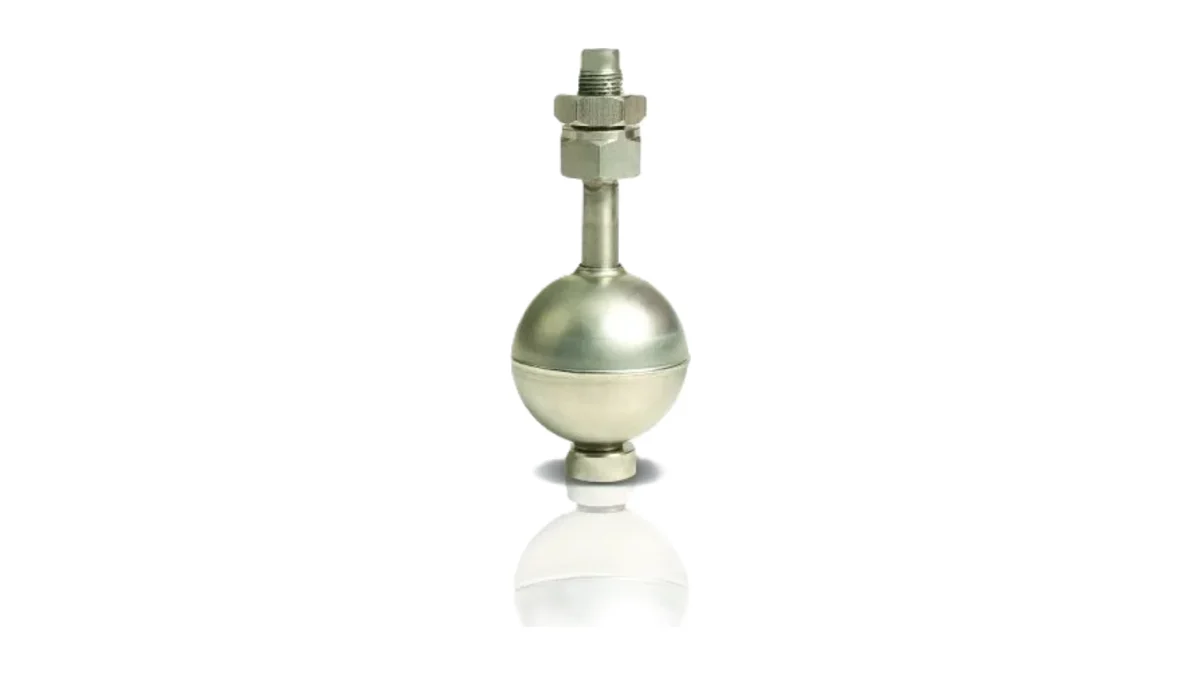
Reliable liquid level control in tanks ensures that pumps, valves and alarms switch at the right moment. Small tanks and tight spaces in particular call for a compact solution. A stainless steel vertical level switch is a robust float switch with a reed contact, mounted vertically from the top or bottom of the tank.
What Is a Stainless Steel Vertical Level Switch?
The switch consists of a stainless steel stem and a float with a built-in magnet that moves freely along it. A reed switch, completely sealed from the process, sits inside the stem. The float follows the liquid level up and down the stem and actuates the reed switch at the set point.
Working Principle
- Float movement: Buoyancy keeps the float on the liquid surface.
- Magnetic actuation: When the magnet in the float reaches the reed switch inside the stem, it pulls the contacts.
- Contact change: A normally open (NO) contact closes or a normally closed (NC) contact opens.
- Control: The signal is used by a pump, solenoid valve, alarm or control panel.
Because there is no physical contact between the reed switch and the liquid, the contacts are not affected by the medium or moisture.
Advantages
- Compact design: Suitable for small tanks and limited installation space.
- Durability: Corrosion-resistant stainless steel; AISI 316 or PTFE-coated versions for aggressive liquids.
- Flexible contact choice: NO or NC; on some models the function can be reversed by turning the float over.
- Easy installation: Threaded connection for mounting through the tank roof or bottom.
Applications
- Shipbuilding; sewage and bilge tanks
- Waste water and fresh water tanks
- Food industry
- Fuel tanks
- Acid, chemical and petrochemical tanks (with suitable materials)
Technical Data
| Feature | Value |
|---|---|
| Body and float | AISI 304 (optional AISI 316, PTFE-coated) |
| Operating temperature | -10 / +125 °C |
| Max. operating pressure | 16 bar |
| Connection | BSP or NPT thread (min. 3/8″) |
| Min. liquid density | 0.8 g/cm³ |
| Contact type | NO / NC |
| Max. switching voltage | 400 V AC/DC |
| Max. switching power / current | 60 VA / 1 A |
| Protection class | IP68 (optional Ex-proof) |
None of the voltage, current and power limits may be exceeded; for example, at 230 V AC the 60 VA limit allows about 0.26 A.
Frequently Asked Questions
What liquid density does a vertical level switch need?
With the standard float it works in liquids with a density of at least 0.8 g/cm³. Lighter liquids require a separate float selection.
What is the difference between vertical and horizontal level switches?
A vertical switch is mounted from the top or bottom of the tank and the float moves along the stem. A horizontal switch is mounted through the side wall and is chosen when the tank roof is not accessible.
Can a pump be connected directly to the reed contact?
Not recommended. Reed contacts are low-power (60 VA); pumps and contactors should be switched via an interposing relay.
Conclusion
Stainless steel vertical level switches provide compact, sealed and long-lasting level control in small and medium tanks. With the right material, contact type and load connection, they operate trouble-free for years. For other solutions, see our level control devices page.
Buy stainless steel level switches online
Browse products on or-fa.com, our export store, see prices in USD and order online.
Buy Online →Request a QuoteAsk on WhatsAppRelated product group
Level Control Devices →Technical support
Talk to our team to choose the right product.
+90 224 444 67 32[email protected]
Related Articles
Let’s choose the right product for your project
Buy from our online store or request a project-specific quotation.