
Stainless Steel Y-Strainer: Design, Selection and Maintenance
Learn the function, technical data, applications, correct installation position and maintenance of stainless steel Y-type strainers.
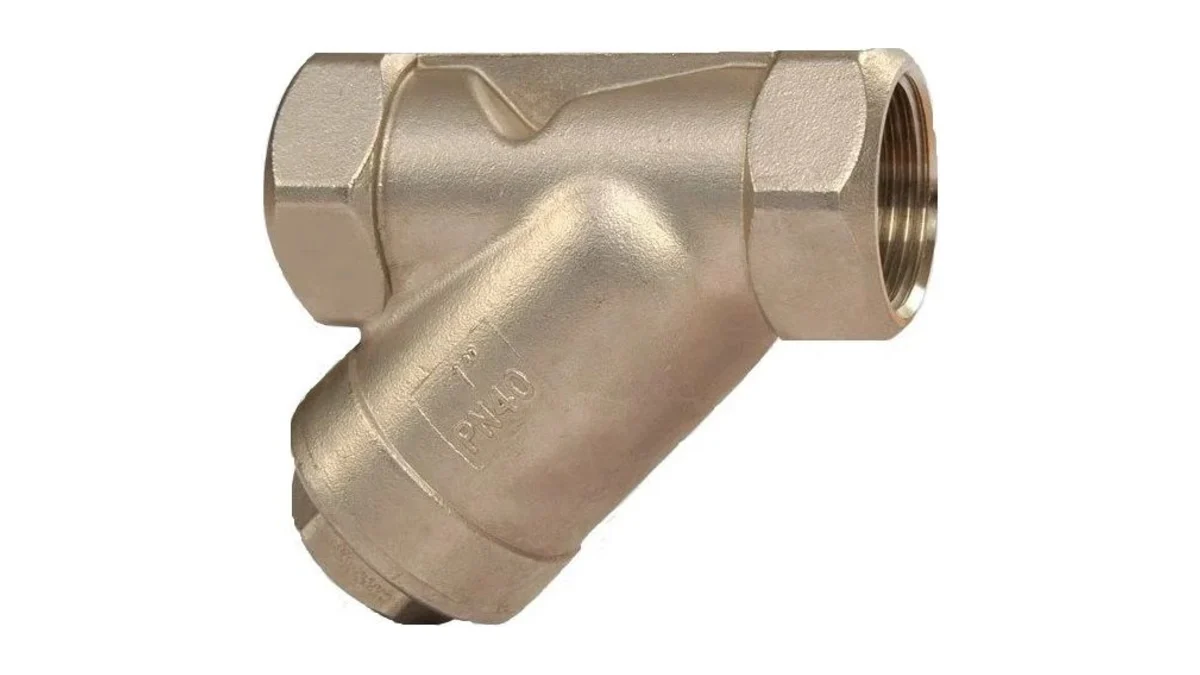
Fluids carried in pipelines may contain solid particles such as welding slag, rust, sand and sediment. These particles damage pumps, meters, control valves, steam traps and pressure reducers and cause blockages and loss of tightness. A stainless steel Y-strainer is a Y-type strainer with a stainless steel body and screen, installed in the line to retain these particles on the screen.
A stainless steel body offers higher corrosion resistance than brass or cast iron strainers, so it is preferred for corrosive fluids, hygienic lines and outdoor installations.
How Does a Y-Strainer Work?
After entering the body, the fluid passes through a cylindrical screen in the Y-shaped pocket. Solid particles stay inside the screen while the cleaned fluid flows to the outlet. The screen is removed through the bottom cap (plug), cleaned and refitted without removing the strainer from the line. Before cleaning, the line must always be depressurised and isolated with suitable shut-off valves.
Technical Data
Example values from the threaded stainless steel strainers supplied by ORFA:
| Feature | Ayvaz YS-800 | Imported AISI 304 model |
|---|---|---|
| Body | AISI 304 / AISI 316 | AISI 304 |
| Screen | Stainless steel | Stainless steel mesh, 500 µm |
| Nominal size | DN15 – DN50 (1/2″ – 2″) | 1/2″ – 3″ |
| Max. pressure | 40 bar | 16 bar |
| Temperature | -25 °C / +180 °C | -20 °C / +180 °C |
| Cap gasket | PTFE | Model-dependent |
Advantages
- Corrosion resistance: Stainless body and screen give long life with a wide range of fluids.
- Equipment protection: Protects downstream pumps, valves and instruments from particles.
- Easy maintenance: The screen can be cleaned without removing the body from the line.
- Compact design: The Y-body takes less space than basket strainers.
- Wide operating range: Up to 40 bar and 180 °C depending on the model.
Applications
- Hot and cold water lines, heating and cooling systems
- Condensate and steam lines
- Compressed air lines
- Oil lines
- Inlets of pumps, control valves and fittings
- Food, chemical, oil and power plants
Installation Rules
- The arrow on the body shows the flow direction; do not install in reverse.
- In liquid lines, install with the screen pocket pointing downwards.
- In steam and gas lines, install with the screen pocket pointing sideways (in the horizontal plane) so that condensate does not collect in the pocket and the risk of water hammer is reduced.
- Place it immediately upstream of the protected equipment and fit isolating valves on both sides for cleaning.
- Select the screen mesh according to the sensitivity of the protected equipment; a very fine screen clogs faster and increases pressure drop.
Maintenance
In newly commissioned systems, check the screen frequently during the first weeks, when installation debris accumulates. After that, the cleaning interval depends on how dirty the fluid is. Pressure gauges upstream and downstream allow the rising pressure difference to be monitored; an increasing difference shows that the screen is filling up.
Frequently Asked Questions
Can a stainless steel Y-strainer be used on steam?
Yes. The Ayvaz YS-800 series, for example, is suitable for steam, water, gas and chemical fluids up to 40 bar and 180 °C. On steam, install it with the screen pocket pointing sideways.
How often should the screen be cleaned?
There is no fixed interval; it depends on how dirty the fluid is. Frequent checks are recommended in the first weeks of a new installation. A rising pressure difference between inlet and outlet shows that cleaning is due.
How do I choose between stainless steel and brass strainers?
Brass-body strainers are an economical choice for general heating and water systems. Stainless steel should be preferred for corrosive fluids, higher temperatures and pressures, hygienic lines or fluids not compatible with copper alloys.
Conclusion
Stainless steel Y-strainers are simple but critical components that protect expensive equipment thanks to their corrosion-resistant design and easy maintenance. With the right screen, correct installation position and regular cleaning they work efficiently for many years. See all models on our Y-Type Strainers page.
Buy threaded Y-type strainers online
Browse products on or-fa.com, our export store, see prices in USD and order online.
Buy Online →Request a QuoteAsk on WhatsAppRelated product group
Y-Type Strainers →Technical support
Talk to our team to choose the right product.
+90 224 444 67 32[email protected]
Related Articles
Let’s choose the right product for your project
Buy from our online store or request a project-specific quotation.