
Air Vents for Steam Systems: What They Are, How They Work and Where to Fit Them
Learn how thermostatic air vents automatically discharge air from steam systems, plus their technical data and the right points to install them.

When a steam installation is started up, its pipework and steam-using equipment are full of air; when the steam supply is shut off, the steam condenses and the resulting vacuum draws air back in. An air vent for steam systems is a thermostatic device that discharges this air automatically, so that steam reaches the heating surfaces quickly and at full temperature.
This article explains why air causes problems in steam systems, how an air vent works, the technical data of the model supplied by ORFA and where the device should be installed.
Why Is Air a Problem in Steam Systems?
- Lower heat transfer: Air is a good insulator. An air film on heating surfaces hinders heat transfer from the steam to the product and lengthens heat-up times.
- Lower steam temperature: In a steam-air mixture the partial pressure of the steam, and therefore its temperature, is lower than that of pure steam at the same total pressure.
- More corrosion: Oxygen and carbon dioxide from the air dissolve in the condensate; when the condensate returns to the boiler these gases accelerate corrosion in pipes, equipment and the boiler.
What Is an Air Vent for Steam Systems?
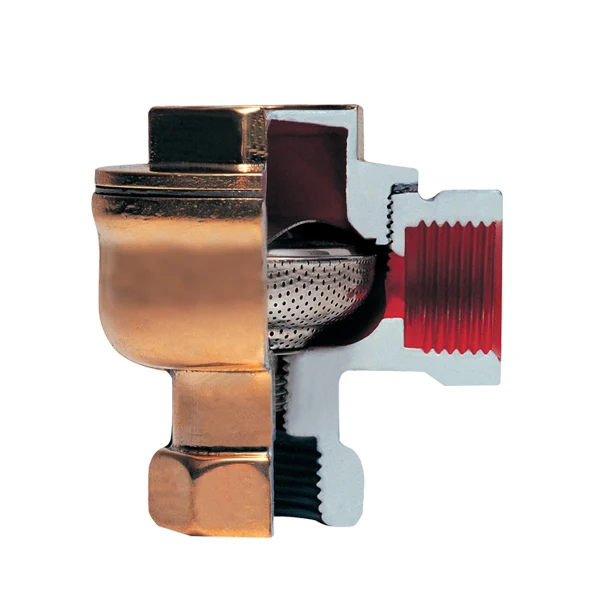
A steam air vent is a valve that automatically discharges air and non-condensable gases from steam lines and steam-using equipment and closes by itself when steam arrives. It removes the need for manual venting and works automatically at every start-up and shutdown.
Operating Principle
Air vents work on the thermostatic principle: the thermostatic element inside expands or contracts according to the temperature of the surrounding fluid.
- Cold start: While the system is cold, the element is contracted and the valve is open.
- Air discharge: As the line fills with steam, the cold air and steam-air mixture pushed ahead of it escape through the open valve.
- Closing: When the mixture approaches steam temperature, the element expands and closes the valve, so no live steam is lost.
- Re-opening: If air collects around the device again and the temperature drops, the element contracts and the valve reopens.
Technical Data
| Feature | Value |
|---|---|
| Body and cover | Brass |
| Internals | AISI 304 stainless steel |
| Connection | Threaded |
| Nominal size | DN15 (1/2″) |
| Maximum pressure | 10 bar |
| Maximum operating temperature | 150 °C |
Applications
- Ends of steam mains and steam headers
- Steam radiators and coils
- Heat exchangers
- Steam irons and low-pressure steam units
Installation Notes
- Right location: Air is pushed ahead of the steam and collects at the end of the line and at the point of equipment furthest from the steam inlet. Fit the air vent there, preferably above the condensate drain point.
- Cooling leg: Connect the vent with a short, uninsulated pipe so the thermostatic element can sense the cooler air.
- Easy maintenance: An isolating valve upstream allows service or replacement without shutting the system down.
- Safe discharge: Direct the outlet so the hot steam-air mixture cannot harm personnel.
Frequently Asked Questions
What is the difference between an air vent and a steam trap?
A steam trap mainly discharges condensate while holding back steam. An air vent is fitted where air collects and its job is to discharge air and non-condensable gases. Thermostatic steam traps can also vent air, but a dedicated air vent at points such as the end of a steam main speeds up start-up.
At what temperature does an air vent close?
The thermostatic element closes when the mixture temperature approaches the saturation temperature of the steam. The exact closing temperature depends on the manufacturer and model.
Why is an air vent needed at all?
Air is heavier than steam and is pushed to the end of the line, where it collects. Without an automatic outlet, heat-up takes longer, heat transfer falls and the risk of corrosion rises.
Conclusion
Air vents for steam systems discharge accumulated air automatically, shortening heat-up times, improving heat transfer and reducing corrosion risk. Brass-bodied models with stainless steel internals are a practical solution, especially for low-pressure steam circuits. Browse all models in our air vents for steam circuits product group, or ask the ORFA technical team for help with selection.
Buy steam air vents online
Browse products on or-fa.com, our export store, see prices in USD and order online.
Buy Online →Request a QuoteAsk on WhatsAppRelated product group
Air Vents for Steam Circuits →Technical support
Talk to our team to choose the right product.
+90 224 444 67 32[email protected]
Related Articles
Let’s choose the right product for your project
Buy from our online store or request a project-specific quotation.