
Steam Header Design: Sizing, Safety and Efficiency
Key design rules for sizing, materials, condensate drainage, connections and insulation of the steam header that distributes steam from the boiler to consumers.
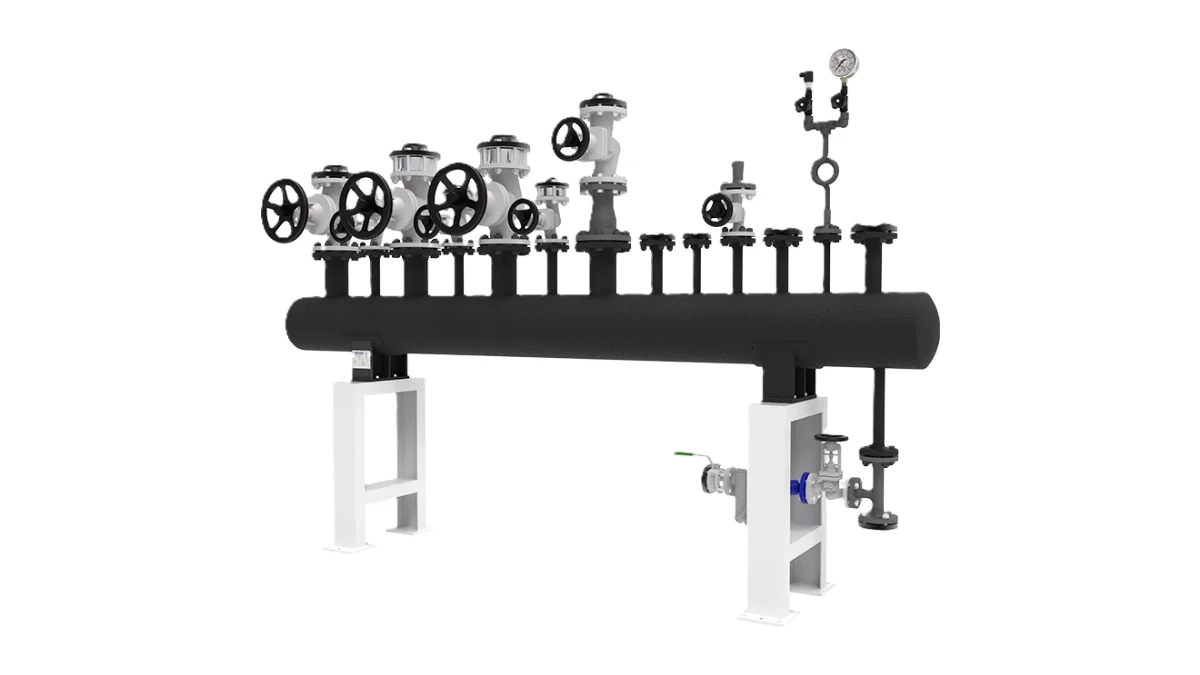
Steam systems are among the most energy-intensive and efficiency-sensitive parts of any plant. Their safety and performance often depend on a component that looks like a simple piece of pipe but is vital: the steam header. Good steam header design ensures that steam from the boiler is collected and distributed evenly to the various consumer lines.
A poorly designed or undersized header leads to pressure fluctuations, wet steam, water hammer and energy losses. This article walks through what an ideal steam header should look like.
1. Correct Sizing
A header does not just collect steam; it also calms the flow and provides stable distribution to consumers. Sizing should therefore be based on engineering calculations using the plant’s total and peak steam flow, operating pressure and number of outlets.
- Undersized header: steam velocity rises, pressure drop increases, condensate droplets are carried along and consumers receive wet steam.
- Oversized header: investment cost, insulation requirement and condensate formation from surface heat loss increase unnecessarily.
2. Materials Suitable for Pressure Equipment
A steam header is pressure equipment operating continuously at high temperature and pressure. Shell, pipe and connection materials should therefore be steels specified for pressure applications with documented elevated-temperature properties; P235GH and P265GH are commonly used carbon steel grades for this purpose. General structural steels should not be used for pressure parts.
- Material certificates: traceability and suitability of materials should be verified by certificates.
- Corrosion control: internal corrosion is mainly prevented by correct boiler feedwater treatment and by draining condensate from the header without delay.
3. Design Details
Condensate drainage
Condensate in a steam line reduces heat transfer, wets the steam and causes dangerous water hammer.
- The header should be installed with a slight fall towards the drain point.
- At the lowest point there should be a condensate collecting pocket of adequate diameter relative to the header.
- The pocket should be drained by a suitable steam trap (usually a trap set with strainer and isolation valves).
Location of connections
- Take outlets from the top: all branch connections to consumers should be taken from the top of the header so that condensate running along the bottom does not enter the branches and consumers receive dry steam.
- Isolation valve on every outlet: each consumer line should have its own valve so that one line can be maintained while the others keep running.
- Safety and measurement: fit a pressure gauge on the header; safety valves should be installed where the system’s overpressure protection design requires them (for example, if the header is downstream of a pressure reducing valve).
- Air venting: an air vent at the end of the header helps remove air during start-up.
Insulation
- Energy saving: the header and its connections should be insulated to an appropriate thickness; bare surfaces cause both heat loss and extra condensate.
- Safety: insulation also prevents burns from hot surfaces.
Frequently Asked Questions
Why are outlets taken from the top of a steam header?
Condensate collects at the bottom of the header by gravity. Taking outlets from the top keeps this condensate out of the consumer lines, delivers dry steam and reduces the risk of water hammer.
Why does a steam header need a steam trap?
If condensate in the header is not drained, it wets the steam, reduces heat transfer and causes water hammer. A steam trap connected to the collecting pocket at the lowest point continuously discharges condensate without losing steam.
How is the header size determined?
By engineering calculation based on the plant’s total and peak steam flow, operating pressure, and the number and size of outlets. The aim is to keep steam velocity low for stable, dry distribution.
Conclusion
A correctly sized steam header made of pressure-rated material, well drained and insulated, is a critical investment for the efficiency and safety of the whole steam system. Get support from the ORFA technical team for the steam traps, valves and distribution equipment your header needs, and explore our steam distribution and condensate collection manifolds product group.
Buy steam traps online
Browse products on or-fa.com, our export store, see prices in USD and order online.
Buy Online →Request a QuoteAsk on WhatsAppRelated product group
Steam Distribution and Condensate Collection Manifolds →Technical support
Talk to our team to choose the right product.
+90 224 444 67 32[email protected]
Related Articles
Let’s choose the right product for your project
Buy from our online store or request a project-specific quotation.