
Threaded Ball Valves: Design, Types and Applications
Learn how threaded, quarter-turn ball valves work, which body materials are available, what their advantages are and where they are used.
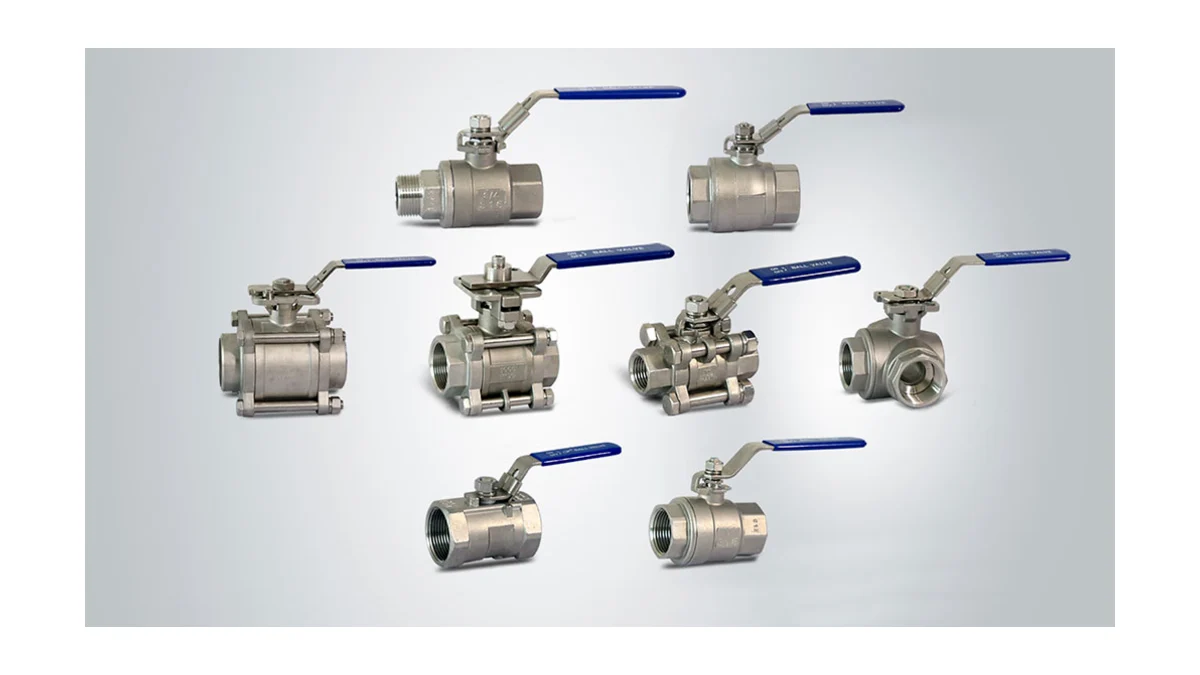
Reliable shut-off of liquid and gas flow is essential for both efficiency and safety in industrial plants. On small and medium-sized pipelines, one of the most practical valves for this job is the threaded ball valve. Its screwed ends connect directly to the pipe, and a quarter turn takes it from fully open to fully closed.
This article explains how threaded ball valves work, which materials they are made of, their advantages and the applications they suit best.
What Is a Threaded Ball Valve?
A threaded ball valve is a quarter-turn (90°) shut-off valve installed with threaded (screwed) end connections. Flow is controlled by a ball with a bore through its centre. When the valve is open, the bore is aligned with the pipe and the medium passes freely. Turning the handle 90° rotates the ball so that the bore sits across the flow path and the ball presses against the seats, shutting off the flow.
Ball valves are primarily on-off valves. Preventing backflow is not their function; where reverse flow must be stopped, a separate check valve is required. Keeping the valve partly open for long periods to throttle flow is also not recommended, as it can erode the seats.
Advantages of Threaded Ball Valves
- Tight shut-off: Contact between the ball and the seats isolates the medium reliably in the closed position.
- Quick, simple installation: Threaded ends connect to the pipe without welding or flanges, which is practical on small-bore lines.
- Easy operation: The quarter-turn mechanism opens or closes the valve in one movement, and the handle position shows the valve status.
- Low pressure drop: In full-bore designs the ball bore is close to the pipe’s inside diameter, so flow resistance is minimal.
- Wide choice of materials: Stainless steel, brass, cast and PVC bodies cover many different media.
- Ready for automation: Models with an actuator mounting pad can be fitted with electric or pneumatic actuators.
Types of Threaded Ball Valves
| Body material | Key feature | Typical use |
|---|---|---|
| Stainless steel | High corrosion resistance | Chemical plants, process and utility lines in food plants, water treatment |
| Brass | Economical and reliable | General water, air and non-aggressive media |
| Cast iron / ductile iron | Robust and economical | General building services and heating lines |
| PVC | Corrosion-resistant, lightweight | Water, compatible chemicals, irrigation |
In addition, actuator-compatible threaded ball valves are designed for remote or automatic on-off duty. Pressure and temperature limits differ by material, so always check the valve marking and catalogue data when selecting.
Applications
- Heating and cooling (HVAC) systems: As isolation and service valves in water circuits.
- Chemical industry: On transfer lines for chemicals compatible with the valve materials.
- Paper and textile industries: On water, dye and process liquid lines.
- Petrochemical and storage facilities: On small-bore auxiliary lines.
- Water treatment plants: On water and treatment chemical dosing and transfer lines.
- Food and beverage industry: Stainless steel models on water and utility lines.
- Agriculture: To open and shut off water in irrigation systems.
Frequently Asked Questions
Can a threaded ball valve be used to regulate flow?
Ball valves are designed for on-off service. Operating them partly open for long periods can wear the seats and impair sealing. For accurate flow regulation, use control valves such as balancing or globe valves.
Does a threaded ball valve prevent backflow?
No. A ball valve only opens or closes the line. Where backflow must be prevented, install a separate check valve.
Which material should I choose?
Brass is an economical choice for general water and air lines. Stainless steel suits corrosive media and hygiene-sensitive environments, while PVC is used in many water and chemical applications. Pressure and temperature limits vary with material, so check the product ratings.
Conclusion
Threaded ball valves offer a reliable, economical and easy-to-use shut-off solution for small and medium-sized lines. Choosing the right valve type and a material suited to the medium and operating conditions keeps the system running trouble-free for years. Explore the material and connection options in our ball valves product group, or ask the ORFA technical team for selection support.
Buy threaded ball valves online
Browse products on or-fa.com, our export store, see prices in USD and order online.
Buy Online →Request a QuoteAsk on WhatsAppRelated product group
Ball Valves →Technical support
Talk to our team to choose the right product.
+90 224 444 67 32[email protected]
Related Articles
Let’s choose the right product for your project
Buy from our online store or request a project-specific quotation.