
Variable Speed Booster Sets: Constant Pressure and Energy Savings
Variable speed booster sets adjust pump speed to the instantaneous water demand, keeping pressure constant and cutting energy use. Learn how they work and what they offer.
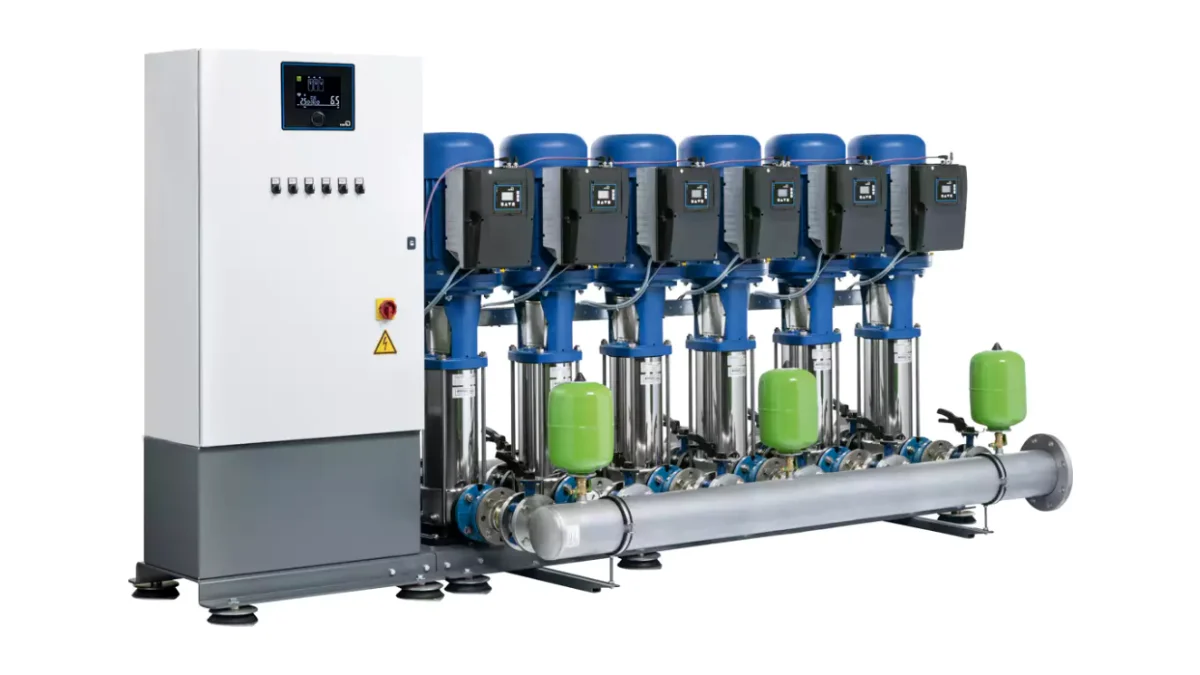
Water consumption in buildings and plants changes constantly during the day: high in the morning and evening, close to zero at night. Fixed-speed booster sets respond to this by switching the pump on and off frequently, resulting in fluctuating pressure and wasted energy. A variable speed booster set, also called a VFD or frequency-controlled booster set, adjusts the motor speed to the instantaneous demand, keeping pressure constant and using only as much energy as needed.
This article covers the design, working principle and benefits of variable speed booster sets and how they compare with fixed-speed systems.
What Is a Variable Speed Booster Set?
A variable speed booster set is a water pressure boosting system consisting of one or more pumps, a frequency converter (drive, inverter) that adjusts pump speed, a pressure sensor (transmitter), a diaphragm pressure tank and a control panel. In multi-pump sets, each pump can have its own drive, or one drive-controlled pump can work in cascade with fixed-speed pumps.
Working Principle
- Pressure measurement: A pressure sensor on the discharge manifold continuously measures system pressure and sends it to the controller.
- Comparison: The controller compares the measured pressure with the set point (PID control).
- Speed adjustment: The frequency converter changes the supply frequency to the motor and thus the pump speed. Speed rises when demand increases and falls when it decreases.
- Constant pressure: Because speed is adjusted continuously, pressure at the taps remains stable regardless of consumption.
- Sleep mode: When consumption stops, the pump shuts down after a set time and restarts when pressure drops.
Where Do the Energy Savings Come From?
According to the affinity laws for centrifugal pumps, flow varies in proportion to speed, head with the square of speed and power approximately with the cube of speed. Reducing speed by 20 percent, for example, theoretically cuts the power requirement roughly in half. Actual savings depend on the static head of the system, the demand profile and pump selection, but they are significant in buildings with variable demand.
Fixed-Speed vs Variable Speed Booster Sets
| Feature | Fixed-speed (pressure switch) | Variable speed |
|---|---|---|
| Pressure | Fluctuates between cut-in and cut-out pressures | Held constant at the set point |
| Energy use | Pump always runs at full speed | Decreases with demand |
| Starting | Direct-on-line start, inrush current and pressure surge | Soft start and soft stop |
| Pressure tank | Larger volume required | A small tank is sufficient |
| Initial cost | Lower | Higher |
Benefits
- Energy savings: The pump only runs at the speed required.
- Constant water pressure: Comfortable use regardless of fluctuations in demand.
- Longer equipment life: Soft starts and stops reduce mechanical stress and water hammer.
- Fewer start/stop cycles: Frequent switching on and off is avoided.
- Low noise: At low demand the pump runs at lower, quieter speed.
- Protection functions: The system is protected against dry running, phase faults and overcurrent.
Control and Monitoring Features
Depending on the model, variable speed booster sets may offer:
- PID pressure control, flow detection and sleep mode
- Phase monitoring and operating hours tracking
- Duty pump alternation in multi-pump sets
- Password-protected menus and a user-friendly display (7 inch on some models)
- Remote monitoring via MODBUS RTU, PLC and HMI integration (on some models)
Applications
- Residential complexes and apartment buildings
- Hotels and hospitals
- Schools and offices
- Shopping centres
- Service and process water boosting in industrial plants
Frequently Asked Questions
How much energy does a variable speed booster set save?
Savings depend on the demand profile and the static head of the installation. Since pump power varies roughly with the cube of speed, savings are significant in buildings with variable demand.
Does a variable speed booster set need a pressure tank?
Yes, but a much smaller tank than in fixed-speed systems is sufficient. It covers small leaks and prevents unnecessary pump starts.
Can an existing fixed-speed booster be converted to variable speed?
If the pump and motor are suitable, it can be converted by adding a drive and a pressure sensor. A specialist should assess whether the motor is suitable for drive operation and how the panel must be modified.
Conclusion
Variable speed booster sets are modern pressure boosting solutions that combine constant pressure, low energy consumption and long equipment life. Choosing the right pumps and control strategy lowers operating costs while improving user comfort. Explore single- and multi-pump options in our Booster Sets and Hydrophores product group.
Buy booster sets online
Browse products on or-fa.com, our export store, see prices in USD and order online.
Buy Online →Request a QuoteAsk on WhatsAppRelated product group
Booster Sets and Hydrophores →Technical support
Talk to our team to choose the right product.
+90 224 444 67 32[email protected]
Related Articles
Let’s choose the right product for your project
Buy from our online store or request a project-specific quotation.