
Vortex Steam Separator: How a Cyclonic Steam Separator Works
Learn how a vortex (cyclonic) steam separator removes water droplets from steam, how it differs from baffle types and how it should be installed.
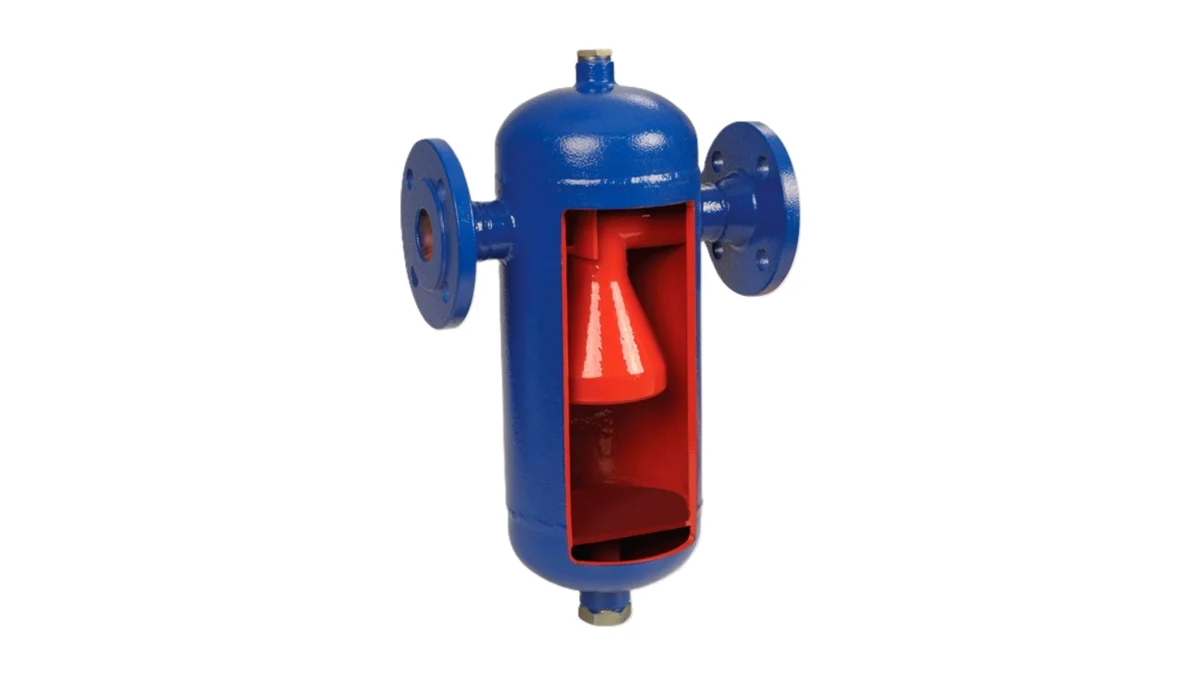
Steam leaving a boiler is rarely completely dry: water droplets carried over from the boiler and condensate formed in the mains travel along with the steam. This wet steam reduces heat transfer, erodes valves and heat exchangers and increases the risk of water hammer. A vortex steam separator is a cyclone-type steam separator that spins the steam flow and removes these droplets by centrifugal force.
This article explains how a vortex (cyclonic) separator works, how it differs from baffle-type designs, how to install it and where it is used.
What Is a Vortex Steam Separator?
A vortex steam separator is a pressure vessel installed in the steam line that makes the flow rotate by means of guide vanes or a tangential inlet. The swirling motion throws water droplets and entrained solids, which are heavier than steam, against the body wall. The water runs down the wall, collects at the bottom and is discharged through a steam trap, while the dried steam leaves through the central outlet.
A separator is not a filter: its main task is to remove water from steam. Although some dirt and scale is removed with the water, a strainer should still be fitted ahead of sensitive equipment.
Working Principle
- Inlet: Wet steam enters the separator.
- Vortex formation: Guide vanes or a tangential inlet give the flow a fast rotating motion.
- Separation: Centrifugal force throws the denser water droplets and particles towards the wall.
- Dry steam outlet: Steam freed of droplets leaves through the central outlet towards the point of use.
- Drainage: Separated condensate collects at the bottom of the body and is removed by a steam trap.
Vortex vs Baffle Separators
| Feature | Vortex (cyclonic) type | Baffle type |
|---|---|---|
| Separation mechanism | Centrifugal force created by the vortex | Flow striking baffles and changing direction |
| Sensitivity to flow velocity | Efficiency falls as velocity drops; correct sizing is important | Maintains efficiency over a wider flow range |
| Typical use | Lines with relatively steady flow | Lines with variable flow |
For baffle types and the general benefits of separators, see our article what is a steam separator.
Advantages
- Better heat transfer: Dry steam does not form a water film on heat transfer surfaces, so heating equipment works more efficiently.
- Equipment protection: Control valves, pressure reducing valves, heat exchangers and turbines are protected against erosion and wear caused by water droplets.
- Lower water hammer risk: Removing water from the line reduces the risk of water hammer.
- More stable processes: Better steam quality improves temperature control and product quality.
Installation and Selection
- Install the separator directly upstream of the equipment to be protected (pressure reducing valve, control valve, heat exchanger, etc.) or at the boiler outlet.
- Connect a steam trap that discharges condensate continuously and promptly (usually a float type) to the bottom drain, with a strainer ahead of it.
- Size the separator by steam flow and pressure, not only by pipe size; an oversized vortex separator loses efficiency at low velocity.
- The pressure rating and body material must cover the operating pressure and temperature.
Technical Data
The Ayvaz SPR series steam separators supplied by ORFA are available in different pressure ratings:
| Model | Pressure rating | Features |
|---|---|---|
| Ayvaz SPR-16 | PN16 | Carbon steel body, carbon steel internals (stainless optional), flanged, DN15–DN200, see datasheet for max. temperature |
| Ayvaz SPR-25 | PN25 | For higher-pressure lines |
| Ayvaz SPR-40 | PN40 | Cyclone-type model for high-pressure lines |
Applications
- Boiler outlet lines
- Upstream of pressure reducing and control valves
- Steam turbine inlets
- Heater batteries, dryers and heat exchangers
- Autoclaves and sterilizers
- Commercial kitchen and laundry equipment
- Textile dyeing and finishing machines, bakery ovens, tea and tobacco processing
Frequently Asked Questions
How do I choose between a vortex and a baffle separator?
A vortex separator works with high efficiency on lines with relatively steady flow. Where the flow varies over a wide range, baffle types maintain their efficiency better. In both cases selection should be based on steam flow and pressure.
Which steam trap should drain the separator?
Because separated condensate must be removed without delay, float (mechanical) traps that discharge continuously are usually preferred. A strainer ahead of the trap is recommended.
Can a vortex separator replace a strainer?
No. A separator mainly removes water from steam. Equipment sensitive to particles still needs a strainer upstream.
Conclusion
A vortex steam separator delivers dry steam by removing water with centrifugal force, improving heat transfer and protecting equipment against erosion and water hammer. Correct sizing and drainage through a suitable steam trap are the keys to efficient operation. You can explore the models in our Steam Separators product group.
Buy steam separators online
Browse products on or-fa.com, our export store, see prices in USD and order online.
Buy Online →Request a QuoteAsk on WhatsAppRelated product group
Steam Separators →Technical support
Talk to our team to choose the right product.
+90 224 444 67 32[email protected]
Related Articles
Let’s choose the right product for your project
Buy from our online store or request a project-specific quotation.