
Wafer Swing Check Valve: Working Principle, Models and Installation
Learn how single-disc wafer swing check valves installed between flanges work, how spring-assisted and springless models differ and what to watch during installation.
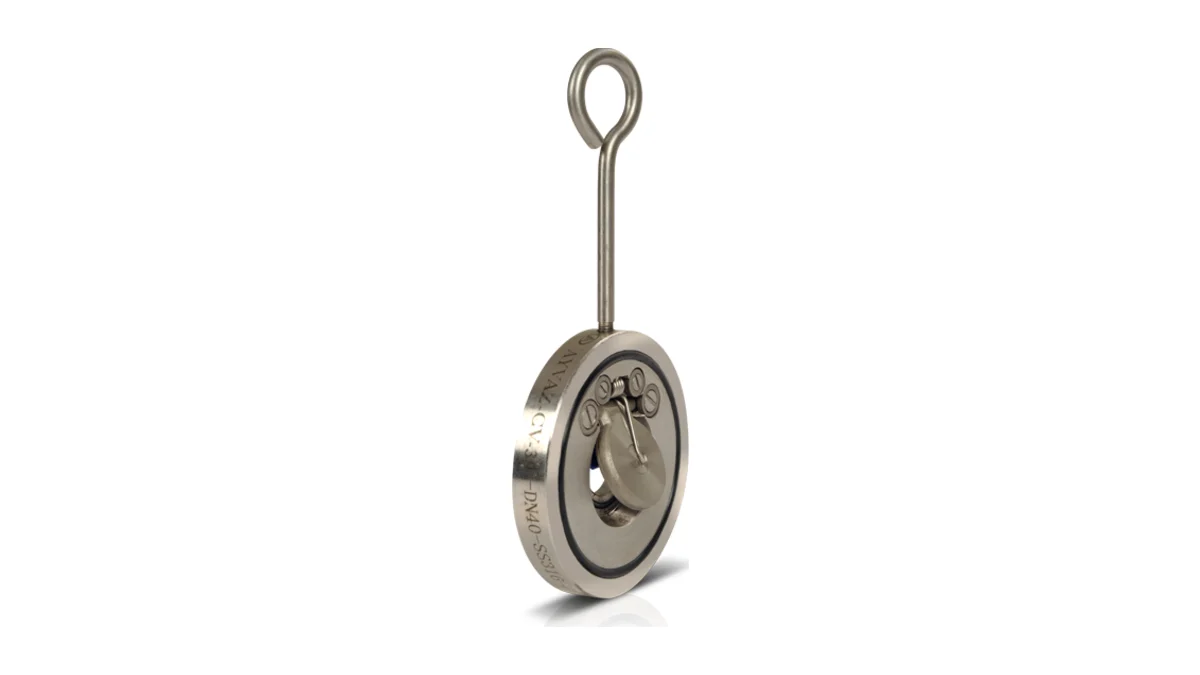
At pump discharges and at any point where reverse flow could damage equipment, flow must travel in one direction only. A wafer swing check valve is a compact check valve clamped between two pipe flanges, with a single hinged disc that opens with the flow and closes against reverse flow. Being much shorter and lighter than flanged swing check valves makes it a practical choice for water, HVAC and process lines.
This article explains how a wafer swing check valve works, the difference between spring-assisted and springless designs, installation rules and the technical data of the models ORFA supplies.
What Is a Wafer Swing Check Valve?
A swing check valve works with a disc that pivots on a hinge. “Wafer” means that the body has no flanges of its own and is clamped between two pipe flanges with studs, saving both space and weight.
Working Principle
- Forward flow: Fluid pressure pushes the disc open.
- Open position: With the disc open, the fluid passes through the line.
- Flow stops or reverses: As the flow weakens, the disc returns to its seat by spring force on spring-assisted models, or by its own weight and the reverse flow on springless models.
- Closed position: Once the disc seats, backflow is prevented.
Spring-Assisted vs Springless
| Feature | Spring-assisted | Springless |
|---|---|---|
| Closing | The spring closes the disc as soon as flow stops, reducing slam and water hammer | The disc closes by gravity and reverse flow |
| Pressure loss | Some cracking pressure is needed to overcome the spring | Lower cracking pressure and pressure loss |
| Installation | Horizontal and vertical (upward flow) lines | Only where the disc can close by gravity (horizontal or vertical upward flow) |
Advantages
- Backflow protection: Protects pumps and equipment against damage and contamination caused by reverse flow.
- Compact design: Much shorter and lighter than flanged swing check valves; fits tight spaces.
- Low pressure loss: The single-disc design offers relatively little resistance when open.
- Easy installation: Fitted between two existing flanges without separate flange connections.
Models Supplied by ORFA
| Model | Body / disc | Seal | Operating temperature | Pressure |
|---|---|---|---|---|
| Ayvaz ÇV-30 (spring-assisted) | AISI 316 stainless steel / AISI 316 | EPDM | -10 °C to approx. +100 °C | PN16 |
| Ayvaz ÇV-33 (springless) | AISI 316 stainless steel | Viton (FKM) | -10 °C to +180 °C | PN16 |
| Ayvaz ÇV-35 (spring-assisted) | Galvanized carbon steel / nickel-plated disc | EPDM | -10 °C to approx. +100 °C | PN16 |
The models are available in several nominal sizes from DN32 upwards and fit between PN10 and PN16 flanges. Check the product pages for current size options.
Installation Notes
- Follow the flow direction arrow on the body.
- Check the pipe bore and the adjacent arrangement so that the opening disc does not strike the neighbouring pipe, reducer or another valve.
- Avoid installing too close to a pump outlet, elbow or butterfly valve; turbulent flow makes the disc flutter and wear prematurely.
- Make sure the seal material suits the medium and temperature; EPDM-seated models are not suitable for steam.
Applications
- Water, distribution and transmission lines
- Pump discharges and pumping stations
- Heating, cooling and air-conditioning systems
- Shipyards, marine mechanical and cooling systems
- Paper, textile, mineral and oil industries
Frequently Asked Questions
What is the difference between a wafer swing check valve and a dual plate check valve?
Both are installed between flanges. A swing check valve has a single hinged disc, while a dual plate check valve has two half discs folding around a central pin, giving a shorter closing stroke.
Can a wafer swing check valve be installed vertically?
Spring-assisted models can be used in horizontal and vertical upward-flow lines. Springless models must be installed where the disc can close under its own weight, i.e. horizontal or vertical upward-flow lines.
Which model is suitable for higher temperatures?
EPDM-seated spring-assisted models are limited to hot-water temperatures. For higher temperatures, check the temperature and pressure limits of models such as the Viton-sealed springless ÇV-33 against the operating conditions.
Conclusion
Wafer swing check valves provide reliable backflow protection with a compact body and low pressure loss. Choosing the spring-assisted or springless version and the right seal material for the operating conditions is the key to long service life. Explore all check valve options in our Check Valves product group.
Buy check valves online
Browse products on or-fa.com, our export store, see prices in USD and order online.
Buy Online →Request a QuoteAsk on WhatsAppRelated product group
Check Valves →Technical support
Talk to our team to choose the right product.
+90 224 444 67 32[email protected]
Related Articles
Let’s choose the right product for your project
Buy from our online store or request a project-specific quotation.