
Wafer Type Butterfly Valve: Design, Lug Comparison and Installation
Learn the design of wafer type butterfly valves clamped between flanges, how they differ from lug and flanged types, material options and installation rules.
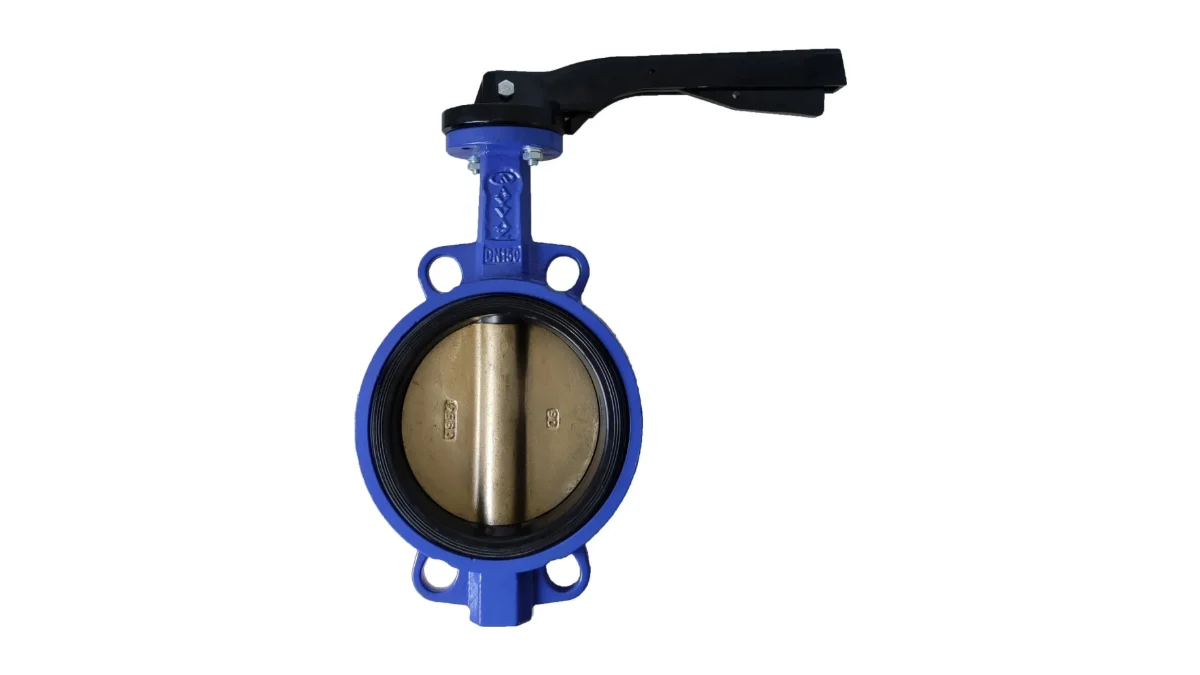
Butterfly valves are economical quarter-turn valves that take up little space on large-diameter lines. Their most common body style, the wafer type butterfly valve, has a slim body without its own flanges and is clamped between two pipe flanges with studs. This makes the valve light and easy to install.
This article covers the design of the wafer butterfly valve, how it differs from lug and flanged types, material options and what to watch for during installation.
What Is a Wafer Type Butterfly Valve?
A butterfly valve is a quarter-turn valve with a disc that rotates on a stem in the middle of the flow path. When the disc is parallel to the flow the valve is fully open; when it is perpendicular, it is fully closed. In the wafer type, the body sits between two flanges; the flange studs pass outside the body, centring and clamping the valve. Bodies are designed to fit PN10 and PN16 flanges.
Design and Main Parts
- Body: Usually cast iron or ductile iron; stainless steel options are available for corrosive service.
- Disc: Ductile iron (coated or nickel-plated), stainless steel or, for media such as seawater, aluminium bronze.
- Liner / seat: An elastomer liner covering the body provides the seal. EPDM is preferred for water and hot water, NBR for media containing oil or fuel.
- Stem and operator: Lever (generally on smaller sizes), gearbox, pneumatic or electric actuator.
Wafer vs Lug vs Flanged Butterfly Valves
| Feature | Wafer | Lug | Flanged |
|---|---|---|---|
| Installation | Clamped between two flanges | Bolted separately to each flange through threaded lugs | Connected by its own flanges |
| Weight and cost | Lightest and most economical | Medium | Heaviest |
| End-of-line service | Not suitable | Suitable (within manufacturer limits) | Suitable |
| Holds the line when one side is removed | No | Yes | Yes |
Advantages
- Compact and light: Takes much less space than gate or flanged valves of the same size.
- Fast operation: Fully opens and closes in a quarter turn and is easy to automate.
- Economical: The cost advantage is especially clear in large sizes.
- Easy installation: No separate flanges are needed; the body is placed between existing flanges.
Installation Notes
- Keep the disc slightly open during installation; fully open, the disc may hit the adjacent pipe, and fully closed, the liner may be pinched and damaged.
- On elastomer-lined valves the liner also acts as the flange gasket; follow the manufacturer’s instructions on whether an additional gasket is used.
- Tighten the studs evenly in a crosswise sequence and make sure the valve is centred between the flanges.
- Do not use a wafer valve as an end-of-line (dead-end) valve; choose a lug type for that purpose.
- When installing close to a pump outlet or elbow, check the orientation of the disc relative to the flow.
Applications
- HVAC systems, cooling towers and boiler rooms
- Water treatment plants and water distribution networks
- Food, beverage and chemical processes, with suitable materials
- Cooling water lines in power plants
- Fire protection systems, using supervised models with the relevant approvals (FM/UL)
Frequently Asked Questions
Can a wafer butterfly valve be used at the end of a line?
No. A wafer valve is held in place by the clamping force between two flanges and cannot safely hold the line when one side is removed. Use a lug type butterfly valve for end-of-line service and where one side must be dismantled for maintenance.
Is a flange gasket needed with a wafer butterfly valve?
On elastomer-lined models, the liner seats against the flange face and acts as the gasket, and most manufacturers do not recommend an additional gasket. Always check the installation instructions of the specific product.
Which liner material should I choose?
EPDM is widely used for water and hot water lines and NBR for media containing oil or fuel. Temperature limits vary by material and model, so check the product’s technical data.
Conclusion
Wafer type butterfly valves are a practical solution, especially on large water and HVAC lines, thanks to their compact body, low cost and fast operation. Choosing body, disc and liner materials to suit the medium and installing the valve correctly ensure a long service life. Explore all models in our Butterfly Valves product group.
Buy wafer butterfly valves online
Browse products on or-fa.com, our export store, see prices in USD and order online.
Buy Online →Request a QuoteAsk on WhatsAppRelated product group
Butterfly Valves →Technical support
Talk to our team to choose the right product.
+90 224 444 67 32[email protected]
Related Articles
Let’s choose the right product for your project
Buy from our online store or request a project-specific quotation.