
Wastewater Submersible Pumps: Impeller Types and Selection Guide
Removing sewage, dirty water and liquids containing solids calls for special clog-resistant pumps. Learn about the impeller types, applications and selection criteria of wastewater submersible pumps.
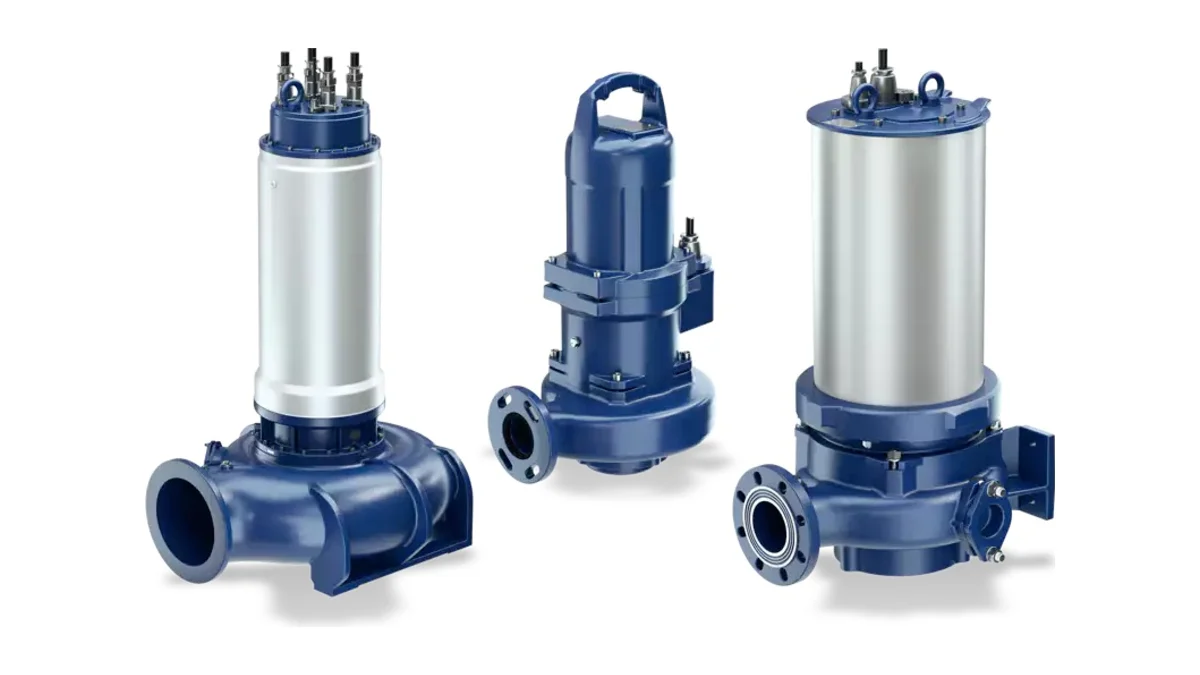
Wastewater management matters to municipalities, industrial plants and buildings from both an environmental and an operational point of view. Wastewater submersible pumps are designed to operate immersed in the liquid and remove sewage, dirty water, industrial effluent and liquids containing solids from sumps and manholes.
This article explains how wastewater submersible pumps are built, the impeller types, their applications and the points to consider when selecting the right pump.
What Is a Wastewater Submersible Pump?
In a wastewater submersible pump the motor and pump are combined in one housing, with the motor protected by a watertight enclosure and mechanical seals. Because the pump sits directly in the sump, no suction line is needed. Clog-resistant impeller designs and wear-resistant materials allow it to handle demanding liquids containing solids.
Impeller Types
The impeller type is one of the most important selection criteria for wastewater pumps:
| Impeller type | Characteristics | Typical use |
|---|---|---|
| Vortex impeller | Recessed in the casing, it moves the liquid by creating a vortex; most solids never touch the impeller. | Fibrous wastewater with solids, high clogging risk |
| Channel (single/double) impeller | Wide channels pass solids, with higher efficiency than a vortex impeller. | Sewage and domestic wastewater |
| Cutter (grinder) impeller | A cutting system shreds solids so they can be pumped through small-diameter pipes. | Septic tanks, toilet waste, small discharge lines |
Applications
- Municipal wastewater: Transfer of raw sewage in lift stations and treatment processes.
- Industrial plants: Removal of process wastewater in sectors such as chemicals, food and textiles.
- Construction sites: Removal of dirty and muddy water.
- Agriculture and livestock: Wastewater and liquid manure transfer.
- Flood water: Rapid removal of water in emergencies.
- Residential and commercial buildings: Draining basements, car parks and areas below sewer level.
Technical Features and Advantages
- High solids handling: Special impeller designs reduce the risk of clogging.
- Heavy-duty construction: Withstands demanding conditions and abrasive content.
- Automatic operation: A float switch starts and stops the pump according to level and protects it from running dry.
- Material options: Cast iron casings are robust and economical; stainless steel models are preferred for wastewater with a high corrosion risk.
- Quiet operation and easy installation: Operating under the liquid keeps noise low, and no suction line simplifies installation.
Choosing the Right Pump
- Wastewater content: Fibres, solid size and abrasive content determine the impeller type. The pump’s free passage (mm) must suit the largest expected solids.
- Flow and head: Calculate taking into account the static lift and the losses in the discharge line.
- Discharge pipe diameter: Cutter pumps are suitable for small-diameter discharge lines.
- Sump design: Size the sump so the pump does not start and stop too frequently; provide a standby pump where uninterrupted operation is required.
Frequently Asked Questions
What is the difference between a wastewater pump and a drainage pump?
Drainage pumps are designed for clean or slightly dirty water and can pass small solids. Wastewater pumps are built with large-passage vortex, channel or cutter impellers for fibrous liquids with large solids, such as sewage.
When should a vortex impeller be chosen?
For fibrous wastewater with solids and a high risk of clogging. Because most solids do not touch the impeller, clogging and wear are reduced; the trade-off is lower efficiency than a channel impeller.
Why is a float switch important?
The float switch starts and stops the pump automatically according to the level in the sump. This prevents overflow and protects the pump from damage caused by running dry.
Conclusion
Selected with the right impeller type and capacity, wastewater submersible pumps remove sewage and dirty water reliably and without clogging. Compare the available types in our submersible pumps product group.
Buy wastewater submersible pumps online
Browse products on or-fa.com, our export store, see prices in USD and order online.
Buy Online →Request a QuoteAsk on WhatsAppRelated product group
Submersible Pumps →Technical support
Talk to our team to choose the right product.
+90 224 444 67 32[email protected]
Related Articles
Let’s choose the right product for your project
Buy from our online store or request a project-specific quotation.