
Pipe Size and Flow Rate Tables: DN Sizes and m³/h Capacities
Flow rates at 1.5 and 2.5 m/s by DN and bore for steel, plastic and stainless pipes, plus flow and volume tables for compressed air lines.
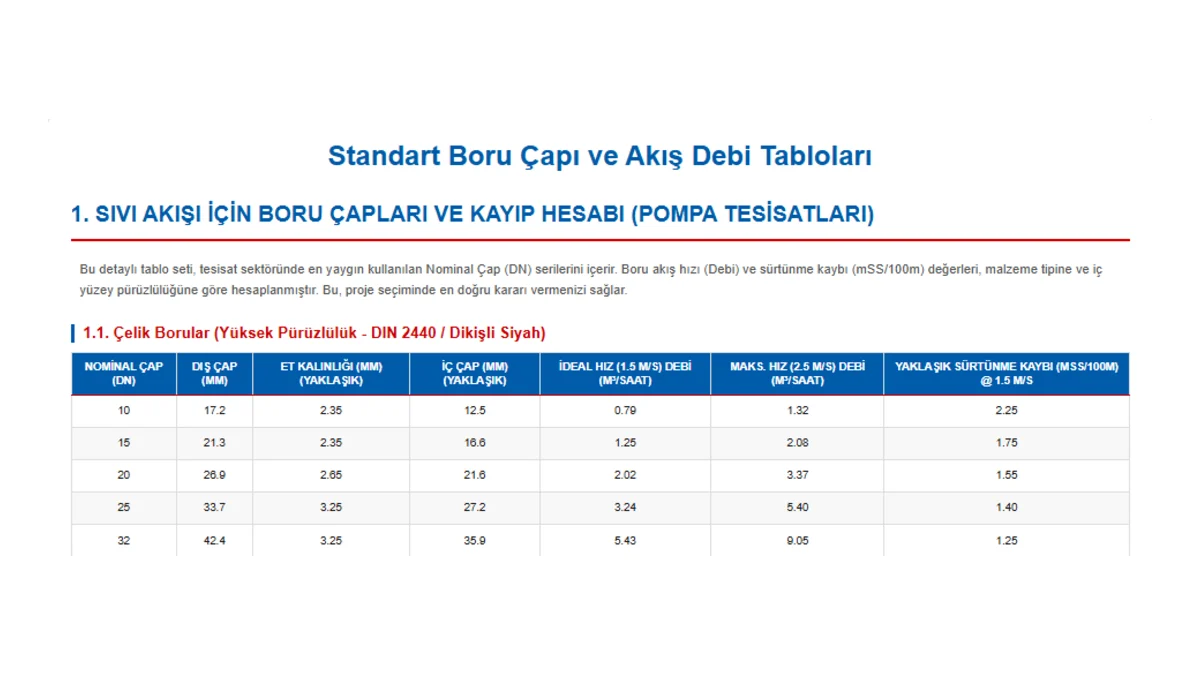
A pipe size and flow rate table shows how many cubic metres per hour a pipe can carry at a given velocity and is the starting point for pipe sizing in pump, booster set and plumbing projects. Flow is the internal cross-section multiplied by velocity, so even at the same DN, the bore – which varies with material and wall thickness – directly affects the result.
On this page you will find DN sizes, bores and flow rates at 1.5 m/s and 2.5 m/s for steel, plastic (PPR/PVC) and stainless steel pipes, plus flow and free-air volume tables for compressed air lines.
How Is Flow Rate Calculated?
Q (m³/h) = v (m/s) × π × d² / 4 × 3600 (d: bore in metres)
For example, a DN50 steel pipe with a 53.0 mm bore carries 1.5 × π × 0.053² / 4 × 3600 ≈ 11.9 m³/h at 1.5 m/s. In liquid lines 1–2 m/s is considered economical; 2.5 m/s can be used as an upper limit, while higher velocities increase noise, wear and the risk of water hammer.
Pipe Size and Flow Rate Tables for Liquids
Steel Pipes (Black Steel; DN10–DN100 DIN 2440 / EN 10255 Medium Series, DN150–DN200 EN 10220)
| DN | Outside diameter (mm) | Wall thickness (mm) | Bore (mm) | Flow @ 1.5 m/s (m³/h) | Flow @ 2.5 m/s (m³/h) | Friction loss @ 1.5 m/s (m WC/100 m) |
|---|---|---|---|---|---|---|
| 10 | 17.2 | 2.35 | 12.5 | 0.66 | 1.10 | 30.5 |
| 15 | 21.3 | 2.35 | 16.6 | 1.17 | 1.95 | 21.2 |
| 20 | 26.9 | 2.65 | 21.6 | 1.98 | 3.30 | 15.1 |
| 25 | 33.7 | 3.25 | 27.2 | 3.14 | 5.23 | 11.3 |
| 32 | 42.4 | 3.25 | 35.9 | 5.47 | 9.11 | 7.9 |
| 40 | 48.3 | 3.25 | 41.8 | 7.41 | 12.35 | 6.6 |
| 50 | 60.3 | 3.65 | 53.0 | 11.91 | 19.86 | 4.9 |
| 65 | 76.1 | 3.65 | 68.8 | 20.08 | 33.46 | 3.5 |
| 80 | 88.9 | 4.05 | 80.8 | 27.69 | 46.15 | 2.9 |
| 100 | 114.3 | 4.50 | 105.3 | 47.03 | 78.38 | 2.1 |
| 150 | 168.3 | 4.50 | 159.3 | 107.63 | 179.38 | 1.3 |
| 200 | 219.1 | 5.90 | 207.3 | 182.26 | 303.76 | 0.9 |
Plastic Pipes (PPR / PVC / U-PVC)
| DN | Outside diameter (mm) | Bore (mm, approx.) | Flow @ 1.5 m/s (m³/h) | Flow @ 2.5 m/s (m³/h) | Friction loss @ 1.5 m/s (m WC/100 m) |
|---|---|---|---|---|---|
| 10 | 16 | 13.0 | 0.72 | 1.19 | 24.7 |
| 15 | 20 | 16.6 | 1.17 | 1.95 | 18.2 |
| 20 | 25 | 21.0 | 1.87 | 3.12 | 13.5 |
| 25 | 32 | 27.2 | 3.14 | 5.23 | 9.8 |
| 32 | 40 | 33.8 | 4.85 | 8.08 | 7.5 |
| 40 | 50 | 42.6 | 7.70 | 12.83 | 5.6 |
| 50 | 63 | 53.0 | 11.91 | 19.86 | 4.3 |
| 65 | 75 | 65.8 | 18.36 | 30.60 | 3.3 |
| 80 | 90 | 81.6 | 28.24 | 47.07 | 2.6 |
| 100 | 110 | 103.6 | 45.52 | 75.87 | 1.9 |
| 150 | 160 | 154.6 | 101.37 | 168.95 | 1.2 |
| 200 | 225 | 205.6 | 179.28 | 298.80 | 0.8 |
Stainless Steel Pipes (304 / 316)
| DN | Outside diameter (mm) | Bore (mm, approx.) | Flow @ 1.5 m/s (m³/h) | Flow @ 2.5 m/s (m³/h) | Friction loss @ 1.5 m/s (m WC/100 m) |
|---|---|---|---|---|---|
| 15 | 21.3 | 17.3 | 1.27 | 2.12 | 17.9 |
| 25 | 33.7 | 29.7 | 3.74 | 6.24 | 9.1 |
| 50 | 60.3 | 55.3 | 12.97 | 21.62 | 4.2 |
| 80 | 88.9 | 84.9 | 30.57 | 50.95 | 2.5 |
| 100 | 114.3 | 108.3 | 49.74 | 82.91 | 1.9 |
| 150 | 168.3 | 163.3 | 113.10 | 188.50 | 1.1 |
| 200 | 219.1 | 215.1 | 196.23 | 327.05 | 0.8 |
Flow rates are calculated from the bore. Friction losses are for 1.5 m/s and water at 15 °C, using Darcy-Weisbach / Colebrook-White (roughness: black steel 0.045 mm, plastic 0.007 mm, stainless 0.015 mm). Plastic pipe bores vary with PN/SDR class, so the bores listed are approximate.
Pipe Size and Flow for Compressed Air
Compressed Air Flow by Air Velocity (m³/h)
Values are the volumetric flow of air in the line at working pressure (velocity × internal cross-section). Velocities of around 6–8 m/s are commonly used in main distribution lines to limit pressure drop.
| Air velocity (m/s) | DN15 | DN25 | DN40 | DN65 | DN100 | DN150 |
|---|---|---|---|---|---|---|
| 3 | 2.16 | 6.12 | 14.76 | 39.24 | 92.52 | 202.32 |
| 4 | 2.88 | 8.28 | 19.44 | 52.56 | 123.12 | 269.64 |
| 5 | 3.60 | 10.08 | 24.48 | 65.52 | 154.08 | 336.96 |
| 6 | 4.32 | 12.24 | 29.16 | 78.48 | 184.68 | 403.2 |
| 8 | 5.76 | 16.2 | 38.88 | 104.76 | 246.6 | 540.0 |
Volume of Free Air Under Pressure (dm³)
The volume of compressor free air delivery (FAD) at working pressure is approximately Vcompressed = Vfree / (p + 1) (p in bar g, atmospheric pressure taken as 1 bar; using 1.013 bar gives results about 1% higher).
| Free air volume (dm³) | 4 bar g (dm³) | 6 bar g (dm³) | 8 bar g (dm³) |
|---|---|---|---|
| 5 | 1.0 | 0.71 | 0.56 |
| 10 | 2.0 | 1.43 | 1.11 |
| 25 | 5.0 | 3.57 | 2.78 |
| 50 | 10.0 | 7.14 | 5.56 |
| 100 | 20.0 | 14.29 | 11.11 |
| 200 | 40.0 | 28.57 | 22.22 |
| 500 | 100.0 | 71.43 | 55.56 |
Frequently Asked Questions
Is DN the inside diameter of the pipe?
No. DN (nominal size) is only a designation. The actual bore depends on the pipe standard, material and wall thickness; a DN50 steel pipe has a bore of about 53 mm, while a DN50 PPR/PVC pipe differs.
Which velocity should be used in liquid lines?
For domestic water and pump lines 1–2 m/s is usually economical. Lower velocities are preferred in pump suction lines to avoid cavitation.
Why do plastic pipes give a different flow at the same DN?
Plastic pipes have different outside diameters and wall thicknesses from steel pipes; as the bore changes, so does the flow at the same velocity. Always use the actual bore when sizing.
Conclusion
Basing pipe selection on the actual bore and a suitable velocity, rather than the DN alone, ensures both adequate flow and reasonable pressure loss. These tables allow quick preliminary sizing of liquid and compressed air lines. See our pipes product group for suitable pipes for your installation.
Buy pipes online
Browse products on or-fa.com, our export store, see prices in USD and order online.
Buy Online →Request a QuoteAsk on WhatsAppRelated product group
Pipes →Technical support
Talk to our team to choose the right product.
+90 224 444 67 32[email protected]
Related Articles
Let’s choose the right product for your project
Buy from our online store or request a project-specific quotation.