
Bronze Threaded Safety Valve: Operation, Selection and Installation
Learn the operating principle, selection criteria and installation rules of bronze threaded safety valves that protect boilers, pressure vessels and heat exchangers.
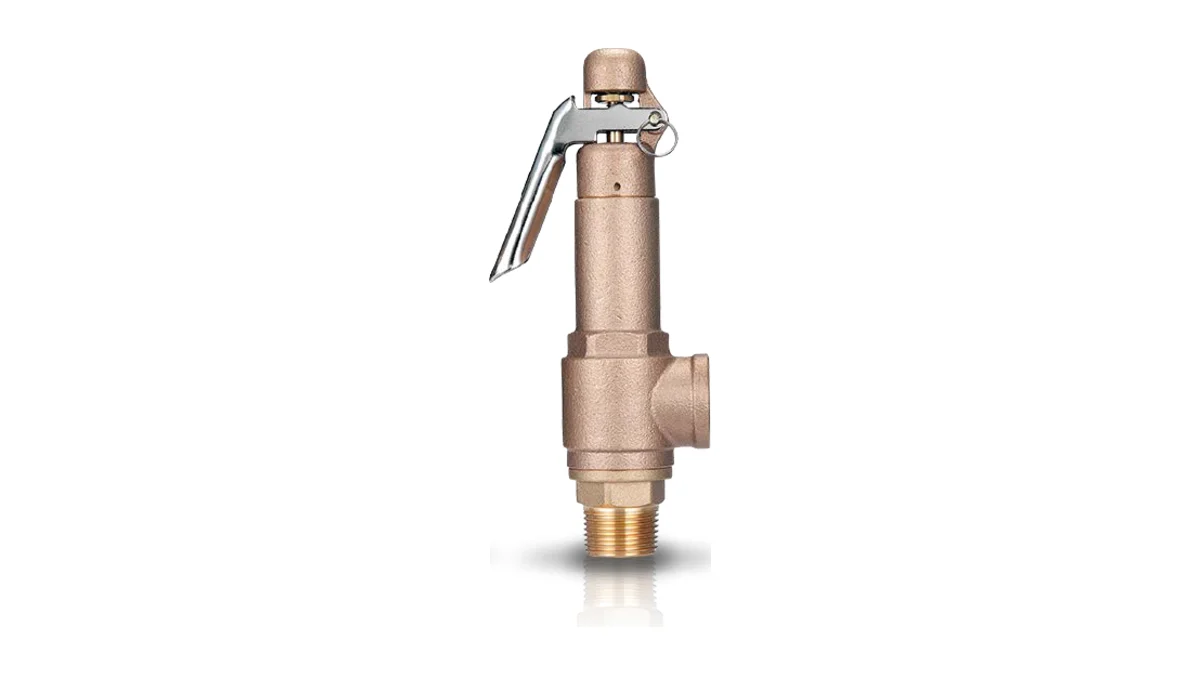
The safety valve is the last line of defence in a pressurised system: when controls fail or an unexpected pressure rise occurs, it opens and relieves the excess pressure, protecting both equipment and people. The bronze threaded safety valve, with its corrosion-resistant bronze body and threaded connection, is widely used on small and medium capacity boilers, pressure vessels and heat exchangers.
This article explains how the bronze threaded safety valve works, its advantages and applications, and what to consider for correct selection and installation.
What Is a Bronze Threaded Safety Valve?
It is a spring-loaded safety valve that opens automatically when system pressure reaches its preset opening (set) pressure and relieves the excess pressure. “Threaded” means the valve is screwed into the installation. The bronze body offers good corrosion resistance in water and steam service.
How Does It Work?
- Normal operation: The set spring presses the disc onto the seat and the valve stays closed.
- Overpressure: When the force of system pressure on the disc exceeds the spring force, the disc lifts and the medium is discharged.
- Pressure falling: When pressure drops somewhat below the set pressure, the spring reseats the disc and the valve closes.
Why Is It Important?
- Equipment protection: Protects pressure vessels, boilers, heat exchangers and pipework from damage caused by overpressure.
- Personnel safety: Reduces the risk of explosions and dangerous leaks.
- System safety: Prevents system pressure from exceeding the safe limit even if other controls fail.
Advantages
- Automatic, reliable protection: Works on system pressure alone, with no external energy.
- Corrosion resistance: The bronze body withstands water, steam and humid environments.
- Range of settings: Models are available set to different opening pressures.
- Fast response: Opens quickly at set pressure for effective relief.
- Compact and easy to install: Threaded ends make installation on small connections practical.
Technical Data
| Feature | Value |
|---|---|
| Body | Bronze |
| Internals | Brass or stainless steel, depending on model |
| Connection | Threaded |
| Set range | Depends on model and spring; e.g. 2.1–10.5 bar for the Ayvaz L9-LB series and 10.5–20 bar for the L9-LBP series |
| Media | Steam, water, air and suitable gases (depending on model) |
Maximum operating pressure, temperature and discharge capacity vary by model and should be checked in the product catalogue.
Applications
- Steam boilers
- Pressure vessels
- Heat exchangers
- Lines in chemical plants carrying media compatible with bronze
- Auxiliary systems in power generation plants
Selection and Installation Rules
- Set pressure: The set pressure must not exceed the maximum allowable working pressure of the protected equipment.
- Capacity: The valve must be able to discharge the maximum flow that can occur in the system; do not select on connection size alone.
- Mounting position: Install safety valves vertically and as close as possible to the protected equipment.
- No isolation in between: Do not install a shut-off valve between the protected equipment and the safety valve.
- Safe discharge: Route the discharge to a safe point where it cannot harm personnel.
- Periodic checks: Check operation and setting regularly in line with regulations and the manufacturer’s instructions.
Frequently Asked Questions
What is the difference between a safety valve and a pressure reducing valve?
A pressure reducing valve works continuously to hold outlet pressure at its set value. A safety valve is normally closed and opens only when pressure reaches its set point, to protect the system.
How should a safety valve be sized?
Sizing is based not on connection size but on the flow that must be relieved (capacity), the set pressure and the type of medium.
Which media are bronze safety valves used for?
They are used for media compatible with bronze, such as steam, water and air. The bronze body resists corrosion; check material compatibility for chemical media.
Conclusion
Bronze threaded safety valves are the final safety barrier against overpressure and, when correctly selected and installed, reliably protect equipment and people. Set pressure, capacity and installation rules form the basis of selection. You can explore models in other materials and types in our safety valves product group.
Buy bronze safety valves online
Browse products on or-fa.com, our export store, see prices in USD and order online.
Buy Online →Request a QuoteAsk on WhatsAppRelated product group
Safety Valves →Technical support
Talk to our team to choose the right product.
+90 224 444 67 32[email protected]
Related Articles
Let’s choose the right product for your project
Buy from our online store or request a project-specific quotation.