
Threaded Steam Pressure Reducing Valve: Working Principle and Technical Data
Learn how threaded, direct-acting steam pressure reducing valves lower steam pressure to the required level on small and medium flow lines, and review their technical data.
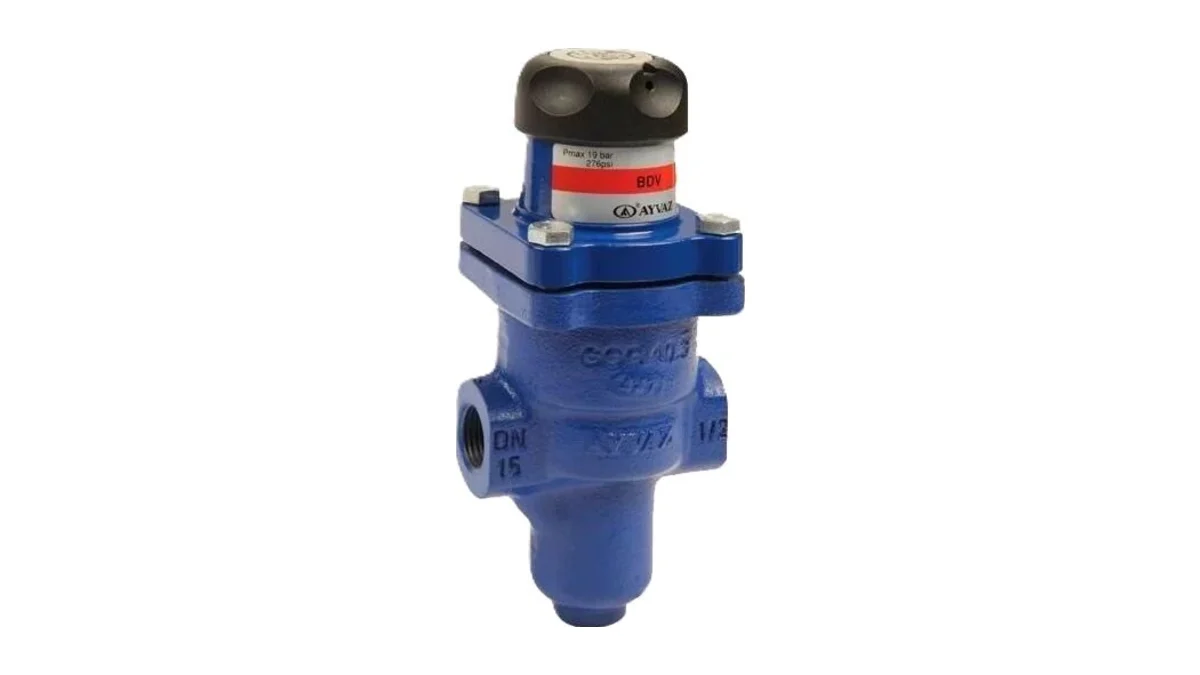
In industrial plants, steam is usually distributed from the boiler at high pressure, while consumers such as heaters, ironing presses and dyeing machines often work at a lower pressure. Reducing steam to the correct pressure before each consumer is necessary for process quality as well as safety and energy efficiency. A threaded steam pressure reducing valve is a direct-acting pressure reducing valve with threaded (BSP or NPT) end connections that needs no external energy.
This article explains the working principle, set pressure ranges, technical data and applications of threaded direct-acting steam pressure reducing valves.
What Is a Threaded Steam Pressure Reducing Valve?
It is a valve that reduces high-pressure steam to a lower, constant pressure. The two terms in its name mean:
- Direct-acting: The valve needs no pilot circuit, electricity or compressed air to control the outlet pressure; it works through the balance between a set point spring and the force created by the outlet pressure.
- Threaded: The valve is installed in the pipeline with threaded end connections (BSP or NPT). Threaded models are generally used on smaller pipe sizes.
Working Principle
- Inlet: High-pressure steam reaches the valve inlet.
- Set point spring: The spring, compressed by the adjusting screw or handwheel, tends to hold the valve open.
- Outlet pressure feedback: The outlet pressure acts on a diaphragm (or bellows) and opposes the spring force.
- Balance: As the outlet pressure approaches the set point the valve throttles; as it falls the valve opens. This keeps the outlet pressure at the set value.
Technical Data
| Feature | Value |
|---|---|
| Outlet pressure set ranges | 0.14–1.70 bar / 1.40–4.00 bar / 3.50–8.60 bar |
| Media | Steam, compressed air and suitable gases |
| Connection | Threaded (BSP or NPT) |
| Body material | GGG40.3 ductile iron |
| Internals | Stainless steel (stem, seat, strainer) |
| Pressure rating | PN25 |
| Maximum design temperature | 210 °C |
| Maximum inlet pressure | 19 bar |
| Maximum outlet pressure | 8.6 bar |
Select a set range that covers the required outlet pressure; keeping the required value in the middle of the selected range gives more stable control.
Advantages
- Stable outlet pressure: Keeps the outlet pressure close to the set point despite inlet pressure changes.
- No external energy: Works without electrical or air connections.
- Compact design: Threaded ends and a small body make installation in tight spaces easy.
- Easy installation and adjustment: The outlet pressure can be changed easily with the adjusting screw or handwheel.
- Durability: Ductile iron body and stainless steel internals ensure a long service life.
Applications
- Textile industry: dyeing, printing and finishing machines
- Food plants: cooking kettles and process equipment
- Small steam consumers in chemical and petrochemical plants
- Paper mills
- Auxiliary steam lines in refineries and power plants
- Ship engine room systems
Frequently Asked Questions
What does “threaded” mean for a pressure reducing valve?
It means the valve is connected to the pipeline with threaded (BSP or NPT) ends. It does not refer to the internal mechanism of the valve.
Which set range should I choose?
Choose the range that includes the outlet pressure you need; for example, the 1.40–4.00 bar range is suitable for an outlet pressure of 3 bar.
What is the maximum inlet pressure for a threaded steam PRV?
According to the technical data given here, up to 19 bar inlet pressure at a design temperature of up to 210 °C.
Conclusion
Threaded steam pressure reducing valves provide a stable outlet pressure on small and medium flow steam lines without external energy. With the right set range, they improve process safety and energy efficiency. Explore other pressure control solutions on our Pressure Control Valves page.
Buy pressure reducing valves online
Browse products on or-fa.com, our export store, see prices in USD and order online.
Buy Online →Request a QuoteAsk on WhatsAppRelated product group
Pressure Control Valves →Technical support
Talk to our team to choose the right product.
+90 224 444 67 32[email protected]
Related Articles
Let’s choose the right product for your project
Buy from our online store or request a project-specific quotation.