
Diaphragm Pumps: Types and Industry Applications
Diaphragm pumps safely transfer difficult liquids in industries from chemicals to food. Learn about air-operated and electric types, material options and how they are used in each sector.
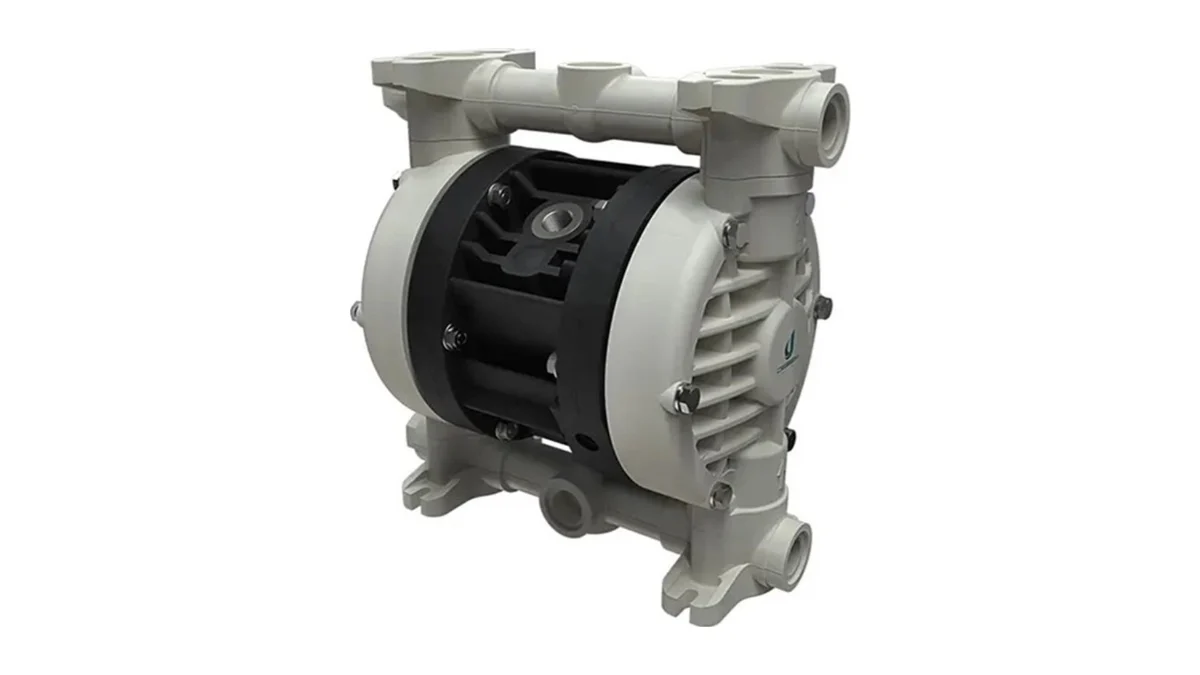
Abrasive, viscous or particle-laden liquids are a challenge for many conventional pumps. Diaphragm pumps are positive displacement pumps that work through the reciprocating movement of a flexible diaphragm (membrane) and transfer such liquids safely, without leaks and in a controlled way.
This article explains how diaphragm pumps work, the differences between air-operated and electric types, the material options and their applications by industry.
How Does a Diaphragm Pump Work?
When the diaphragm is drawn back, low pressure forms in the pump chamber and liquid fills it through the inlet check valve. When the diaphragm is pushed forward, the liquid is sent through the outlet check valve into the discharge line. Because the diaphragm forms a barrier between the pumped liquid and the drive mechanism, the liquid never contacts moving mechanical parts. For a detailed look at the working principle of air-operated double diaphragm pumps, see our article on the double diaphragm pump.
Types of Diaphragm Pumps
| Type | Characteristics | Typical use |
|---|---|---|
| Air-operated (pneumatic) diaphragm pumps | Run on compressed air with no electric motor. Simple, portable and able to run dry. | Transfer, unloading, field and mobile work, solvent and paint transfer |
| Electric diaphragm pumps | Driven by an electric motor or solenoid; need no compressed air and give a steadier flow. | Continuous transfer, precise chemical dosing |
| Stainless steel pumps | Combine mechanical strength with corrosion resistance. | Chemical, food and pharmaceutical applications |
| Plastic (PP, PVDF) pumps | High chemical resistance to acids and alkalis. | Acid, alkali and aggressive chemical transfer |
Advantages
- Broad liquid compatibility: Handles abrasive, viscous, particle-laden and shear-sensitive liquids.
- Leak-free operation: The diaphragm design eliminates rotating shaft seals.
- Dry-running capability: Air-operated models are not damaged by running dry.
- Self-priming: Depending on the model, can lift liquid from about 4–5 metres when dry and up to about 9 metres when primed with liquid.
- Gentle product handling: Low shear keeps sensitive products intact.
- Solids handling: Can pass solid particles up to a certain size depending on pump size.
- Easy maintenance: The simple design allows quick diaphragm and ball replacement.
- Bolted casing option: A bolted casing provides more secure sealing than clamped designs.
Material Options
- Casing: Materials such as aluminium, stainless steel, PP and PVDF.
- Diaphragm: Plastics and elastomers such as PTFE, EPDM and NBR, selected according to the chemical nature and temperature of the liquid.
Applications by Industry
- Chemical industry: Transfer of acids, alkalis, solvents, adhesives, paints and inks.
- Water and wastewater treatment: Chemical dosing, sludge and chemical waste transfer.
- Food and beverage: Viscous products such as milk, cream, ayran, mustard, mayonnaise, ketchup, chocolate and jam (with models made of food-grade materials and holding the relevant certificates).
- Pharmaceuticals: Liquid transfer requiring hygiene.
- Mining and construction: Sludge, particle-laden water and site wastewater.
- Petrochemicals: Transfer of petroleum products and solvents.
- Ceramics: Slip transfer and glazing applications.
- Shipyards: Bilge water removal and waste transfer.
- Textiles: Dye and chemical transfer.
- Machining: Coolant (cutting fluid) transfer and waste management.
- Vehicle service stations: Waste oil transfer.
- Meat and fish processing: Animal by-product transfer, fish oil storage and filling.
Frequently Asked Questions
Should I choose an air-operated or an electric diaphragm pump?
An air-operated model suits sites with compressed air, explosive atmospheres or frequent relocation. Where compressed air is not available, or continuous operation with steady flow or precise dosing is required, an electric model is preferred.
How is the diaphragm material selected?
It is chosen according to the chemical nature, temperature and abrasiveness of the liquid. PTFE offers broad chemical resistance, while elastomers such as EPDM and NBR are economical for certain groups of liquids. The choice should be confirmed with chemical resistance charts.
Can diaphragm pumps be used for food products?
Yes, with models made of food-grade materials and holding the relevant certificates. Their low shear transfers viscous and delicate food products without damaging them.
Conclusion
With their leak-free design, broad liquid compatibility and choice of drives, diaphragm pumps are a reliable transfer solution across industries from chemicals to food. For models suited to chemical transfer, explore our acid and chemical pumps product group.
Buy diaphragm pumps online
Browse products on or-fa.com, our export store, see prices in USD and order online.
Buy Online →Request a QuoteAsk on WhatsAppRelated product group
Acid and Chemical Pumps →Technical support
Talk to our team to choose the right product.
+90 224 444 67 32[email protected]
Related Articles
Let’s choose the right product for your project
Buy from our online store or request a project-specific quotation.