
Double-Acting Pneumatic Actuator: Working Principle and Applications
Double-acting pneumatic actuators use compressed air to drive the valve in both the opening and closing directions. Learn how they work, their benefits and typical applications.
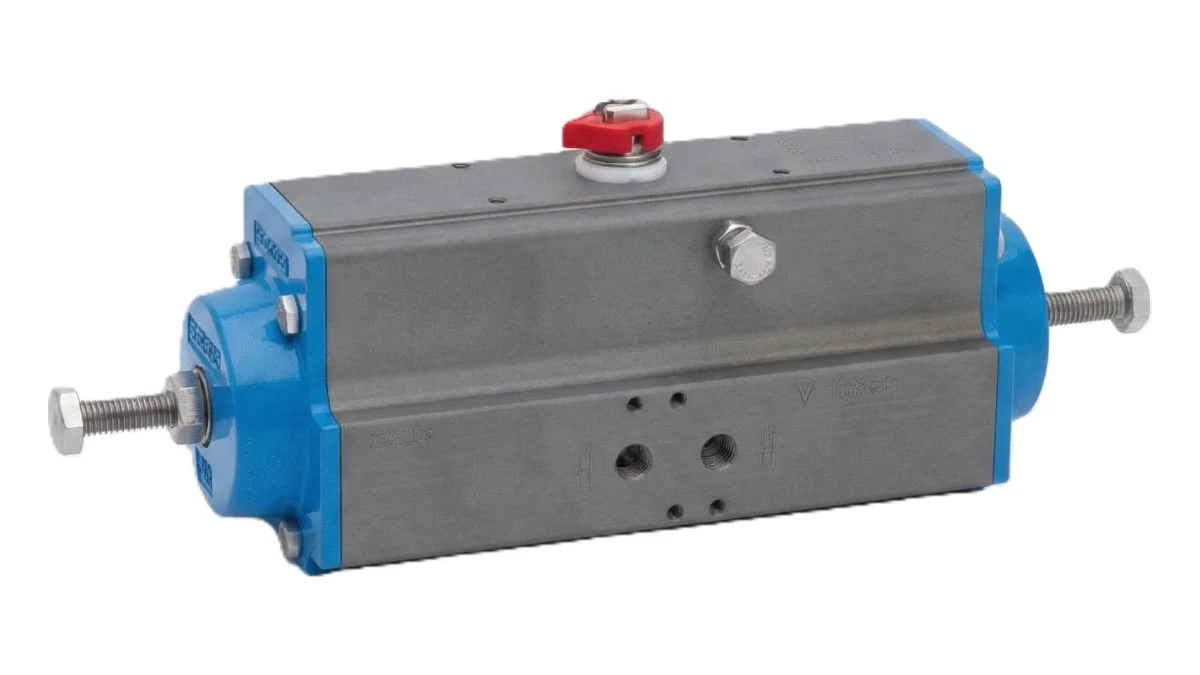
Controlling process fluids reliably is critical to the efficiency and safety of any industrial plant. One of the most widely used devices for automatically opening and closing valves is the double-acting pneumatic actuator. Running on compressed air, it delivers strong, fast and dependable motion.
This article explains how double-acting pneumatic actuators work, their advantages, typical technical features and where they are used.
What Is a Double-Acting Pneumatic Actuator?
A double-acting pneumatic actuator is a device that produces mechanical motion using compressed air. “Double-acting” means that both the opening and the closing strokes are powered by air; there is no return spring. For this reason it is also called an air-to-air actuator. It is most commonly used to automate quarter-turn (90°) valves such as butterfly and ball valves.
Working Principle
A double-acting pneumatic actuator converts the energy of compressed air into rotary motion:
- Air supply: Compressed air is fed into one of the two air ports on the body.
- Piston movement: The air pushes the pistons inside the body, creating linear motion.
- Conversion to rotation: The linear movement of the pistons is converted into shaft rotation, usually by a rack and pinion mechanism.
- Valve operation: The shaft turns the attached valve through 90° to open or close it.
- Reverse stroke: When air is supplied to the other port, the pistons move in the opposite direction and the valve is driven to its other position.
Air is usually directed by a 5/2-way solenoid valve mounted on the actuator.
Advantages
- Strong, fast operation: Compressed air provides high torque and short opening and closing times.
- Adjustable speed: Opening and closing speeds can be set with flow control (throttle) elements on the exhaust.
- Compact design: With no spring pack, it is smaller than a spring-return model of the same torque.
- Reliability: Robust design and quality materials ensure long, trouble-free service.
- Wide choice: Models are available in a range of sizes, torque ratings and control options.
Typical Technical Features
| Feature | Value |
|---|---|
| Body material | Extruded aluminium |
| Piston material | Cast aluminium |
| Shaft material | Nickel-plated steel (stainless steel option depending on model) |
| Bearings | Low-friction engineering plastic |
| Operating medium | Air or non-corrosive gases |
| Rotation angle | 90° |
| Valve mounting | ISO 5211 |
Operating pressure, temperature range and torque output vary by model; always refer to the product data sheet when selecting.
Applications
- Butterfly and ball valve automation
- Damper control
- Process automation
- Chemical and petrochemical industries
- Food and beverage industry
- Water treatment plants
- HVAC (heating, ventilation and air conditioning) systems
How to Choose the Right Actuator
An actuator should be sized according to the torque the valve requires and the air pressure available on site. Valve torque depends on the valve type, size, line pressure and the properties of the medium. Allowing a safety margin ensures reliable operation as friction increases over time. The ORFA Endüstriyel Mamüller San. ve Tic. A.Ş. team can review your system requirements and help you select the most suitable actuator.
Frequently Asked Questions
What is the difference between double-acting and single-acting pneumatic actuators?
In a double-acting actuator both opening and closing are powered by compressed air. In a single-acting actuator one direction is powered by air and the return stroke by springs, so the valve automatically moves to its safe position when air is lost.
What happens to a double-acting actuator if the air supply fails?
Since there is no return spring, the valve normally stays in its last position. If a fail-safe position is required, a spring-return (single-acting) actuator should be used.
Which valves can a double-acting pneumatic actuator be fitted to?
It fits quarter-turn valves with an ISO 5211 mounting pad, such as butterfly valves and ball valves.
Conclusion
Double-acting pneumatic actuators are compact, reliable automation components that move valves quickly and powerfully. Correct torque sizing and proper installation improve process control, efficiency and safety. To see models across different torque ranges, explore our Pneumatic Actuators product group.
Buy pneumatic actuators online
Browse products on or-fa.com, our export store, see prices in USD and order online.
Buy Online →Request a QuoteAsk on WhatsAppRelated product group
Pneumatic Actuators →Technical support
Talk to our team to choose the right product.
+90 224 444 67 32[email protected]
Related Articles
Let’s choose the right product for your project
Buy from our online store or request a project-specific quotation.