
What Is a Flow Control Valve? Working Principle, Setting and Applications
Learn how diaphragm flow control valves keep the flow rate at a set value without external energy, even when inlet pressure changes, and how they are set and installed.
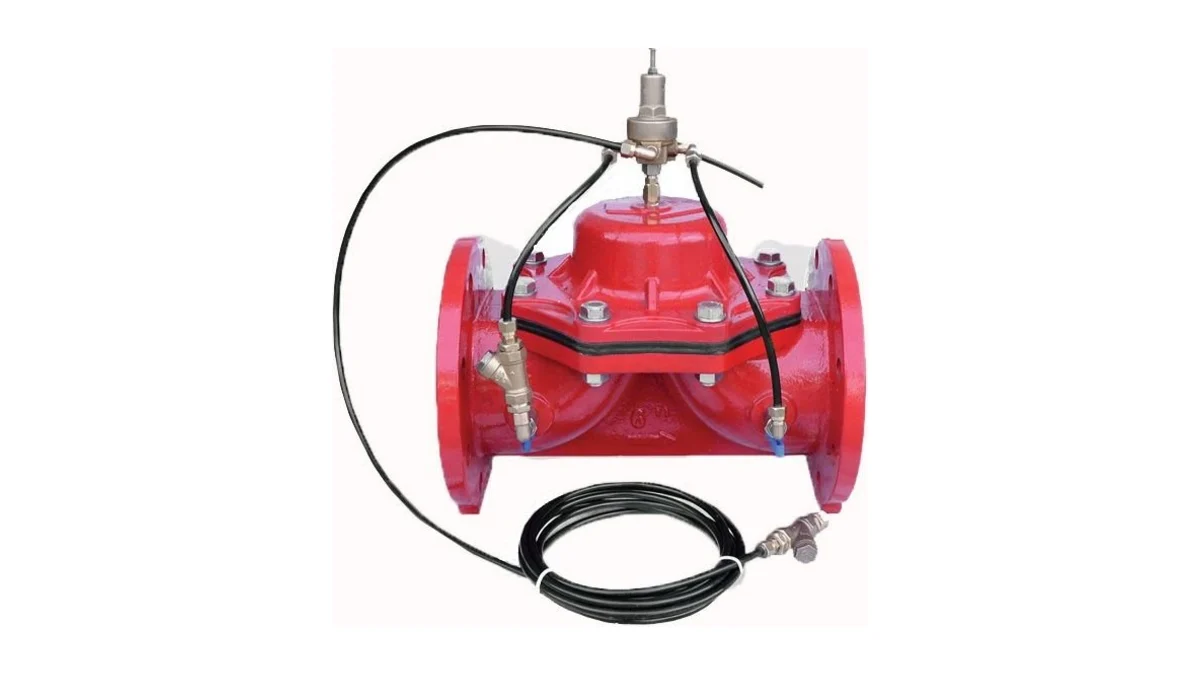
In water treatment, filtration and distribution systems, keeping the flow through a line at a defined value is important both for correct process operation and for avoiding water waste. A flow control valve is an automatic control valve that keeps the flow rate through the valve at its set value even when the inlet pressure or the system demand changes.
This article covers the working principle of line-pressure operated diaphragm flow control valves, how to set and install them, their technical data and their applications.
What Is a Flow Control Valve?
A flow control valve limits the flow in a line to a preset value and holds it there. Diaphragm-type valves are operated by the pressure of the water in the line itself and need no external energy source such as electricity or compressed air. This is particularly important in critical applications such as preventing excessive flow during backwashing in filtration systems, which protects the filter bed.
Working Principle
A diaphragm flow control valve consists of a main valve, a control (pilot) circuit and an orifice plate installed in the line:
- Sensing the flow: A differential pressure that depends on the flow rate develops across the orifice plate. These pressures are transmitted to the control circuit through signal tubes.
- Comparison: The control circuit compares the sensed differential pressure with the set value.
- Diaphragm movement: If the flow exceeds the set value, water is admitted to the diaphragm chamber of the main valve and the valve throttles; if the flow drops, the chamber is relieved and the valve opens.
- Constant flow: Through this continuous correction, the flow is held at the set value despite changes in inlet pressure.
Technical Data
Key technical data of the Ayvaz flow control valve supplied by ORFA:
| Feature | Value |
|---|---|
| Body and cover material | GGG40 ductile iron |
| Diaphragm | Fabric-reinforced natural rubber |
| Spring material | Stainless steel (AISI 302) |
| Pressure ring | Polyamide (PA6) |
| Maximum working pressure | 16 bar |
| Maximum working temperature | 80 °C |
| Connection | Flanged |
| Energy requirement | None (operated by line pressure) |
Key Advantages
- No external energy: Operates on line pressure, so no electrical or compressed air connection is needed.
- Easy, precise setting: The required flow rate can be set easily and accurately.
- Water savings: Prevents excessive water use in processes such as backwashing.
- Easy maintenance: Simple construction; parts such as the diaphragm can be replaced without removing the body from the line.
Setting and Installation
- The flow rate is set with the orifice plate and signal tubes connected. After the 3-way ball valve in the control circuit is turned to “Auto”, the required flow is reached using the adjuster on the valve.
- The valve can be installed horizontally or vertically, which makes it adaptable to different piping layouts.
- The flow direction must match the arrow on the body.
- A strainer upstream of the valve is recommended to keep the control circuit from clogging.
Applications
- Backwash lines of water treatment and filtration systems
- Closed-loop water distribution networks
- Heating, ventilation and air conditioning installations
- Agricultural irrigation systems
Frequently Asked Questions
Does a flow control valve need electricity?
No. A diaphragm flow control valve is operated by the pressure of the water in the line and needs no external energy source.
What is the difference between a flow control valve and a pressure reducing valve?
A pressure reducing valve keeps the outlet pressure constant. A flow control valve keeps the flow through the line at its set value regardless of pressure.
What temperatures can a flow control valve handle?
The Ayvaz flow control valve described here is suitable for up to 80 °C and 16 bar.
Conclusion
Flow control valves keep the line flow constant without external energy, ensuring that filtration and distribution systems work correctly and preventing water waste. Correct setting and installation result in long, trouble-free operation. Explore our flow measurement and control solutions on the Flow Measurement and Control Equipment page.
Buy flow control valves online
Browse products on or-fa.com, our export store, see prices in USD and order online.
Buy Online →Request a QuoteAsk on WhatsAppRelated product group
Flow Measurement and Control Equipment →Technical support
Talk to our team to choose the right product.
+90 224 444 67 32[email protected]
Related Articles
Let’s choose the right product for your project
Buy from our online store or request a project-specific quotation.