
Industrial Safety Valves: Types and Correct Selection
Learn how industrial safety valves protect pressurised systems against overpressure, the difference between full lift and proportional lift types, ARI-Armaturen series and selection criteria.
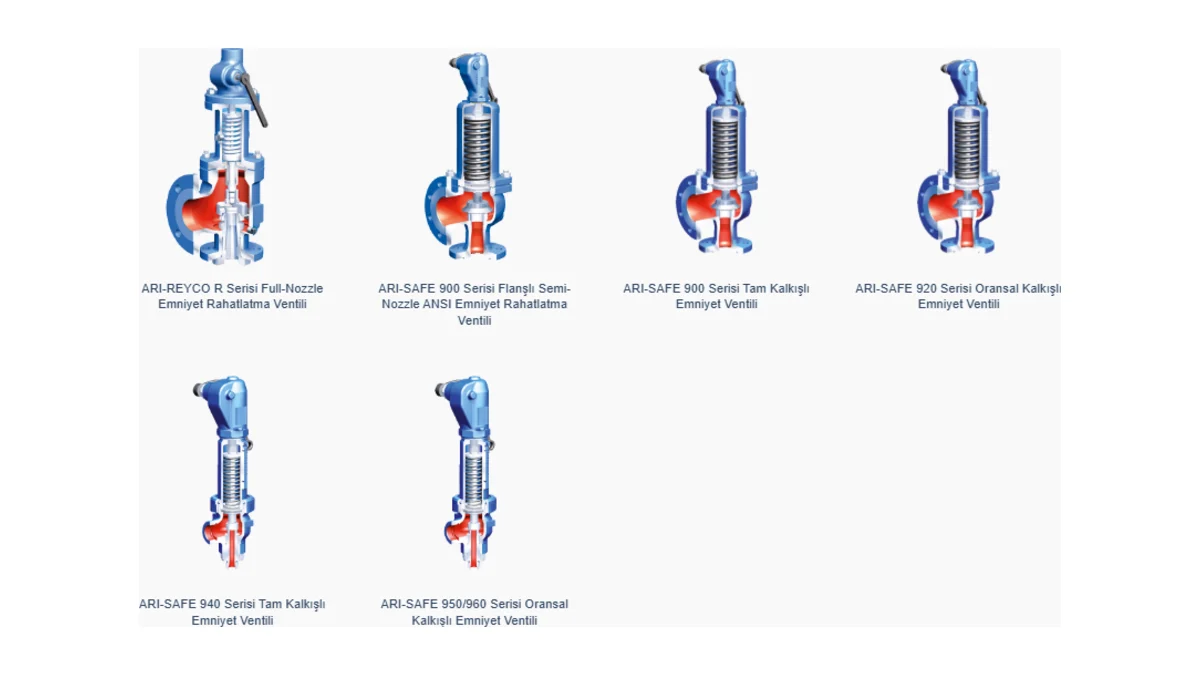
In sectors such as petrochemicals, power generation, chemicals and food processing, the safety of pressurised systems is a top priority. Unexpected pressure rises can cause equipment damage, production losses and serious accidents. Industrial safety valves are the last line of defence: they open automatically when pressure exceeds the permitted limit and protect the system. In this field, ORFA supplies ARI-Armaturen safety valves.
This article explains how safety valves work, the main types, the ARI-Armaturen product series and the criteria to consider for correct selection.
What Is a Safety Valve and How Does It Work?
A safety valve opens by itself, without any external energy, when system pressure reaches the preset opening pressure (set pressure), and discharges the excess pressure. In normal operation the disc is held against the seat by spring force and the valve stays closed. When the pressure force exceeds the spring force, the disc lifts and the medium is discharged. Once the pressure falls back to a safe level, the valve closes again.
Safety valves protect pressure equipment such as steam boilers, pressure vessels, heat exchangers, compressors and pipelines.
Full Lift and Proportional Lift Safety Valves
| Type | Operation | Typical medium |
|---|---|---|
| Full lift | Opens suddenly and fully with a small pressure rise once set pressure is reached, giving high discharge capacity. | Steam, gas, air |
| Proportional lift | Opens gradually, in proportion to the pressure rise. | Liquids |
ARI-Armaturen Safety Valve Series Supplied by ORFA
- ARI-REYCO R Series (API 526, full nozzle): ANSI/ASME flanged; for high-pressure applications and high relieving capacity, with material options for steam, gas and liquids.
- ARI-SAFE Series (Fig. 901/902/911/912), flanged: DIN/EN flanged, full-lift and standard-lift versions; grey cast iron, ductile iron, cast steel and stainless steel bodies. The semi-nozzle SAFE SN and the SAFE 900 versions developed for steam/hot water also belong to this family.
- ARI-SAFE-P Series (Fig. 921–924), flanged: For small relieving capacities, DN15–DN150; various body materials.
- ARI-SAFE-TC Series (Fig. 941–946), threaded: Full-lift and standard-lift versions for small-bore applications; DN15–DN25, PN40; ductile iron or stainless steel body.
- ARI-SAFE-TCS (Fig. 951–953) and ARI-SAFE-TCP (Fig. 961–963) Series, threaded: Stainless steel body, DN15–DN25, PN100; for high-pressure applications with set pressures up to 100 bar.
Selecting the Right Safety Valve
Safety valve selection and sizing directly affect system safety. The following data should be defined before ordering:
- Medium: Steam, gas, air or liquid.
- Set pressure: Chosen so as not to exceed the maximum allowable pressure of the protected equipment.
- Operating temperature: The system’s maximum operating temperature.
- Required relieving capacity: Enough to discharge the excess flow safely in the worst credible case.
- Connection type and size: Flanged or threaded, and inlet and outlet nominal sizes.
- Back pressure: The effect of pressure in the discharge line on valve selection.
- Material compatibility: Body and trim materials suited to the corrosive properties of the medium.
Frequently Asked Questions
What is the difference between a safety valve and a pressure reducing valve?
A pressure reducing valve is a control valve that continuously holds the outlet pressure at the desired value. A safety valve is normally closed and opens only when pressure reaches the set value, to protect the system.
Which type of safety valve should be used on steam lines?
For compressible media such as steam, gas and air, full lift safety valves are generally preferred. Proportional lift types are used for liquids.
Who should set a safety valve?
Setting and sealing the set pressure should be done by authorised, properly equipped persons or organisations. The setting must not be altered during operation.
Conclusion
Industrial safety valves are indispensable for the safety of pressurised systems and the people who work around them. Choosing a valve that matches the medium, set pressure and required capacity determines how effective the protection is. Explore ARI-Armaturen safety valve options in our safety valves product group, or contact the ORFA technical team for selection support.
Buy safety valves online
Browse products on or-fa.com, our export store, see prices in USD and order online.
Buy Online →Request a QuoteAsk on WhatsAppRelated product group
Safety Valves →Technical support
Talk to our team to choose the right product.
+90 224 444 67 32[email protected]
Related Articles
Let’s choose the right product for your project
Buy from our online store or request a project-specific quotation.