
Multi-Pump Booster Sets: Design and Working Principle
When a single pump cannot meet the water demand of a large building, booster sets with pumps operating in parallel take over. Learn how they work, their components and their advantages.
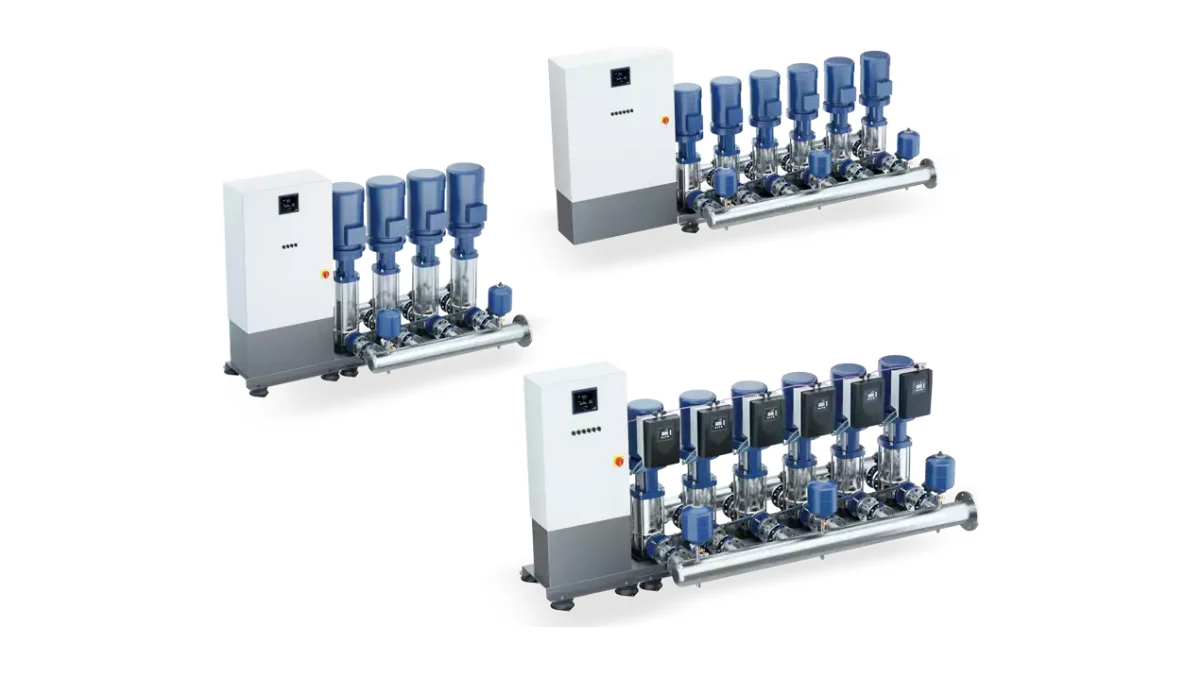
In high-rise residential buildings, housing complexes, hotels, hospitals and industrial plants, water consumption varies greatly through the day and a single pump is often not enough. Multi-pump booster sets are water pressure boosting systems in which several pumps operate in parallel to meet this variable demand and keep the network at a steady pressure.
This article explains the design, working principle, control methods, advantages and applications of multi-pump booster sets.
What Is a Multi-Pump Booster Set?
A multi-pump booster set is a skid-mounted system in which two or more pumps are connected in parallel to common suction and discharge manifolds, together with a pressure vessel, a control panel and auxiliary equipment. It adapts automatically to changes in demand and supplies the installation with water at the required pressure.
Working Principle
- Low demand: When consumption is low, only one pump runs.
- Rising demand: As pressure begins to fall, the control panel brings additional pumps on line one after another.
- Peak demand: At peak consumption all duty pumps run together, depending on the system design. In systems with a standby pump, one pump is held in reserve in case of failure.
- Pressure control: A pressure transmitter or pressure switches continuously monitor system pressure; pumps are switched off in sequence as demand falls.
The control panel also alternates the lead pump, so running hours are equalised and the pumps wear evenly.
Control Methods
| Method | How it works |
|---|---|
| Cascade (on/off) control | Pumps run at fixed speed and are switched on and off in sequence according to demand. Pressure fluctuates within a set band. |
| Variable speed (frequency inverter) control | Pump speeds are adjusted to demand; pressure is kept almost constant, energy is saved at part load and sudden pressure changes are reduced. |
Components
- Pumps: Usually 2, 3 or 4 units, mostly vertical multistage pumps in stainless steel or cast iron.
- Pressure vessel: Diaphragm tank sized for the system and the control type.
- Control panel: Microprocessor-based cascade or frequency inverter panel.
- Manifolds: Stainless steel or carbon steel suction and discharge manifolds.
- Fittings: An isolation valve and check valve on each pump, pressure transmitter or switch, pressure gauge.
- Protection: Level or pressure protection against dry running.
Advantages
- High flow capacity: Several pumps together meet high water demand.
- Energy efficiency: Only as many pumps as needed run; savings increase further with variable speed control.
- Stable pressure: The required pressure is maintained despite changing consumption.
- Redundancy: If one pump fails or is under maintenance, the others keep supplying water.
- Fully automatic operation: The control panel removes the need for operator intervention.
Applications
- High-rise buildings and housing complexes
- Shopping centres and office buildings
- Hotels and hospitals
- Schools and universities
- Industrial plants
- Water treatment plants
Frequently Asked Questions
When is a multi-pump booster set needed?
It is the right choice for buildings where water consumption is high and varies greatly through the day, and where supply interruptions are unacceptable. Multiple pumps provide both capacity and redundancy.
Variable speed or cascade booster set?
Where demand changes constantly and pressure stability matters, variable speed sets are more comfortable and energy-efficient. Cascade sets are simpler with a lower initial investment.
Why do the pumps alternate?
The control panel changes the lead pump in rotation to equalise running hours. This balances wear and extends pump life.
Conclusion
Multi-pump booster sets deliver stable pressure, redundancy and energy efficiency for large and variable water demand. With the right number of pumps and control type they provide a building with an uninterrupted, comfortable water supply. Explore the options in our booster sets and hydrophores product group.
Buy multi-pump booster sets online
Browse products on or-fa.com, our export store, see prices in USD and order online.
Buy Online →Request a QuoteAsk on WhatsAppRelated product group
Booster Sets and Hydrophores →Technical support
Talk to our team to choose the right product.
+90 224 444 67 32[email protected]
Related Articles
Let’s choose the right product for your project
Buy from our online store or request a project-specific quotation.