
Pump Control Valve: Preventing Water Hammer at Pump Start-Up and Shutdown
Learn the operating sequence, check valve function, settings and correct installation of the hydraulic pump control valve fitted at the pump discharge.
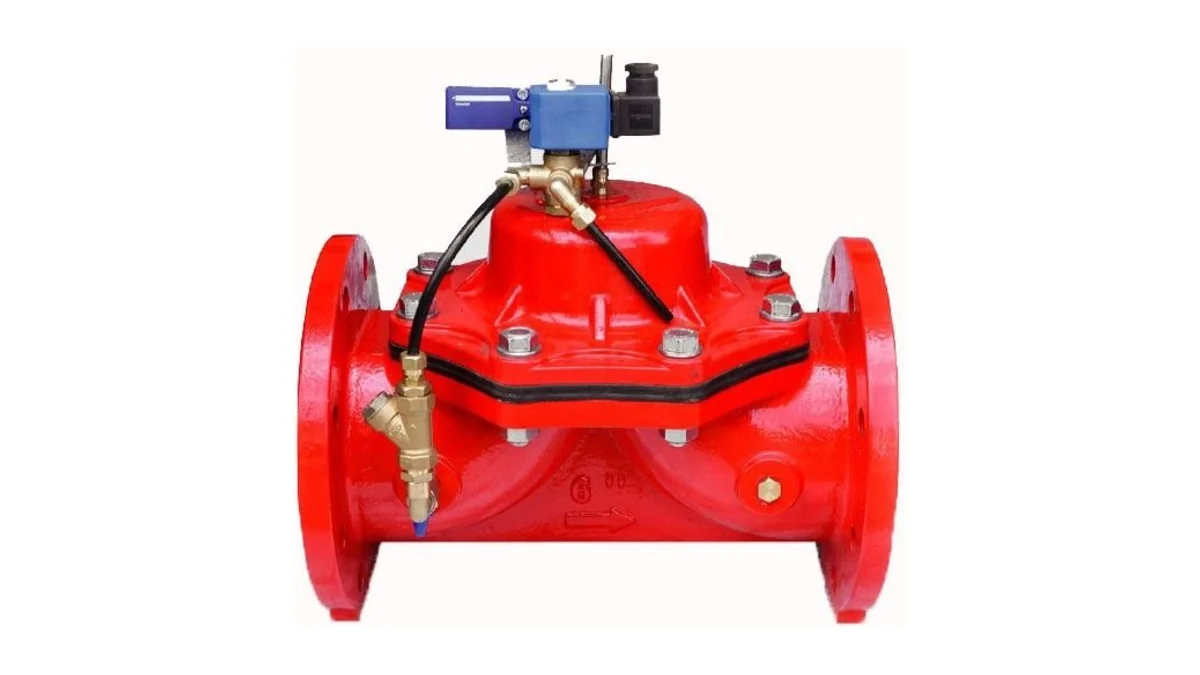
Starting and stopping centrifugal pumps directly causes sudden changes in flow and, as a result, water hammer (pressure surges) in the line. A pump control valve is a hydraulic control valve installed in series at the pump discharge; it connects the pump to the system slowly and in a controlled way, and disconnects it just as gently when the pump is stopped.
Also called a booster pump control valve or pump protection control valve, it also acts as a check valve and prevents reverse flow – protecting the pump as well as the pipeline and fittings.
What Is a Pump Control Valve?
A pump control valve consists of a line-pressure-operated diaphragm or piston main valve, a solenoid pilot that controls the main valve’s control chamber, adjusters that set the opening and closing speeds, and a limit switch that signals when the valve is closed. The valve works together with the pump control panel (pump controller, timer relay or PLC).
Operating Sequence
Pump start-up
- The control panel starts the pump while the main valve is closed.
- When pump pressure exceeds line pressure, the solenoid pilot vents the main valve’s control chamber.
- The main valve opens slowly at the set speed; flow increases gradually and no surge is generated.
Pump shutdown
- The stop command goes first to the solenoid pilot, not to the pump.
- While the pump keeps running, the main valve closes slowly at the set speed using pump pressure.
- When the valve is fully closed, the limit switch signals the control panel, and only then is the pump stopped.
Thanks to this sequence the flow is never cut off abruptly, and the risk of water hammer during start-up and shutdown is minimised.
On power failure
On a sudden power failure the pump cannot be stopped in a controlled way. In that case the valve behaves like a check valve as pump pressure drops and closes before reverse flow begins. For long, high-pressure transmission lines, additional measures against power-failure surges – such as surge anticipating valves or surge vessels – should be evaluated.
Features and Benefits
- Automatic, synchronised operation: The control panel manages the sequence between pump and valve; no manual intervention is needed.
- Surge prevention: Gradual opening and closing prevent pressure surges at start-up and shutdown.
- Hydraulic check valve function: Prevents reverse flow when the pump stops or power fails.
- Adjustable opening and closing speeds: Needle valves allow the speeds to be set independently to suit the system.
- Low energy demand: The main valve is driven by line pressure; electricity is needed only for the solenoid pilot.
- Easy maintenance: Internal parts such as the diaphragm and seals can be reached by removing the cover, without taking the valve out of the line.
Applications
- Municipal water booster and transmission stations
- Booster sets in buildings and plants
- Irrigation pumping stations
- Industrial process and cooling water pumps
- Pump stations with several pumps running in parallel
Installation Recommendations
- Install the valve at the pump discharge in line with the flow direction arrow.
- Fit isolating valves upstream and downstream for maintenance.
- Provide a filter in the control circuit and clean it regularly so the pilot circuit does not clog.
- Wire the limit switch and solenoid according to the operating sequence in the pump panel and test them during commissioning.
Frequently Asked Questions
Does a pump control valve replace a check valve?
The valve closes when the pump stops or power fails and thus prevents reverse flow – it acts as a hydraulic check valve. Whether an additional check valve is needed should be assessed for each project.
Why is the pump stopped only after the valve has closed?
Abruptly stopping the flow causes water hammer. When the valve closes slowly while the pump is still running, the flow decreases gradually to zero; the pump is stopped only after the limit switch confirms the valve is closed.
How are the opening and closing speeds adjusted?
Needle valves in the pilot circuit control how much water enters and leaves the control chamber, so opening and closing speeds can be set independently.
Conclusion
By connecting the pump to the system slowly and disconnecting it slowly, the pump control valve prevents water hammer and reverse flow and is an essential item in pump stations. Correct settings and proper synchronisation with the pump panel extend the life of both the pump and the installation. Explore other automatic control solutions on our Hydraulic Control Valves page.
Buy hydraulic control valves online
Browse products on or-fa.com, our export store, see prices in USD and order online.
Buy Online →Request a QuoteAsk on WhatsAppRelated product group
Hydraulic Control Valves →Technical support
Talk to our team to choose the right product.
+90 224 444 67 32[email protected]
Related Articles
Let’s choose the right product for your project
Buy from our online store or request a project-specific quotation.