
Solenoid Controlled Pressure Reducing Valve: Pressure Reduction with Remote On-Off
Learn how a hydraulic control valve combining a pressure reducing pilot with a solenoid pilot works, how it is set, how to choose NC or NO and where it is used.
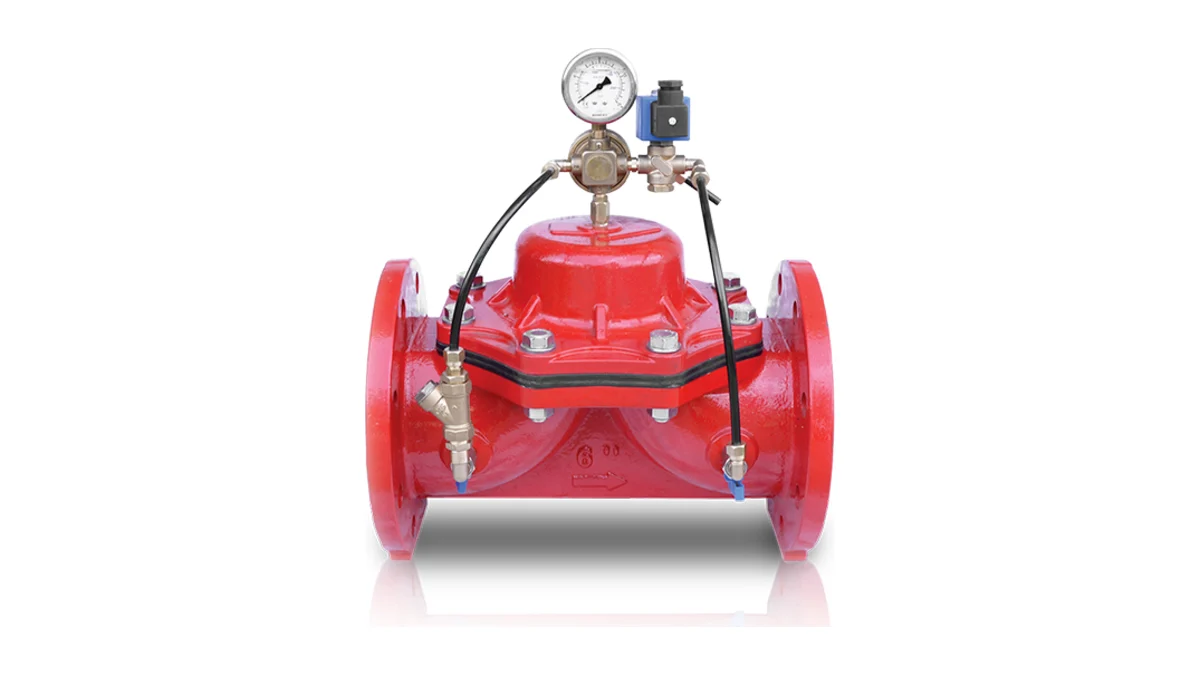
Water distribution networks, irrigation systems and plant water lines often need two things at once: reducing a high inlet pressure to a safe value, and opening or shutting the line remotely and automatically. A solenoid controlled pressure reducing valve is a pilot-operated hydraulic control valve that combines both functions in a single body.
The valve keeps the set outlet pressure constant regardless of changes in flow and inlet pressure, while an electric signal determines whether the valve operates in pressure reducing mode or shuts off completely.
What Is a Solenoid Controlled Pressure Reducing Valve?
It consists of a line-pressure-operated diaphragm main valve, an adjustable pressure reducing pilot mounted on the main valve and a solenoid pilot valve. No external energy is needed to move the main valve; it operates using the pressure of the water in the line. Electricity is used only to drive the solenoid coil.
Operating Principle
Pressure reduction
The pressure reducing pilot continuously senses the outlet pressure:
- If outlet pressure rises above the set point, the pilot throttles, pressure builds in the main valve’s control chamber and the main valve moves towards closing.
- If outlet pressure falls below the set point, the pilot releases pressure from the control chamber and the main valve moves towards opening.
This continuous balance keeps the outlet pressure at the set value even when flow and inlet pressure change.
On-off control by solenoid
The solenoid pilot controls the pressure applied to the main valve’s control chamber. Depending on the signal from a controller, timer relay, switch or PLC:
- with the solenoid in the “operate” state, the valve works as a pressure reducing valve;
- with the solenoid in the “close” state, pressure is applied to the control chamber and the valve shuts completely.
Important: the outlet pressure value is not set by the electric signal but by the adjusting screw on the pressure reducing pilot. The solenoid controls whether the valve is regulating or closed.
NC and NO Options
| Type | Solenoid energised | Solenoid de-energised | Suitable for |
|---|---|---|---|
| Normally closed (NC) | Reduces pressure | Valve closed | Systems where closing on power failure is safe (e.g. irrigation zones) |
| Normally open (NO) | Valve closed | Reduces pressure | Systems where supply must continue on power failure |
For battery-operated controllers, models with latching (permanent magnet) solenoids can be used to save energy.
Advantages
- Two functions in one valve: Pressure reduction and remote on-off without separate valves.
- Stable outlet pressure: The set pressure is maintained despite changes in flow and inlet pressure.
- Easy automation: Connects directly to PLCs, timer relays or irrigation controllers.
- Low energy use: The main valve is driven by line pressure; electricity is used only for the solenoid.
- Manual override: Many models have a manual open/close facility on the solenoid or pilot circuit.
- Easy maintenance: The diaphragm and internals can be accessed without removing the valve from the line.
Applications
- Water distribution networks and reservoir outlets
- Zone control in agricultural irrigation
- Water supply lines in buildings and plants
- Industrial process and cooling water lines
- Water supply lines of HVAC systems
- Water systems on ships and marine structures (with suitable materials)
For fire protection systems, use pressure reducing valves made for fire service and carrying the relevant approvals (e.g. UL/FM or local regulations).
Installation and Adjustment
- Installation: The valve can be installed horizontally or vertically according to the flow arrow on the body; check the manufacturer’s instructions for the preferred position.
- Protection: Fit a strainer upstream and isolating valves on both sides. A pressure gauge on the outlet and, where needed, a relief/safety valve are recommended.
- Electrical connection: Select and connect the solenoid coil to match the output voltage of the controller (AC or DC).
- Pressure setting: With the valve in pressure reducing mode and water flowing, turn the pilot adjusting screw until the outlet gauge shows the required value. The pilot’s adjustment range depends on its spring, so choose a spring that suits the required outlet pressure.
Frequently Asked Questions
Can the outlet pressure be changed by the electric signal?
Not on standard solenoid controlled pressure reducing valves. The outlet pressure is set with the adjusting screw on the pilot; the solenoid controls whether the valve operates or closes.
What happens on power failure?
It depends on the solenoid type. NC valves close when power is lost, while NO valves continue to reduce pressure.
Does the valve need electric power to operate?
The main valve is moved by the water pressure in the line. Electricity is needed only for the solenoid pilot.
Conclusion
Solenoid controlled pressure reducing valves keep line pressure at a safe, constant value while allowing the line to be controlled remotely and automatically. With the right pilot spring, the right solenoid type and correct installation they deliver stable operation for many years. See other pilot-operated valves on our Hydraulic Control Valves page.
Buy hydraulic pressure reducing valves online
Browse products on or-fa.com, our export store, see prices in USD and order online.
Buy Online →Request a QuoteAsk on WhatsAppRelated product group
Hydraulic Control Valves →Technical support
Talk to our team to choose the right product.
+90 224 444 67 32[email protected]
Related Articles
Let’s choose the right product for your project
Buy from our online store or request a project-specific quotation.