
What Is a Gate Valve? Operating Principle, Types and Applications
Learn the operating principle, stem and seat types, advantages, limitations and applications of gate valves that fully open or completely shut off flow.
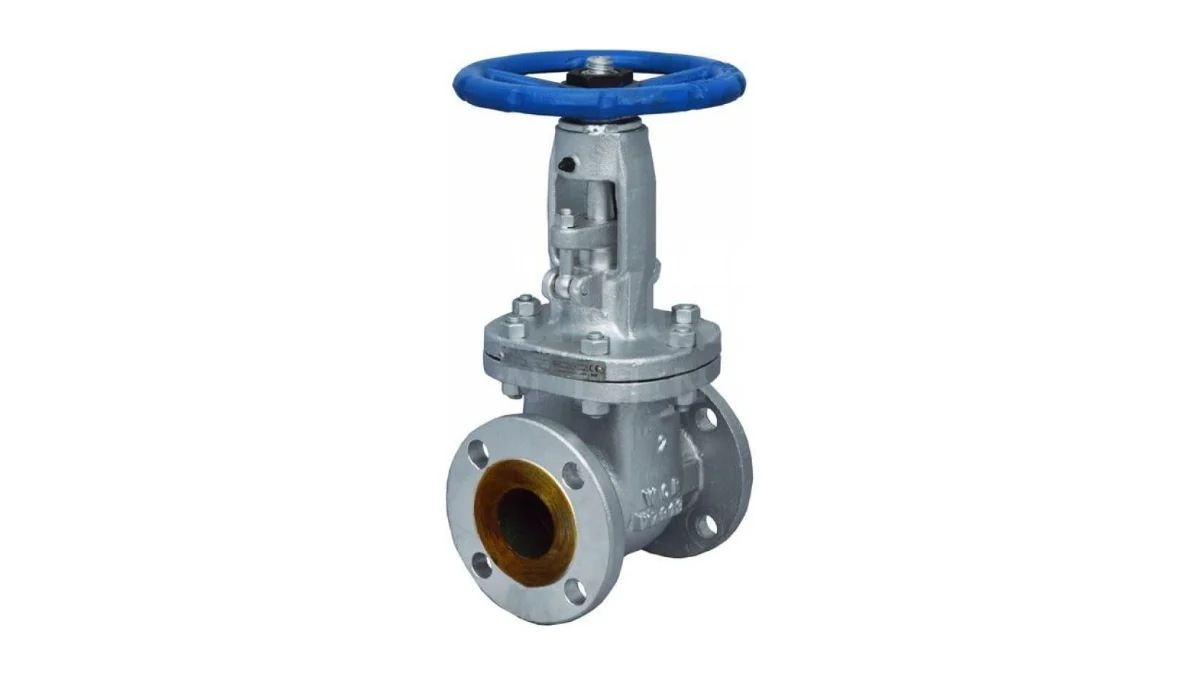
In industrial plants and water systems, lines must be safely opened and shut off for both maintenance and operational safety. One of the most common valves for this job is the gate valve. A gate valve either lets the flow pass completely or shuts it off completely, and it is widely used, especially on large-diameter lines.
This article covers the operating principle, types, advantages and limitations of gate valves, as well as their industrial applications.
What Is a Gate Valve?
A gate valve takes its name from the gate (wedge) that closes the flow path like a door. The gate moves perpendicular to the direction of flow. In the fully open position it is withdrawn completely from the flow path, so the medium meets almost no obstruction and pressure drop is very low. In the fully closed position the gate covers the whole bore and stops the flow.
Gate valves are on-off (isolation) valves. They are ideal where frequent operation is not required and low pressure drop across the line is wanted.
Operating Principle
The stem is turned by a handwheel or actuator; its thread converts the rotation into the up-and-down movement of the gate.
- Opening: As the stem turns, the gate is drawn upwards and the flow path opens.
- Closing: Turning the stem the other way lowers the gate until it seats and shuts off the flow.
Because the gate must travel its full stroke, gate valves take longer to open and close than quarter-turn ball or butterfly valves.
Types of Gate Valves
By stem design
- Rising stem: The stem rises as the valve opens, so its position shows from outside whether the valve is open or closed.
- Non-rising stem: The stem rotates in place and only the gate moves. Suitable for buried and confined installations.
By sealing design
- Metal seated: The gate seats against metal seats; used at higher temperatures and pressures, for example on steam and process lines.
- Resilient (elastomer) seated: The gate is rubber-coated, giving tight shut-off in water service.
By end connection
Threaded models are common in small sizes and flanged models in large sizes. Weld-end models are also available for high-pressure and high-temperature service.
Advantages and Limitations
| Advantages | Limitations |
|---|---|
| Very low pressure drop when fully open | Not suitable for flow regulation (throttling) |
| Suitable for flow in both directions | Longer opening and closing time |
| Simple, robust design | Tall and heavy in large sizes |
Applications
- Water treatment and distribution: Shutting off large water mains and isolating network sections.
- Power plants: Cooling water, steam and auxiliary systems, with models suited to high temperature and pressure.
- Chemical industry: On chemical lines, with gate valves made of materials compatible with the medium.
- Petrochemical plants: Shutting off crude oil and refined product lines.
- HVAC systems: Isolating water lines in large heating and cooling installations.
Frequently Asked Questions
Should I choose a gate valve or a ball valve?
Both are on-off valves. A ball valve operates quickly with a quarter turn; a gate valve is an economical solution especially in large sizes, on lines that are operated infrequently and where low pressure drop is required.
What is the difference between rising and non-rising stem gate valves?
On a rising stem valve the stem moves up as the valve opens and the position is visible from outside. On a non-rising stem valve the stem rotates in place; the valve height does not change, making it suitable for confined spaces and buried installation.
Can a gate valve be installed in either flow direction?
Most wedge gate valves are suitable for flow in both directions. If the valve body carries a flow arrow, follow the manufacturer’s instructions.
Conclusion
With their simple, robust design, low pressure drop and wide range of applications, gate valves are among the basic isolation devices in industrial flow control. Choosing the right stem, seat and connection type ensures a long service life. Explore models of different types and sizes in our gate valves product group.
Buy gate valves online
Browse products on or-fa.com, our export store, see prices in USD and order online.
Buy Online →Request a QuoteAsk on WhatsAppRelated product group
Gate Valves →Technical support
Talk to our team to choose the right product.
+90 224 444 67 32[email protected]
Related Articles
Let’s choose the right product for your project
Buy from our online store or request a project-specific quotation.