
Solvent Weld U-PVC Fittings
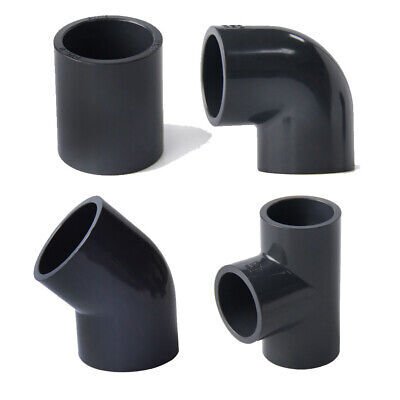
Solvent cement U-PVC fittings are socketed parts in which the rigid PVC pipe end is solvent welded into the fitting socket to form a permanent, leak-tight joint.
They are used on pool, treatment, irrigation main and chemical process lines. Ten fitting types from elbows to unions are in this group; size and pressure class depend on the model.
Main Applications
- Pool circulation lines
- Water treatment plants
- Irrigation mains and distribution lines
- Chemical process lines
- Industrial cold water lines
Technical Data
| Fitting types | Elbow, tee, reducing tee, cross, socket, reducing socket, reducer, end cap, stub flange, union |
|---|---|
| Material | U-PVC (depending on model) |
| Connection | Solvent cement (socketed) |
| Sizes | Depending on model, please ask |
| Pressure class | Depending on model |
| Temperature | Cold water, limit depending on model |
| Cement | Solvent cement suited to U-PVC |
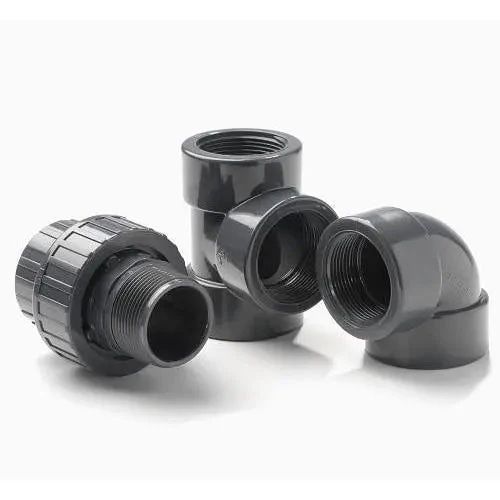
| Threaded type | With threaded U-PVC fittings |
Material Options
| Part | U-PVC (pressure) | PVC drainage | PPR |
|---|---|---|---|
| Body | Unplasticised rigid PVC | PVC | PP-R |
| Connection | Solvent cement or thread | Gasketed socket or solvent cement | Socket fusion welding |
| Pressure | Pressure lines (PN depending on model) | Non-pressure (gravity) lines | Pressure lines |
| Hot water | Not suitable | Not suitable (depending on model) | Suitable |
| Use | Cold clean water, pools, chemicals | Soil and rainwater | Hot and cold domestic water |
Which material? In a solvent joint the pipe end is chamfered, surfaces are cleaned and, after cement is applied, the pipe is pushed into the socket in one movement; the line must not be pressurised before the curing time recommended by the manufacturer.
Advantages
Permanent Seal
- Pipe and socket fuse
No Equipment Needed
- Cement and brush are enough
Wide Choice of Parts
- 10 types
Chemical Resistance
- Per fluid (depending on model)
Construction and Design Features
- Socketed U-PVC body
- Socket bore matched to pipe outside diameter
- Detachable face on stub flanges and unions
- One piece (except unions)
Send the pipe size, fitting types and quantities as a list; we will confirm stock of solvent cement U-PVC fittings.
How to Choose?
- Measure the pipe sizeDetermine the U-PVC pipe outside diameter.
- Draw up the parts listCount elbows, tees, sockets and transitions from the line plan.
- Define removal pointsPlace unions or stub flanges in front of equipment.
- Respect the curing timePressure test after the cement has cured.
Complementary Products
Why ORFA?
Types of Solvent Weld U-PVC Fittings

U-PVC Solvent Weld Elbows
U-PVC solvent weld elbows change direction on rigid PVC lines and are joined with solvent cement.
Details →
U-PVC Solvent Weld Unions
U-PVC solvent weld unions are fitted to rigid PVC lines with solvent cement and give a removable joint.
Details →
U-PVC Solvent Weld Reducing Tees
U-PVC solvent weld reducing tees are used to take a smaller branch off a rigid PVC line.
Details →
U-PVC Solvent Weld Stub Ends
U-PVC solvent weld stub ends prepare the end of a rigid PVC pipe for a flanged connection.
Details →
U-PVC Solvent Weld End Caps
U-PVC solvent weld end caps close the end of a rigid PVC pipe with solvent cement.
Details →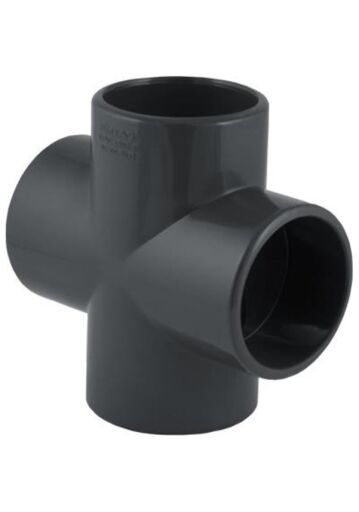
U-PVC Solvent Weld Crosses
U-PVC solvent weld crosses split flow in four directions on rigid PVC lines.
Details →
U-PVC Solvent Weld Reducing Couplers
U-PVC solvent weld reducing couplers join two rigid PVC pipes of different sizes.
Details →
U-PVC Solvent Weld Couplers
U-PVC solvent weld couplers join two rigid PVC pipes in a straight line with solvent cement.
Details →
U-PVC Solvent Weld Reducers
U-PVC solvent weld reducers are used to change pipe size on rigid PVC lines.
Details →
U-PVC Solvent Weld Tees
U-PVC solvent weld tees split flow in three directions on rigid PVC lines.
Details →Other U-PVC Fittings
Get a quote for your project
Our sales team will prepare the best solution for your needs.