
Horizontal Multistage Pumps: Design, Types and Applications
Horizontal multistage pumps use impellers in series on a horizontal shaft to reach pressures a single-stage pump cannot. Learn about their design, main types and where they are used.
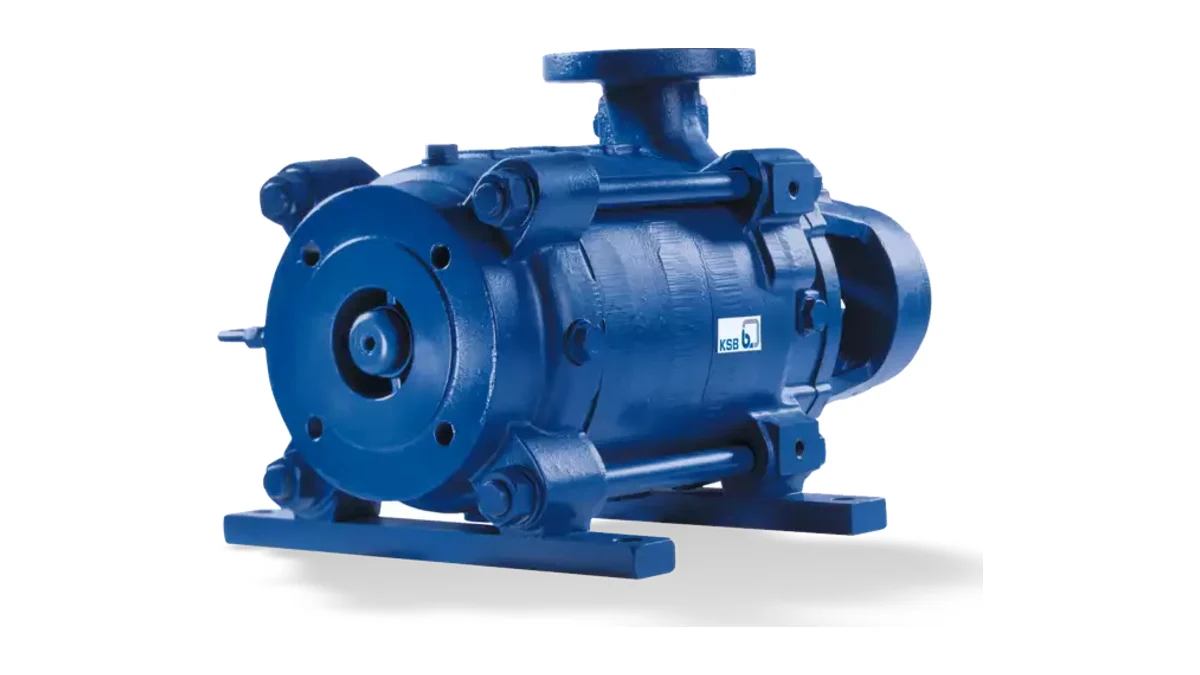
In applications such as boiler feed, water pressure boosting, reverse osmosis and high-pressure washing, the pressure a single impeller can generate is often not enough. A horizontal multistage pump is a centrifugal pump with several impellers arranged in series on the same horizontal shaft, each stage raising the pressure a little further. This design achieves high head at moderate flow rates.
This article covers the design, working principle, main types, advantages and applications of horizontal multistage pumps.
What Is a Horizontal Multistage Pump?
A horizontal multistage pump is a centrifugal pump with its motor and shaft in a horizontal position and two or more impellers (stages) connected in series on the shaft. Each stage consists of an impeller and a diffuser that guides the liquid to the inlet of the next impeller. The total head of the pump is approximately the sum of the stage heads, while the flow rate is independent of the number of stages.
Working Principle
- Inlet: Liquid enters the first-stage impeller through the suction nozzle.
- Stage-by-stage pressure rise: Each impeller adds energy; the diffuser converts velocity into pressure and guides the liquid to the next impeller.
- High-pressure discharge: After passing through all stages, the liquid leaves the discharge at the required pressure.
As stages are added, axial thrust builds up on the impellers. In large, high-pressure pumps this force is balanced with a balancing disc or drum, or with opposed impellers.
Main Types
| Type | Design | Typical use |
|---|---|---|
| Compact (close-coupled) horizontal multistage | Motor and pump in one unit; usually stainless steel impellers and diffusers | Pressure boosting in homes and small buildings, irrigation, small booster sets |
| Ring-section (segmental) horizontal multistage | Stage casings clamped together with tie bolts; shaft supported at both ends, coupled motor on a baseplate | Boiler feed, industrial processes, high-pressure water transfer |
Advantages
- High pressure: Head can be increased by adding stages.
- Efficiency: Uses energy efficiently in high-pressure duties when operated at the right point.
- Long service life: Robust construction and suitable materials ensure long operation under heavy duty.
- Easy maintenance: The horizontal layout gives easy access to pump and motor; modular stages can be replaced when needed.
- Flexibility: The same hydraulic design can be adapted to different pressures by changing the number of stages.
Applications
- Water supply and pressure boosting systems
- Steam boiler feed
- Industrial process water
- Reverse osmosis and water treatment systems
- Cooling and heating circuits
- Agricultural irrigation and sprinkler systems
- High-pressure water transfer in mining and construction
- Fire-fighting systems (as approved pump sets complying with the relevant standards)
Horizontal or Vertical?
Horizontal multistage pumps offer easier maintenance access and suit larger capacities, while vertical multistage pumps take up less floor space. Vertical types are preferred where space is tight; horizontal types where ease of maintenance and high power matter.
Frequently Asked Questions
Does the flow increase with more stages?
No. The stages are in series, so the liquid passes through every impeller in turn; adding stages increases head, while flow is determined by impeller size and speed.
Can a horizontal multistage pump be used for boiler feed?
Yes, steam boiler feed is one of the most common applications. Materials and sealing must be chosen with the feedwater temperature and the pump’s NPSH requirement in mind.
What is the main difference between horizontal and vertical multistage pumps?
The working principle is the same; the difference is in mounting position and design. Vertical pumps take up less space, while horizontal pumps are easier to maintain and better suited to large capacities.
Conclusion
Horizontal multistage pumps are reliable, efficient solutions for water supply, boiler feed and process applications that need high pressure at moderate flow. A pump selected with the right number of stages, materials and sealing will run trouble-free for many years. Browse the models in our horizontal multistage pumps product group, or contact ORFA at +90 224 444 67 32 or [email protected] for selection support.
Buy horizontal multistage pumps online
Browse products on or-fa.com, our export store, see prices in USD and order online.
Buy Online →Request a QuoteAsk on WhatsAppRelated product group
Horizontal Multistage Pumps →Technical support
Talk to our team to choose the right product.
+90 224 444 67 32[email protected]
Related Articles
Let’s choose the right product for your project
Buy from our online store or request a project-specific quotation.