
Self-Acting Pressure Reducing Valve: Bellows-Balanced Design and Installation
Learn about the design, advantages and installation rules of bellows-balanced, actuator-type self-acting pressure reducing valves that keep outlet pressure constant without external energy.
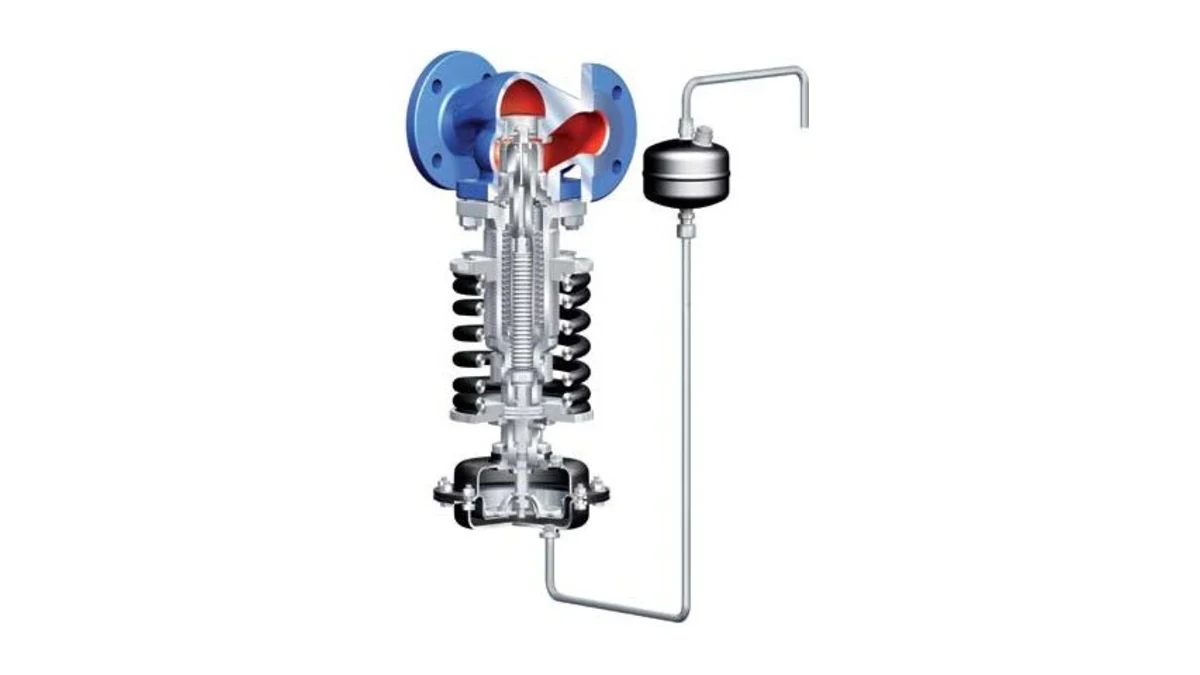
In sectors such as energy, refining, petrochemicals, chemicals, food and paper, reducing the pressure of steam and other media to a level suitable for the process is essential for both equipment safety and energy efficiency. A self-acting pressure reducing valve (also called a direct-acting or self-operated pressure regulator) is a control valve that needs no external energy such as electricity or compressed air. It is operated by the pressure of the medium itself and keeps the outlet pressure at the set value even when the inlet pressure changes.
This article covers the design, advantages, applications and installation rules of actuator-type, bellows-balanced self-acting pressure reducing valves.
How Does a Self-Acting Pressure Reducing Valve Work?
In this type of valve, the downstream (reduced) pressure is transmitted to a diaphragm actuator through a control line tapped from the outlet pipework. The actuator diaphragm compares the force created by the outlet pressure with the force of the set point spring:
- If the outlet pressure rises above the set point, the diaphragm overcomes the spring and throttles the valve,
- If the outlet pressure falls, the spring opens the valve and more medium flows through.
In the spring-loaded, single-seated valve, the effect of the inlet and outlet pressures on the plug is balanced by a balancing bellows. As a result, changes in inlet pressure do not affect the valve position, giving precise pressure control. The set point is adjusted with the set point spring on the actuator.
Advantages
- Pillarless design: The actuator is connected to the valve body with a threaded connection and a quick coupling. Any fault in the actuator, control line or balancing (condensate) pot can therefore be repaired on site without removing the valve body from the line.
- Complete package: Supplied as standard as a package including the valve with actuator, a stainless steel hose between actuator and pot, the balancing pot, a needle valve, an elbow nipple pipe for support, fittings and a flow restrictor.
- Precise pressure control: The bellows-balanced design provides a stable outlet pressure independent of inlet pressure changes.
- Low noise: The standard conical plug is suitable for low-noise operation.
- No external energy: Operated by the pressure of the medium itself.
- Low maintenance: Simple, robust construction requires little maintenance.
Applications
- Power generation plants
- Refineries
- Petrochemical plants
- Chemical industry
- Food plants
- Paper mills
Installation Notes
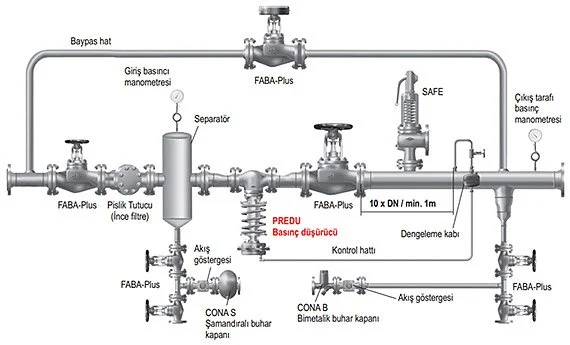
- Install the valve in a horizontal pipeline; in steam service the actuator should hang downwards.
- Flow must follow the arrow on the valve body.
- To prevent condensate collecting in the valve, slope the pipeline slightly downwards on both sides of the valve.
- Connect the control line to the side of the downstream pipe, at mid-height, at least 1 metre from the valve outlet, rising towards the balancing pot at a slope of about 1:10.
- Install the balancing pot in the orientation marked “top” on it. Its position depends on where the control line is tapped (e.g. at the highest point of the pipeline, or level with the valve flange or the tapping point); follow the manufacturer’s installation instructions.
Frequently Asked Questions
Does a self-acting pressure reducing valve need electricity or air?
No. It is operated by the medium pressure transmitted to the actuator through the control line and by the set point spring; no external energy is required.
What does the balancing bellows do?
It balances the forces that the inlet and outlet pressures create on the plug, so the valve position is not affected by inlet pressure changes and the outlet pressure stays stable.
Where should the control line be connected?
On a straight section of pipe at least 1 metre downstream of the valve outlet; a signal taken too close to the valve can cause unstable control due to turbulence.
Conclusion
Self-acting pressure reducing valves deliver precise, stable pressure control without external energy, and their pillarless design allows faults to be repaired without removing the valve from the line. Installed according to the correct rules, they contribute significantly to safe and efficient plant operation. Explore our pressure control solutions on the Pressure Control Valves page.
Buy pressure reducing valves online
Browse products on or-fa.com, our export store, see prices in USD and order online.
Buy Online →Request a QuoteAsk on WhatsAppRelated product group
Pressure Control Valves →Technical support
Talk to our team to choose the right product.
+90 224 444 67 32[email protected]
Related Articles
Let’s choose the right product for your project
Buy from our online store or request a project-specific quotation.