
What Is a Self-Priming Pump? Working Principle, Types and Uses
After an initial fill, self-priming pumps evacuate the air in the suction line themselves and can lift water from below the pump. Learn how they work and what their limits are.
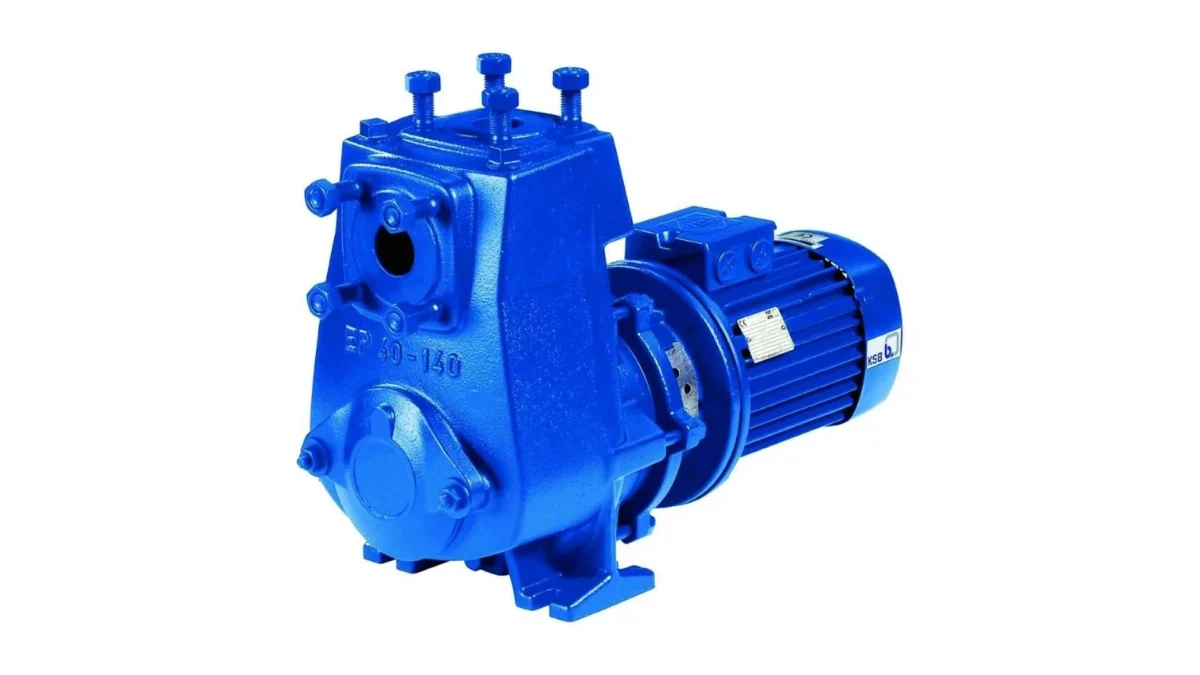
Standard centrifugal pumps cannot pump air; if there is air in the suction line, they cannot start drawing water. This is a serious problem where the pump sits above the water level and the suction line cannot be guaranteed to stay full between starts. A self-priming pump solves it by evacuating the air in the suction line by itself after an initial fill.
This article summarises how self-priming pumps work, their limits, the main types and their applications.
What Is a Self-Priming Pump?
A self-priming pump is a pump whose casing design allows it to expel air from the suction line and draw water even when the line contains air. It is very convenient where the pump is above the water level, air can collect in the suction line or suction is occasionally interrupted.
Working Principle
In self-priming centrifugal pumps, the casing is designed so that a quantity of water always remains inside. The pump therefore only needs to be filled by hand at the first installation.
- Initial fill: The pump casing is filled with water through the priming plug.
- Air-water mixing: When the pump starts, the impeller mixes the water in the casing with air coming from the suction line.
- Separation: The mixture is delivered into a separation chamber in the casing; air escapes through the discharge while water returns to the impeller.
- Vacuum build-up: As air is evacuated, pressure in the suction line falls and atmospheric pressure pushes water up the suction line.
- Normal operation: Once the suction line is full of water, the pump delivers like a normal centrifugal pump.
Jet pumps achieve the same result with an ejector integrated into the casing: part of the delivered water is passed through a nozzle at high velocity, creating low pressure on the suction side.
Limits of Suction Lift
A self-priming pump does not “pull” water; it lowers the pressure in the suction line and atmospheric pressure pushes the water up. The theoretical suction lift is therefore limited to about 10 metres for cold water at sea level. In practice, pipe losses, water temperature and the cavitation margin reduce this to around 7–9 metres depending on pump type; take the exact value from the manufacturer’s data. Use submersible pumps for deeper wells.
Main Types
- Jet pumps: Ejector design, a common solution for clean water supply from shallow wells and tanks.
- Self-priming centrifugal pumps: Pumps with a separation-chamber casing for transfer and irrigation.
- Solids-handling self-priming pumps: Special types designed for construction and wastewater applications.
- Positive displacement pumps: Diaphragm and similar pumps have a certain suction capability by their working principle.
Benefits
- Practical use: Can draw water even with air in the suction line.
- Reliability: Re-primes without external filling if suction is lost or air enters the line.
- Flexible installation: The pump can be placed above the water level in an easily accessible spot.
- Wide range: Options are available in different flows, heads and casing materials.
Applications
- Water supply and transfer from tanks, cisterns and shallow wells
- Garden and agricultural irrigation
- Bilge water removal on boats
- Dewatering of foundations on construction sites (with suitable types)
- Transfer in wastewater treatment plants (with solids-handling types)
Frequently Asked Questions
Does a self-priming pump never need filling?
It does. The pump casing must be filled with water at the first installation. After that, the water retained in the casing lets the pump evacuate the air in the suction line by itself. Never run the pump dry.
How deep can a self-priming pump lift water?
The theoretical limit is about 10 metres; in practice it is usually around 7–9 metres depending on pump type and installation. Check the exact value in the manufacturer’s data.
Is a self-priming pump the same as a jet pump?
A jet pump is one type of self-priming pump and gets its suction capability from an integrated ejector. Self-priming centrifugal pumps reach the same result with a separation-chamber casing design.
Conclusion
Self-priming pumps provide practical, reliable water transfer where air may be present in the suction line and the pump sits above the water level. Respecting suction lift limits and choosing the right type are key to efficient operation. Browse self-priming jet pump models in our Jet Pumps product group.
Buy self-priming jet pumps online
Browse products on or-fa.com, our export store, see prices in USD and order online.
Buy Online →Request a QuoteAsk on WhatsAppRelated product group
Jet Pumps →Technical support
Talk to our team to choose the right product.
+90 224 444 67 32[email protected]
Related Articles
Let’s choose the right product for your project
Buy from our online store or request a project-specific quotation.