
What Is a Centrifugal Pump? Working Principle, Components and Types
We explain the basics of the centrifugal pump, the most common pump type in industry: how it works, its main components, its types and where it is used.
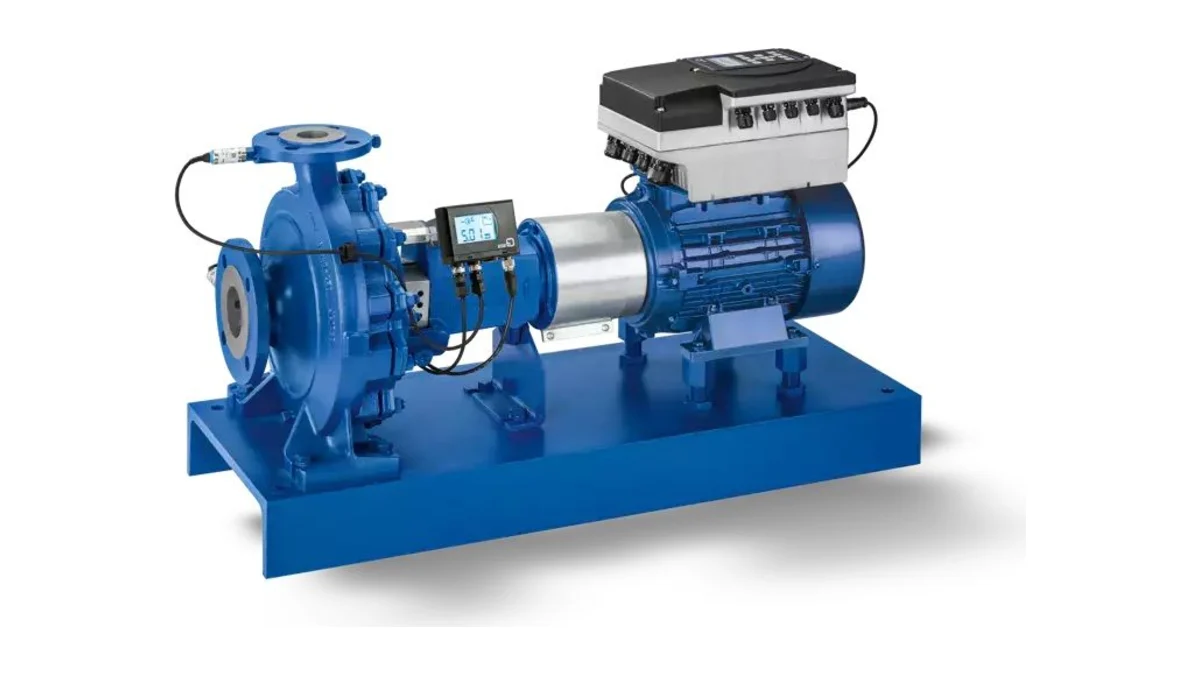
From water supply and chemical plants to heating systems and irrigation, the most widely used pump type for moving liquids is the centrifugal pump. A centrifugal pump is a simple, efficient machine that adds energy to a liquid through a rotating impeller in order to pressurise and transfer it. It is the first choice for applications that need high flow at moderate pressure and delivers a continuous, pulsation-free flow.
This article explains how a centrifugal pump works, its main components, its types and its applications.
What Is a Centrifugal Pump?
A centrifugal pump is a rotodynamic pump that transfers the mechanical energy of the motor to the liquid through a rotating impeller. The impeller accelerates the liquid outwards from the centre, and the casing converts part of this velocity into pressure. Unlike positive displacement pumps, the flow depends on the system resistance: as back pressure rises, flow decreases.
Working Principle
- Suction: As the impeller rotates, the pressure at its inlet (the eye) drops. The higher pressure on the suction side pushes the liquid into the pump.
- Acceleration: The vanes set the liquid in rotation and fling it outwards to the impeller rim; its velocity and pressure increase.
- Conversion and discharge: The liquid slows down in the volute or diffuser, part of its kinetic energy is converted into pressure, and it leaves through the discharge nozzle.
Main Components
| Component | Function |
|---|---|
| Impeller | Rotating part that adds energy to the liquid; can be open, semi-open or closed. |
| Casing (volute/diffuser) | Collects the liquid and converts part of its velocity into pressure. |
| Shaft | Transmits motor torque to the impeller. |
| Mechanical seal | Seals the point where the shaft passes through the casing. |
| Bearings | Support the shaft and carry radial and axial loads. |
| Motor | Drives the pump; usually an electric motor. |
Types of Centrifugal Pumps
- Standard (end-suction) centrifugal pumps: General liquid transfer and circulation.
- Self-priming centrifugal pumps: Once the casing has been filled, they can evacuate air from the suction line; suitable for drawing liquid from wells and tanks.
- Multistage centrifugal pumps: Several impellers in series build up pressure stage by stage; used where high pressure is needed.
- Chemical-resistant centrifugal pumps: Made from materials suited to corrosive or aggressive chemicals.
- Vertical centrifugal pumps: Space-saving; this group includes vertical multistage pumps and pumps immersed in tanks or wells.
Applications
- Water and wastewater treatment plants
- Chemical industry
- Oil and gas industry
- Food and beverage industry
- Power plants
- Building services, heating and cooling systems
- Agriculture and irrigation
Selection Checklist
- Fluid properties: Temperature, viscosity, density, corrosiveness and solids content.
- Flow and head: The actual duty point including system losses.
- Suction conditions: Adequate NPSH margin against cavitation.
- Materials: Casing, impeller and seal materials compatible with the fluid.
- Energy efficiency: Operation around the best efficiency point and an efficient motor.
- Installation and maintenance: Available space and service access.
Frequently Asked Questions
Why are centrifugal pumps suited to high flow rates?
The impeller accelerates the liquid continuously, so large flows can be handled by a compact pump. Where very high pressure is required, multistage centrifugal pumps are used.
What is the difference between a centrifugal and a positive displacement pump?
In a centrifugal pump, flow varies with system resistance. Positive displacement pumps (gear, diaphragm, piston, etc.) deliver a fixed volume per revolution, so their flow is largely independent of pressure.
Can a centrifugal pump run dry?
No. Dry running overheats and damages the mechanical seal. The casing and suction line must be filled with liquid before the pump is started.
Conclusion
With their simple design, high flow capacity and wide choice of models, centrifugal pumps are core equipment in industry and building services. Selected with suitable materials and the right duty point, they save energy and provide long service. Browse our centrifugal pumps page for available models, or ask the ORFA sales team for advice on your application.
Buy centrifugal pumps online
Browse products on or-fa.com, our export store, see prices in USD and order online.
Buy Online →Request a QuoteAsk on WhatsAppRelated product group
Centrifugal Pumps →Technical support
Talk to our team to choose the right product.
+90 224 444 67 32[email protected]
Related Articles
Let’s choose the right product for your project
Buy from our online store or request a project-specific quotation.