
Single-Pump Booster Sets: Components, Operation and Applications
A practical answer to low water pressure in houses and small businesses: the single-pump booster set. Learn about its components, operating cycle and key points for correct installation.
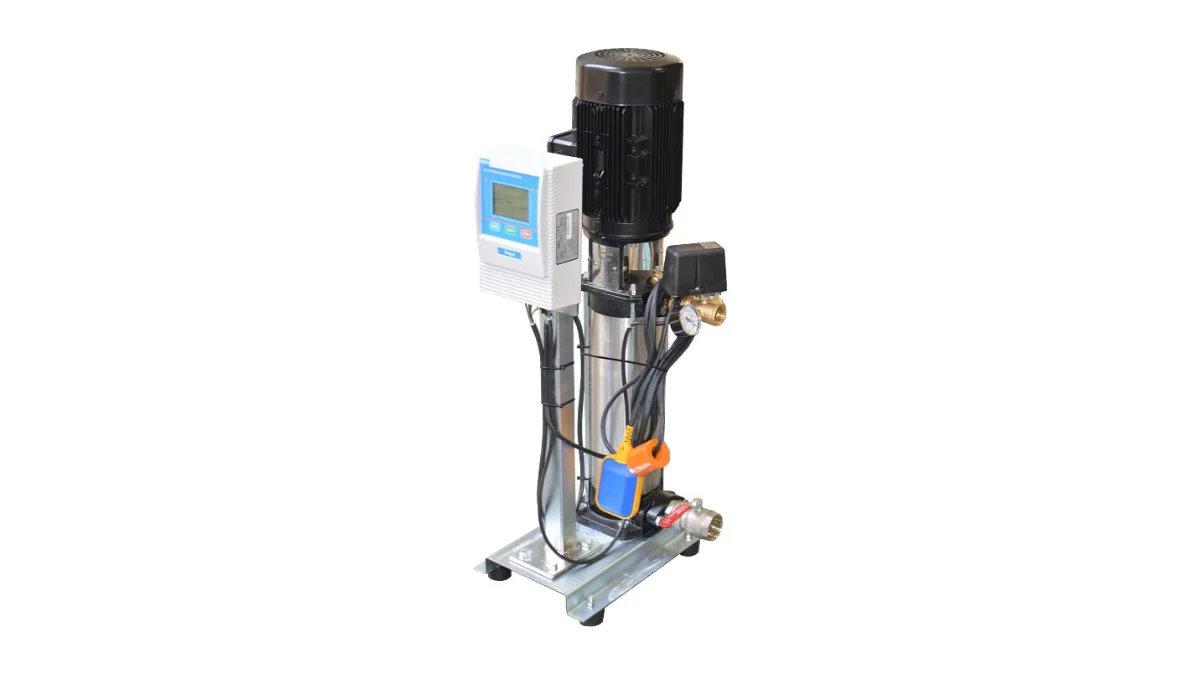
In detached houses, villas and small commercial premises, mains pressure or water from a storage tank is often not enough for comfortable use at taps and showers. A single-pump booster set (hydrophore) is a compact, economical system consisting of one pump, a pressure tank and automatic controls that raises water pressure.
This article covers the components and operating cycle of a single-pump booster set, its advantages and limits, typical applications and the main points to consider when selecting one.
What Is a Single-Pump Booster Set?
A single-pump booster set is a packaged system that takes water from a storage tank or, where permitted, from the mains, pressurises it and delivers it to the points of use. A pressure switch or electronic controller monitors the system pressure and starts and stops the pump automatically as needed.
Components
| Component | Function |
|---|---|
| Pump | Selected for the required flow and head; usually a centrifugal, jet or multistage pump. |
| Pressure (expansion) tank | Stores some pressurised water and prevents the pump from starting too often for small draws. |
| Pressure switch | Starts the pump when pressure falls to the lower setting and stops it at the upper setting. |
| Pressure gauge | Shows the system pressure. |
| Five-way fitting | Connects the pump outlet, tank, pressure switch, gauge and pipework at a single point. |
| Flexible hose | Connects the pressure tank to the fitting. |
| Control panel | Contains motor protection and the required control devices. |
How Does It Work?
- Demand starts: When a tap opens, water is first drawn from the pressure tank and system pressure falls.
- Pump starts: When pressure drops to the cut-in setting, the pump starts.
- Pressurisation: The pump supplies the points of use and refills the tank.
- Pump stops: When demand ends, pressure reaches the cut-out setting and the switch stops the pump.
- Tank supply: Small draws, such as filling a glass, are met from the tank without starting the pump.
Advantages and Limits
- Practical and economical: A simple, cost-effective way to raise water pressure.
- Compact: Takes little space and is easy to install.
- Automatic operation: Starts and stops without user intervention thanks to the pressure switch.
- Comfort: Provides adequate, steady pressure at the points of use.
- Limit: With only one pump there is no standby; if the pump fails, the water supply stops. Buildings with many simultaneous users or no tolerance for interruptions should use multi-pump booster sets.
Applications
- Detached houses and villas
- Garden irrigation
- Small businesses and workshops
- Guesthouses and small hotels
- Restaurants and cafés
Selection Criteria
- Water demand: Number of taps, showers and appliances used at the same time.
- Highest point of use: The elevation the water must reach and the pressure required there.
- Pipe size and length: Determine friction losses.
- Water source: Tank or mains; whether the pump will be above or below the liquid level.
- Power supply: Voltage and frequency suitable for the pump motor (single-phase/three-phase).
Frequently Asked Questions
What does the pressure tank in a booster set do?
The tank stores some pressurised water so that small draws are met without starting the pump. This reduces the number of pump starts and extends motor and switch life.
Why does my booster pump keep starting and stopping?
The most common cause is low tank pre-charge pressure or a damaged diaphragm. A leak in the pipework or a non-return valve that does not seal can also cause frequent starts.
Is a single-pump booster set enough for an apartment building?
Single-pump systems have no standby pump and limited capacity. For multi-apartment buildings, multi-pump booster sets are the better choice for both capacity and uninterrupted supply.
Conclusion
Single-pump booster sets are a practical, economical way to raise water pressure in small buildings. Combined with a correctly sized pump and tank and a properly set pressure switch, they ensure comfortable, trouble-free water use. Browse models of different capacities in our booster sets and hydrophores product group, or contact ORFA at +90 224 444 67 32 or [email protected] for selection support.
Buy single-pump booster sets online
Browse products on or-fa.com, our export store, see prices in USD and order online.
Buy Online →Request a QuoteAsk on WhatsAppRelated product group
Booster Sets and Hydrophores →Technical support
Talk to our team to choose the right product.
+90 224 444 67 32[email protected]
Related Articles
Let’s choose the right product for your project
Buy from our online store or request a project-specific quotation.