Brazed Plate Heat Exchanger: Working Principle, Applications, and Proper Selection
Learn about the structure of compact plate heat exchangers brazed in a vacuum without gaskets, how they differ from gasketed types, their applications, and proper selection criteria.
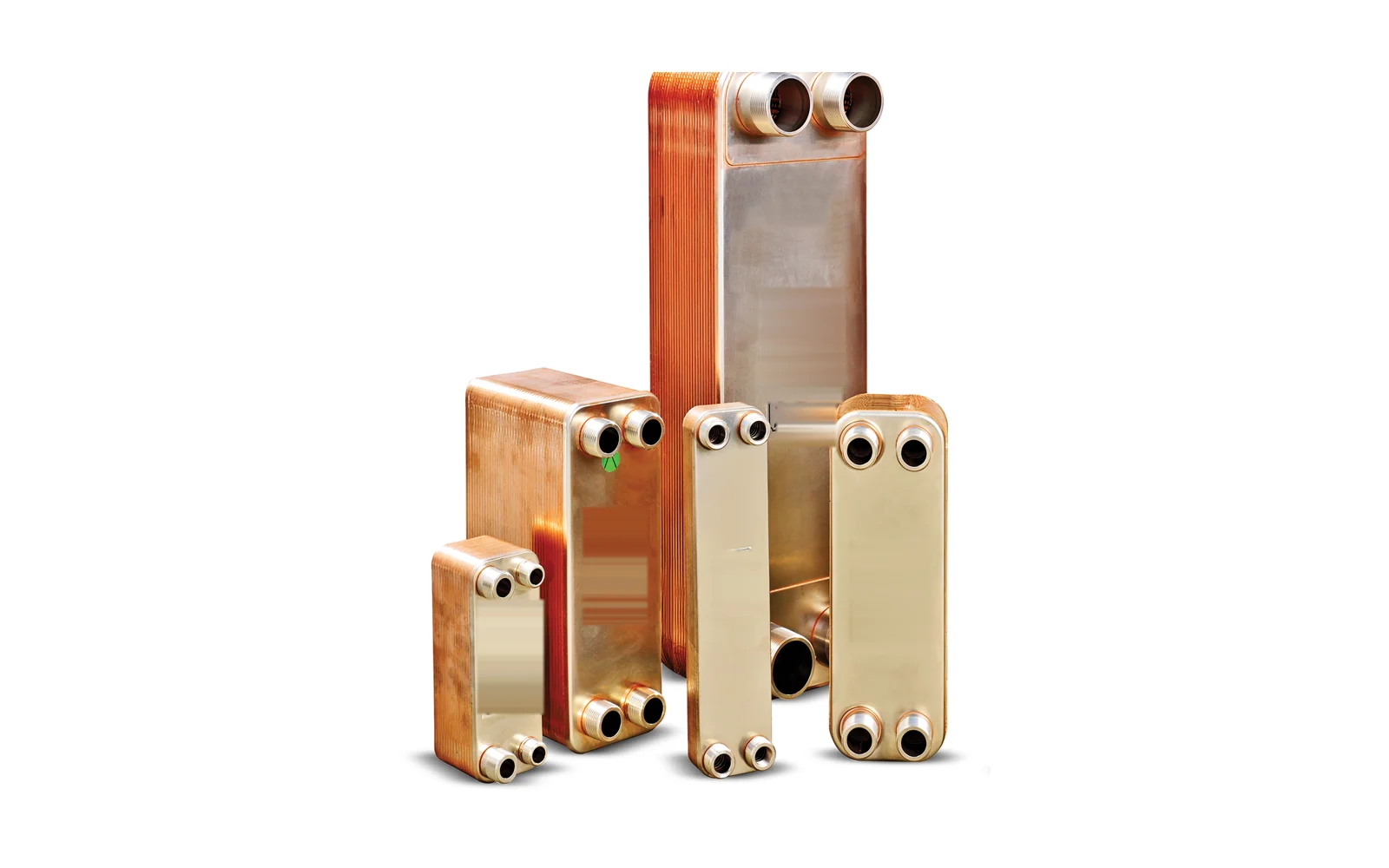
Energy efficiency in industrial installations and HVAC systems is becoming more critical every day. Among heat exchangers that allow two fluids to exchange heat without mixing, the brazed plate heat exchanger stands out by offering high thermal capacity in a much smaller volume compared to shell-and-tube and gasketed types. Its monolithic structure, which does not require elastomer gaskets for sealing, makes it a standard solution for tight mechanical rooms, packaged systems, and lines requiring high pressure.
At the core of this compactness lies the brazing of thin corrugated stainless steel plates together in a vacuum furnace. Since heavy components such as frames, tie bolts, and thick pressure plates are eliminated, the weight and footprint of the unit are significantly reduced. Thanks to thin plate walls and special channel geometry, heat transfer occurs rapidly, positively impacting both initial investment and operating costs.
Structure and Working Principle
A brazed plate heat exchanger consists of numerous thin, pressed corrugated metal plates arranged in a specific pattern between front and rear cover plates. The plates are joined at their contact points with a filler (brazing) material melted in a vacuum furnace. With this method, the entire plate pack becomes a single-piece pressure vessel that is completely leak-tight both internally and externally.
The unit generally features four connection ports—two for the hot (primary) circuit and two for the cold (secondary) circuit; the number of connections can be increased in special dual-circuit applications. Fluids enter through corner ports and distribute into narrow channels between the plates; while hot fluid flows through one channel, cold fluid flows through the immediately adjacent channel.
To maximize heat transfer, fluids are generally connected on a counter-current principle, keeping the logarithmic mean temperature difference (LMTD) between the two fluids high. The herringbone corrugations on the plates induce turbulent flow even at low velocities. Turbulence breaks up the stagnant boundary layer on the plate surface, increasing the heat transfer coefficient and reducing fouling on the surface. Depending on the requirement, wide-angle (high heat transfer), narrow-angle (low pressure drop), or mixed channel patterns can be selected.
Difference from Gasketed Plate Heat Exchangers
Both types transfer heat through corrugated plates, but their mechanical limits and operating characteristics differ due to their joining methods:
| Criterion | Brazed Plate Heat Exchanger | Gasketed Plate Heat Exchanger |
|---|---|---|
| Dismountability | Monolithic brazed structure; plates cannot be dismantled. | Frame can be opened by loosening tie bolts; plates can be dismantled individually. |
| Maintenance and cleaning | Cleaned only via chemical circulation (CIP). | Mechanical and chemical cleaning can be performed; gaskets can be replaced. |
| Pressure and temperature | With no gasket limitations, it can operate between -196 °C and +200 °C; design pressure is typically 30 bar, reaching up to 70 bar in special designs. | Limited by gasket material; typical operating pressure is around 25 bar. |
| Expandability | Capacity is fixed; plates cannot be added later. | Capacity can be increased by adding plates to the extent the frame allows. |
| Cost and size | More economical, lighter, and takes up less space at small and medium capacities. | More economical at large capacities; takes up more space due to its steel frame. |
Applications
Thanks to their high pressure resistance and compact size, brazed plate heat exchangers are widely used in both building installations and industrial processes:
* Heat pumps: Acts as an evaporator and condenser between the refrigerant circuit and heating or cooling water, safely adapting to high operating pressures.
* Combi boilers and domestic hot water: Instantaneously and hygienically heats mains water in individual heating appliances and apartment substations.
* Refrigeration systems: Evaporates or condenses refrigerant with a low refrigerant charge in chiller units, cold storage facilities, and glycol cooling circuits.
* Oil cooling: Cools heated lubricating oil in compressors, gearboxes, and similar machinery using water or glycol-water mixtures to maintain its viscosity.
* Process and waste heat recovery: Serves in temperature control of process fluids and waste heat recovery in laser cutting, welding units, air dryers, and industrial washing lines.
Material and Durability
The long service life of a brazed plate heat exchanger depends on selecting materials compatible with the chemical composition of the fluids passing through it. Heat transfer plates and connection ports are generally manufactured from AISI 316 grade stainless steel.
The brazing material joining the plates is the most critical factor determining chemical compatibility:
* Copper-brazed: The standard choice for the vast majority of heating, cooling, water, glycol, and oil applications.
* Nickel- or stainless-brazed: Used with fluids that react with copper such as ammonia, in pure/deionized water lines, or in processes corrosive to copper.
Standard designs can operate at design temperatures between -196 °C and +200 °C. Design pressure is at the 30 bar level in most applications, while special designs reaching up to 70 bar are available for high-pressure refrigeration and heat pump applications.
Water chemistry must also not be overlooked. Waters containing high chlorine and chloride, fluids with high sulfate and ammonia ratios, and waters with pH values outside the appropriate range increase the risk of corrosion and perforation. Therefore, well water, seawater, high-chlorine pool water, or aggressive acid solutions should not be passed directly through standard copper-brazed heat exchangers; sharing your water analysis during the selection phase is recommended.
Information Required for Proper Selection
A brazed plate heat exchanger must not be selected solely based on pipe diameter or an estimated kilowatt value. An improperly sized heat exchanger will either fail to reach the desired temperature or create excessive pressure drop, straining the pumps. For accurate thermal and hydraulic calculation, the following information is required:
* Thermal capacity (kW or kcal/h): Total heat load to be transferred from one fluid to the other.
* Inlet and outlet temperatures (°C): Inlet and desired outlet temperatures of the primary and secondary circuits.
* Flow rates (m³/h, l/min, or kg/s): Amount of fluid passing through both circuits.
* Allowable pressure drop (kPa or bar): Acceptable resistance limit so as not to exceed the pump head.
* Fluid type: Water, glycol mixture, oil, or refrigerant; concentration and viscosity information for glycol or oil.
* Operating and design pressure (bar): Operating pressure and safety limit of the installation.
* Connection type and diameter: Threaded, brazed/weld-neck, or flanged connection and nominal diameter.
Installation and Maintenance Tips
To ensure the heat exchanger delivers its calculated efficiency on site, installation and operating rules must be followed:
* Flow direction and position: Primary and secondary fluids must be connected in counter-current flow. In evaporator and condenser applications, and in water circuits where air venting is important, the heat exchanger must be mounted vertically, and connections must be made according to the diagram on the label.
* Strainer: Since plate gaps are very narrow, a fine-mesh strainer must be installed at the inlet of both circuits to prevent welding slag, rust, and particles from clogging the channels.
* Air venting and commissioning: Air inside the heat exchanger must be completely vented during initial startup; trapped air reduces the heat transfer surface. During commissioning, the cold circuit should be opened first, followed gradually by the hot circuit.
* Descaling and chemical cleaning (CIP): Scale and deposits accumulated in the non-dismountable structure are removed by isolating the heat exchanger from the circuit and circulating suitable chemicals that do not harm stainless steel and the brazing material, followed by thorough rinsing with water.
* Freeze protection: In cooling applications and installations exposed to outdoor environments, freezing water can rupture the plates. An appropriate ratio of glycol should be added to the water, a low-temperature thermostat and flow switch should be used, and the heat exchanger should be drained during prolonged shutdowns.
Frequently Asked Questions
Can a brazed plate heat exchanger be repaired if it is perforated?
Why is pressure drop important in selection?
Which fluids are unsuitable for copper-brazed heat exchangers?
How can you tell if a heat exchanger is scaled?
Should a brazed heat exchanger be mounted horizontally or vertically?
Because the plate pack is joined as a single piece in a vacuum furnace, internal plates cannot be accessed. Except for mechanical damage to external connections, internal leaks require replacing the unit; therefore, using a strainer and maintaining water chemistry are critical.
Narrow, corrugated channels increase heat transfer while also creating resistance to flow. If the allowable pressure drop is selected too low, an unnecessarily large and expensive heat exchanger is required; if selected too high, existing pumps cannot deliver sufficient flow rate.
Ammonia, waters high in chlorine and chloride (seawater, certain well waters), and acidic chemicals can corrode copper brazing and cause leaks. For such applications, a nickel-brazed heat exchanger or a gasketed heat exchanger with suitable plate material should be preferred.
A drop in the secondary circuit outlet temperature and an increase in the pressure differential between the heat exchanger inlet and outlet above normal levels indicate scaling or clogging. In this case, reverse circulation (CIP) with a suitable chemical should be performed, followed by neutralization and rinsing.
In liquid-to-liquid applications, it can operate in either position, but vertical mounting is recommended for air venting and complete drainage. In evaporator and condenser applications, vertical mounting is mandatory for uniform distribution of the fluid across the plates.
Conclusion
Selecting the brazed plate heat exchanger best suited to your installation’s operating conditions, fluid properties, and capacity needs is decisive for both energy efficiency and system safety. Serving in industrial valves, steam traps, heat exchangers, and piping equipment since 1985, ORFA Endüstriyel’s technical team helps you make the right thermal and hydraulic selection for your project. For technical support and quotes, you can reach us at +90 224 444 67 32.
Buy heat exchangers online
Browse products on or-fa.com, our export store, see prices in USD and order online.
Buy Online →Request a QuoteAsk on WhatsAppRelated product group
Heat Exchangers →Technical support
Talk to our team to choose the right product.
+90 224 444 67 32[email protected]
Related Articles
Let’s choose the right product for your project
Buy from our online store or request a project-specific quotation.